

Utah is piloting AI technologies in healthcare to reduce costs, but the economic benefits depend on regulatory permissions not yet granted. Initial findings show that while AI improves efficiency, it has not yet proven significant cost savings or clinical equivalence.
- Utah has authorized AI pilots to test software's ability to replace some clinical tasks.
- Initial evidence shows high physician agreement but lacks robust economic or health benefits.
- Regulatory permissions are crucial for AI systems to operate cost-effectively and efficiently.
The state is testing whether software can replace clinical labour. The early evidence says the saving depends on a permission nobody has yet granted.
The Price Before the Proof
On October 5, 2026, Utah authorised Nolla Health, an acne-telehealth company operated by Magic Health, to let software write first-time prescriptions for adults with mild-to-moderate acne.
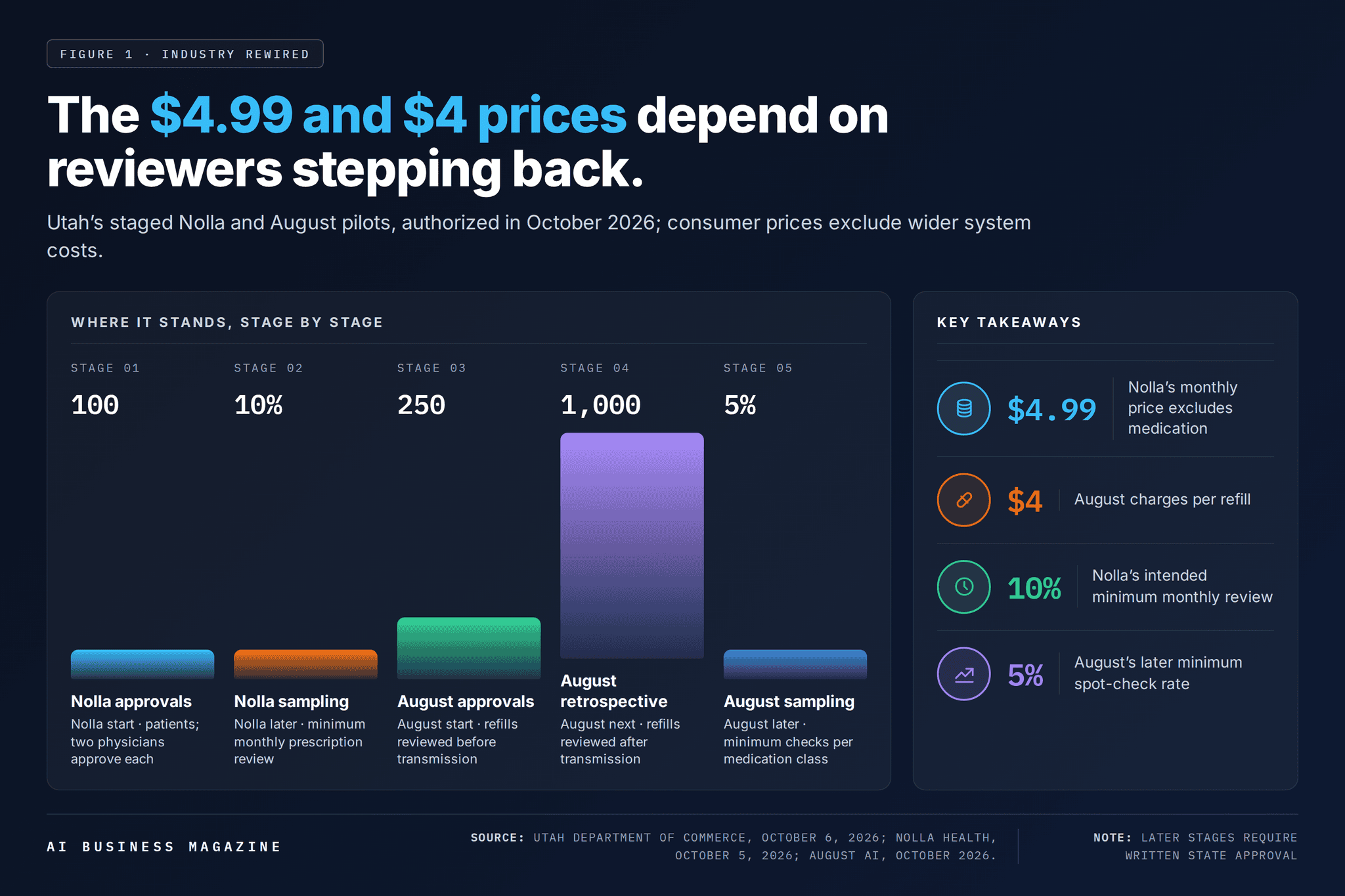
Nolla’s app maps a patient’s face, picks a topical treatment from a physician-approved list and transmits the order to a pharmacy. The subscription costs $4.99 a month, excluding medication.
The state agreement contains an important condition. For the first 100 patients, two Utah-licensed physicians must independently review and approve every recommendation before it goes anywhere.
A consultation that requires two doctors is not a cheap consultation. So the question for any executive pricing automated expertise is direct: where is the saving, and who receives it?
The Sandbox's Case
Utah’s Office of Artificial Intelligence Policy (OAIP), the state body that runs the sandbox, does not license software as a doctor. It works with the Division of Professional Licensing to temporarily modify enforcement of specific rules for one named product and one narrow task.
The economic logic is labour reallocation. A clinician stops handling every routine request and instead reviews exceptions, samples and failures.
The first pilot suggests the routine share is large. Doctronic, an AI prescription-renewal company whose Utah pilot began in October 2025, recommended renewal in 72% of cases and escalated the rest. Reviewing physicians agreed with 91% of those renewals and judged 69% of escalations warranted.
Those are operational figures from the pilot’s early months, not evidence of clinical equivalence. Nearly a year in, the state’s own update says it still lacks robust evidence of economic or public-health benefit.
Doctronic remains in Phase 1. Every request still goes to a physician.
Where the Saving Is Supposed to Appear
The economics live in the review thresholds, not the software.
Nolla moves from two-physician review to a retrospective-review phase covering up to 500 patients only with written state approval. The intended later phase requires monthly review of at least 10% of prescriptions.
August AI, a chronic-medication refill service operated by August Labs, follows the same ladder. A licensed provider checks the first 250 refills, the next 1,000 are reviewed afterwards, and later operation requires spot checks of at least 5% per medication class. Its consumer price is $4 a refill.
To thin oversight, a new-prescription pilot must show at least 95% physician-AI agreement and zero missed hard stops.
Think of it as a toll road priced before the exit ramps open. The subscription figures are set today. The cost structure that justifies them exists only once the state lets reviewers step back.
No Utah pilot had reached that point by October 11. August and Expect Fitness, a company drafting AI pelvic-floor care plans under full physical-therapist review, had not even started. The prices are a bet on future permission, not a report of present cost.
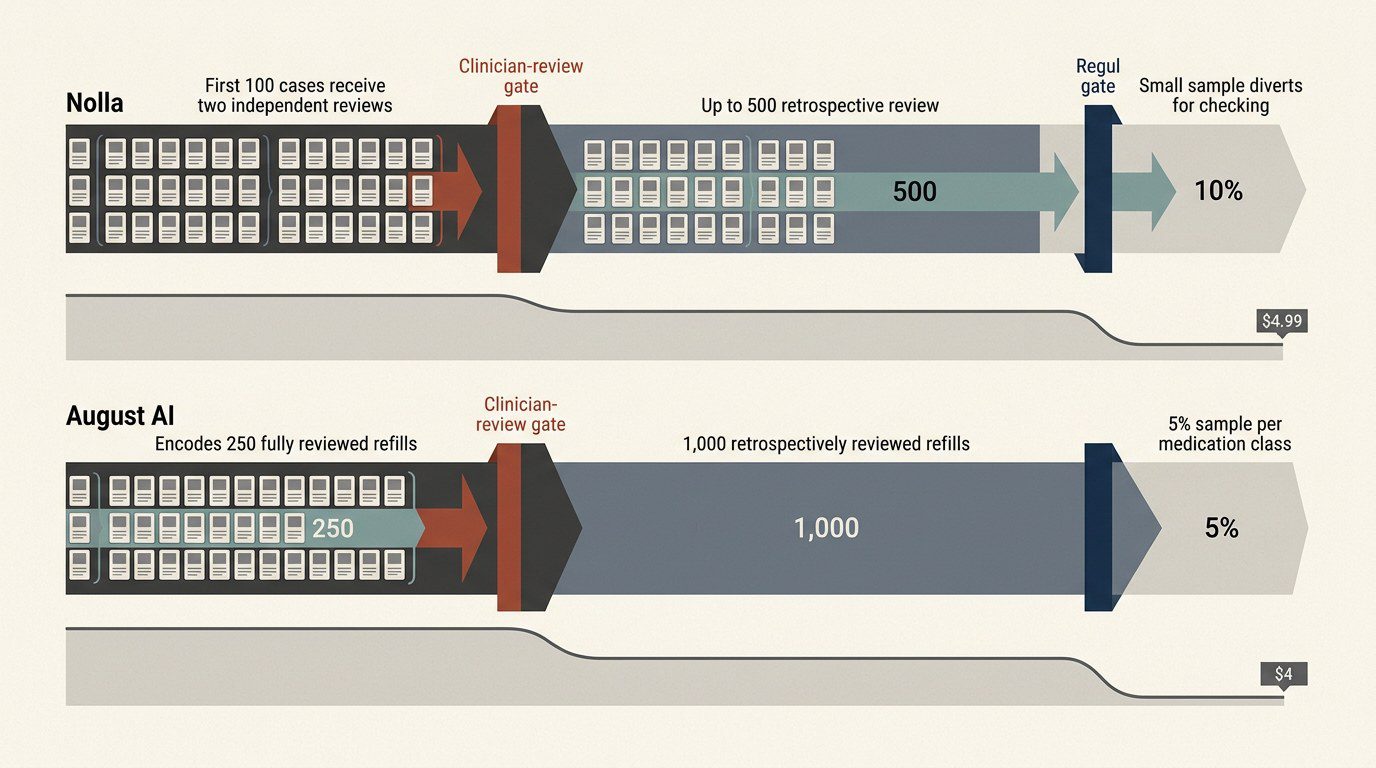
The pilots’ economics change only when regulators allow clinical review to move from every decision to retrospective checks and, eventually, small samples.
The Board Says "Routine" Is Not Routine
In April 2026 the Utah Medical Licensing Board, the state body that licenses physicians, asked for Doctronic to be suspended. It said it had not been consulted before launch.
Its substantive objection matters more than the procedural one. A safe renewal, the board argued, requires reassessing interactions, side effects, laboratory monitoring and whether the medicine remains appropriate. That is clinical judgment, not administration.
OAIP and the licensing division declined to suspend, citing physician approval of every request, while retaining power to modify or cancel.
Two changes suggest the board had a point. Butalbital and Flecainide were removed from the formulary, and each medication group must now cross the transition threshold separately. A third-party red team also found vulnerabilities under adversarial use, though OAIP judged typical-user risk constrained by guardrails.
What this establishes: the task boundary is being redrawn after launch, by the regulator. What it cannot establish: that any patient was harmed. No serious safety incident had been reported.
Why the Experiment Continues Anyway
Every actor has a reason to keep going.
Vendors earn recurring revenue without staffing a clinic for each encounter. The state presents the sandbox as a controlled way to update rules and has named six evaluator organisations to verify company claims.
Large systems now have a fast lane. In September 2026 OAIP signed master agreements with University of Utah Health and Intermountain Health, two large regional health systems. These authorise no clinical use by themselves, but let future pilots skip bespoke negotiation.
That may give them an advantage over smaller providers.
Clinicians are not displaced so much as converted. They may become reviewers, paid for supervision rather than consultation, with physicians remaining the prescribers of record in refill pilots.
That is the gap Michelle Mello, a Stanford law and health-policy professor, identified in JAMA Health Forum in March 2026. If the system injures someone, does responsibility sit with the physician of record, the vendor’s terms of service, or the state agreement? Utah requires malpractice cover and preserves ordinary legal remedies.
A named prescriber does not, by itself, answer her question.
One gating metric is agreement rate. It measures whether doctors concur with software. It does not measure whether patients improved, or what the episode cost.
The Same Technology Is Raising Bills Elsewhere
The sharpest cost evidence comes from the opposite end of healthcare.
In September 2026 the Blue Cross Blue Shield Association, the federation of 33 independent Blue Cross insurers, estimated that hospital coding practices added $942 million to its members’ costs over two years.
It linked the increase to AI tools that scan records and laboratory data for secondary diagnoses. The share of cases coded as complex rose from 37% in 2023 to 40% by late 2025. Roughly $653 million was tied to added diagnoses with no change in treatment.
The caveats are real. This is an insurer-sponsored estimate, not a government audit. Hospitals can argue the conditions were present and previously under-recorded.
Nothing connects the figure to Utah’s pilots.
The mechanism, though, is the point. Software that lowers the labour cost of a consultation and software that raises the coded intensity of a hospital stay are the same capability pointed at different ledgers.
A cheaper front door can coexist with a more expensive back office. The payer who funds the first may be billed for the second.
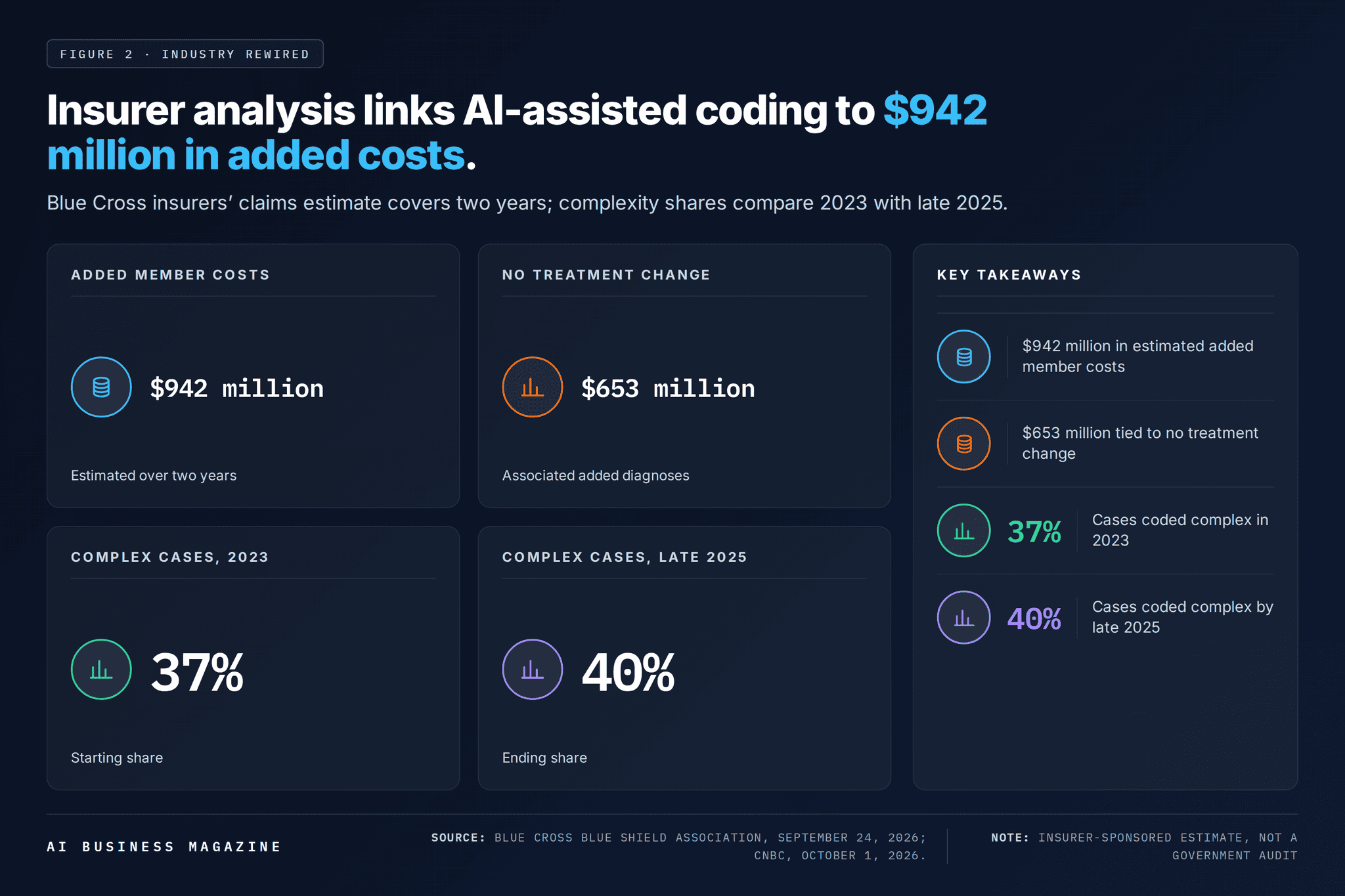

Automation can make the clinical front door cheaper while increasing the number and value of charges produced behind it.
What Changes for Decision-Makers
The observed outcome so far is modest: one pilot nearly a year old with no reported serious safety incident, a regulator-board dispute, and a shrinking formulary.
The plausible implication is larger. Whoever controls the review ratio captures the saving. Vendors gain real-world data and regulatory credibility, though the state says participation is not endorsement.
Health systems with master agreements gain speed. Clinicians may be converted into lower-paid reviewers while liability remains unsettled.
Insurers face two scenarios the research cannot yet separate: fewer office visits, or more claims because a $4 refill removes friction that once suppressed volume. Patients pay the drug cost, follow-up and any uninsured harm regardless.
The missing numbers are the ones a board would ask for first: total episode cost, adherence, downstream visits, pharmacist workload and the cost of correcting misclassified cases. Until those exist, a low sticker price is an input, not a result.
Five Decisions Before Automating an Expert
- Price the review ratio, not the sticker. Model unit cost at full prospective review, retrospective review and sampled review. Fund the first; treat the third as upside.
- Separate agreement from outcome. Track whether the automated decision changed the result for the customer and what the full episode cost, not just how often experts concurred.
- Assign liability in writing before go-live. Name who answers between the reviewing professional, the vendor and the organisation, and confirm insurance follows that allocation.
- Audit adjacent systems for intensity creep. Check whether the same tooling increases documentation, coding or claim volume elsewhere, and whether each added item changed an action.
- Budget for shrinking the scope after launch. Red-team the boundaries, then expect to remove categories, as Utah did with two drugs, without treating it as failure.
The Price Tag, Reconsidered
Nolla’s $4.99 now reads differently. It is the price of a product the state has not yet permitted to operate at the cost that price implies. Doctronic’s agreement is due to reach its scheduled end on October 24, 2026, and the state had not announced a decision at the time of reporting.
The counter-case deserves weight. Doctronic had run for nearly a year with no reported serious incident and 91% physician agreement. The state amended the agreement and removed two medicines from the formulary.
Nolla markets its service as avoiding a waitlist and an office visit, which could save patients time. Nolla’s acne formulary is low-acuity by design, and the board’s objection to Doctronic was partly procedural. It is possible the reviewer cost shrinks as evidence accumulates and the sticker price becomes honest.
But that outcome is a regulatory decision, taken one medication group at a time, on evidence that does not yet exist. If your automation business case only works once a supervisor you do not control agrees to look less often, is it a cost saving, or an application for one?
References
- Utah Commerce — https://commerce.utah.gov/2026/10/05/utah-enhances-pro-human-ai-initiative-with-new-healthcare-pillar-adds-new-pilots-to-its-regulatory-sandbox-and-partners-with-third-party-evaluators/
- Nolla Health — https://www.prnewswire.com/news-releases/nolla-health-announces-nations-first-ai-to-issue-initial-prescriptions-302897659.html
- Utah authorised pilots — https://commerce.utah.gov/ai/regulatory-relief-4/authorized-pilots/
- Utah AI FAQ — https://commerce.utah.gov/ai/ai-faq/
- ACDIS — https://acdis.org/articles/news-clinicians-mostly-agreed-ai-prescribing-pilot%E2%80%99s-renewal-recommendations
- OAIP Doctronic page — https://commerce.utah.gov/ai/regulatory-relief-4/authorized-pilots/doctronic/
- August AI — https://utah.meetaugust.ai/
- Board letter — https://commerce.utah.gov/wp-content/uploads/2026/04/doctronic-letter-from-medical-board.pdf
- Commerce response — https://commerce.utah.gov/wp-content/uploads/2026/04/Medical-Board-Doctronic-Response.pdf
- Healthcare Dive — https://www.healthcaredive.com/news/utah-approves-health-ai-pilots-drug-management-womens-health/832318/
- BCBSA — https://www.bcbs.com/about-us/association-news/new-bcbsa-research-on-ai-hospital-billing-driving-higher-health-care-costs
- CNBC — https://www.cnbc.com/2026/10/01/health-care-costs-insurance-claims-billing-ai.html
Frequently asked questions
What is Utah's approach to integrating AI in healthcare?
Utah is testing AI technologies through regulatory pilots aimed at reducing clinical labor costs. However, the success of these pilots hinges on future regulatory permissions to allow more extensive use of AI.
How does physician oversight impact AI prescription pilots in Utah?
Currently, AI prescription pilots in Utah require substantial physician oversight, which limits potential cost savings. For example, Nolla Health’s initial phase necessitates two physicians to review prescriptions before dispatching.
What are the concerns raised by the Utah Medical Licensing Board regarding AI?
The Utah Medical Licensing Board expressed concerns over the clinical judgment required for prescription renewals and called for a suspension of Doctronic due to lack of proper prior consultation before launch.
What challenges do AI pilots face in proving economic benefits?
The AI pilots face challenges in demonstrating economic benefits as they currently lack the necessary regulatory approvals to operate at a scale that would allow for cost savings. As of now, there is no robust evidence supporting significant economic advantages.
What trends are being observed regarding AI's impact on healthcare costs?
While AI in Utah aims to streamline healthcare processes, a report indicated that AI tools in other healthcare settings have contributed to increased costs, highlighting a complex relationship between automated efficiencies and overall healthcare expenditures.