

The article examines the impact of AI on workforce productivity, highlighting discrepancies between reported time savings and actual productivity gains, and emphasizes the need for strategic organizational changes to realize the full potential of AI technologies in the workplace.
- AI can reduce administrative work significantly, but the actual productivity gains are often unverified.
- There is a notable gap between reported productivity increases and aggregate economic data, leading to skepticism.
- Organizations must implement strategic changes to workflows and employee roles to maximize AI's potential.
The Hours That Vanished
Earlier this month, Providence Health and IBM Consulting described a redesign of how employees move into new internal roles.
The AI and automation did not replace Providence’s existing hiring infrastructure. It worked around that infrastructure to reduce administrative work and accelerate internal transfers.
IBM’s figures are striking. Hiring managers cut administrative effort by 90%. Internal caregivers started new roles 12 days sooner on average.
Transfer costs fell 60% and process accuracy improved by up to 70%.
Nothing in the announcement says what happened to the freed hours. No baseline sample, no implementation cost, no breakdown of which tasks the machine performed.
That silence is the story. Companies are reporting saved time at a scale that national statistics cannot see.
The Official Story: Buy Seats, Save Hours
The accepted narrative is simple. Put an AI assistant inside the tools people already use, and time savings follow.
On 3 June 2026, Microsoft said Infosys, Tata Consultancy Services and Wipro had each expanded Microsoft 365 Copilot licences to more than 100,000 employees. The combined rollout passed 300,000 seats. TCS reported 86% active daily use, with selected teams citing 20–25% productivity gains in research and content work.
Wipro reported more than 29,000 employee-built agents and a performance-review agent cutting effort by nearly 70%.
Black & Veatch, an engineering, construction and consulting company, reported 98% Copilot adoption and savings of up to nine hours per user per week.
Many surveyed business leaders expect AI to raise output. Workday reported on 5 October 2026 that 40% of business leaders expected AI to raise the output of existing staff, against 28% expecting lower headcount.
Every one of those outcome figures is vendor- or company-reported. They cover selected teams, usage rates and self-reported time, not audited revenue per employee. The announcements rarely state what licences and training cost.
The claims are plausible. They are also unverified at the point that matters most: the profit and loss account.
How a Saved Hour Becomes Money, or Doesn’t
A saved hour is not a productivity gain. It is an option on one.
The research describes six linked conditions for exercising it. Map where time goes. Connect the tool to trusted enterprise data.
Define what the system may do unaided and what needs human sign-off. Redesign roles around exceptions and judgment. Build evaluation loops.
Then reinvest the capacity in output, speed, quality or cost.
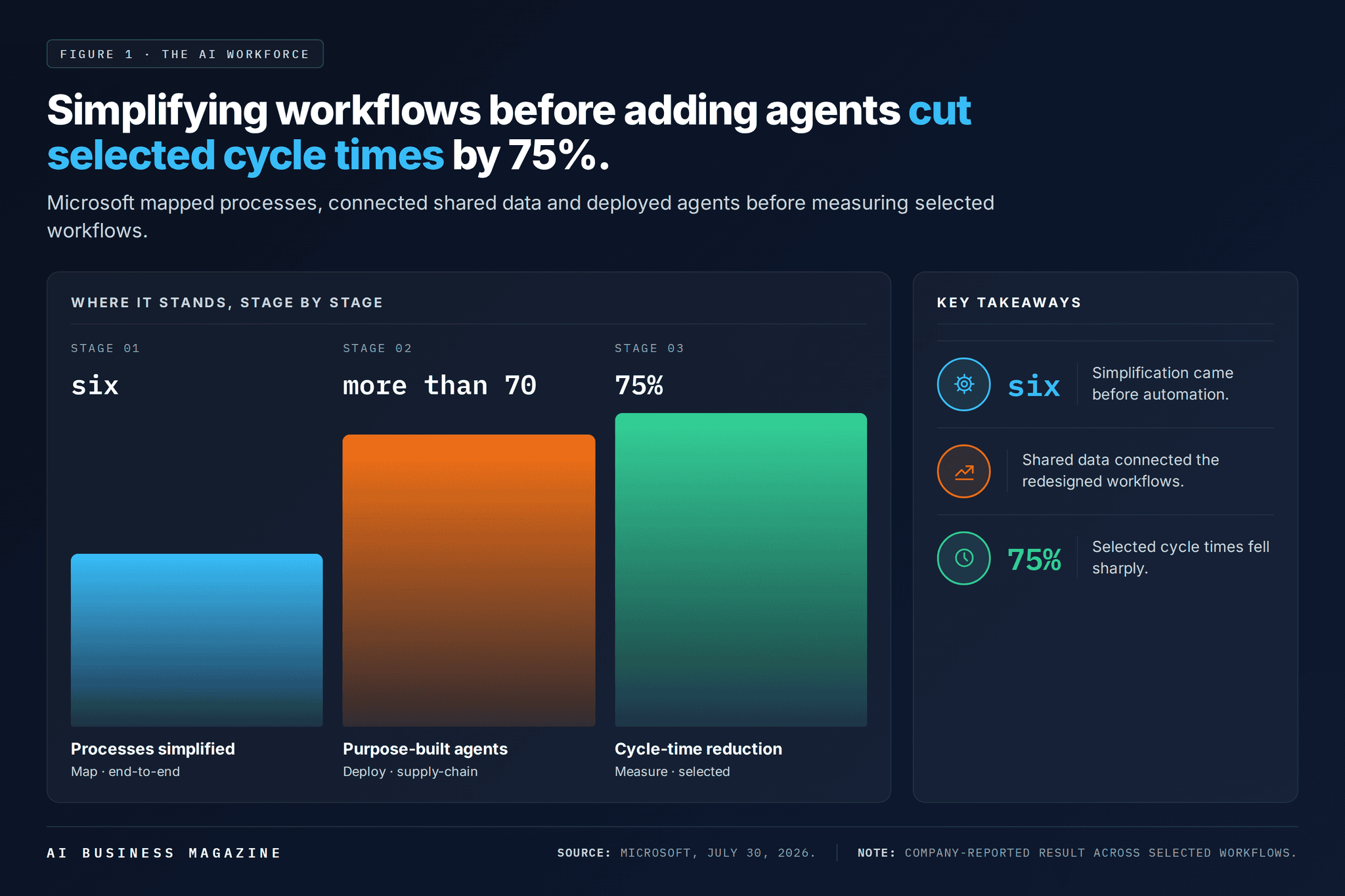
Microsoft’s own Cloud Supply Chain work is the cleanest illustration. It mapped and simplified six end-to-end processes, built a shared data foundation, and only then deployed more than 70 purpose-built agents. The reported result was a 75% reduction in cycle time across selected workflows.
Again a company claim, without external evaluation or full costing.
The sequencing matters more than the percentage. Agents were layered onto simplified processes, not onto whatever existed before.
Here is the consequence most license buyers miss. The first five conditions require organisational work beyond deploying licences. Skip them, and the saved hour has nowhere to go except into the survey that becomes the next press release.
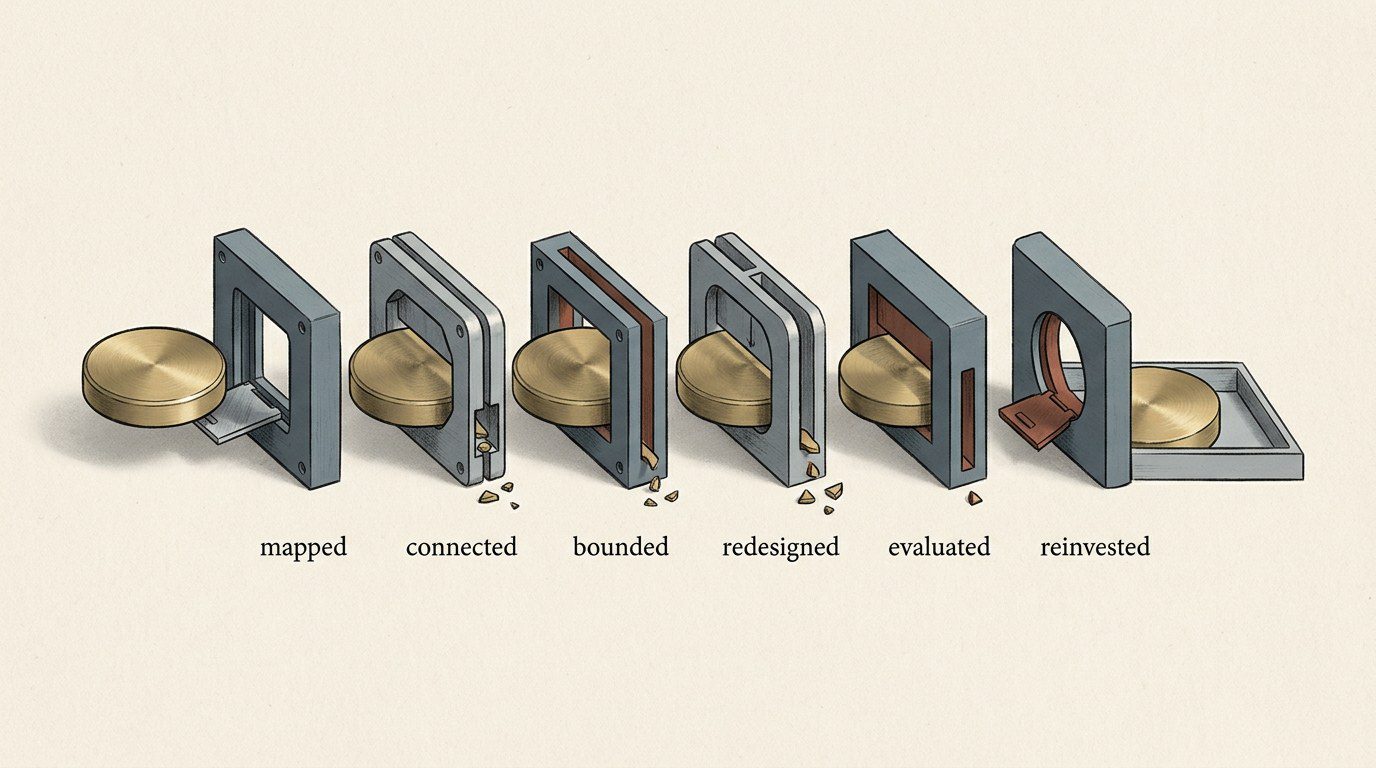
Where a saved hour leaks before it reaches the revenue line.
The Economists Cannot Find the Hours
A Richmond Federal Reserve analysis published on 25 March 2026 examined responses from more than 700 corporate executives.
Firms reported a 1.8% increase in labour productivity attributable to AI in 2025. That is a long way from 90%.
More telling was the gap the researchers found between reported gains in output per worker and the smaller gains implied by sales and employment data. Their reading is cautious: workflow and quality improvements may take time to reach conventional revenue statistics.
The International Labour Organization reached a similar position in June 2026. Worker-reported time savings of a few percentage points had not yet translated consistently into higher measured output, earnings or employment.
What this establishes: the hours saved in case studies are not yet visible in the aggregates that fund budgets and valuations. What it cannot establish: that the hours are fictional. Lag, selective reporting and failed reinvestment are all consistent with the data.
So the 90% and the 1.8% can both be true. That is the uncomfortable part.
Why the Gap Persists
Three forces keep the two numbers apart.
The first is measurement. Microsoft’s sales pilot reported sellers doubling customer-facing time from 25% to 50%, with 9.4% more revenue per head and 20% faster deal closure. But the comparison was 687 sellers split into heavy versus light Copilot users.
Heavy users may simply have been better sellers. The post does not claim otherwise.
The second is incentive. The most circulated figures come from companies selling licences, consultancies implementing them, or customers quoted in their marketing. That does not make the figures false.
It does make the denominators disappear.
The third is a leadership choice the research leaves unresolved. Companies can automate tasks inside an unchanged structure, redesign workflows end to end, reinvest capacity in growth and learning, or bank savings as headcount. The outcome depends on whether released capacity becomes more output, faster service, better quality, innovation or reduced cost.
Jared Spataro, Microsoft’s chief marketing officer for AI at Work, has argued that the next measure of AI progress should be transformed work rather than licence counts or hours saved. That is a notable admission from the company that sells the seats.
Faster, and Sometimes Worse
The reversal arrives from the one controlled experiment in the research.
A peer-reviewed BCG field experiment discussed by Harvard Business School in April 2026 tested 758 consultants using GPT-4 on realistic tasks. On work inside the model’s capability, AI users completed 12.2% more subtasks, worked about 25% faster, and produced output rated 32% higher in quality.
On a brand-strategy task that required spotting a clue buried in interview material, the pattern inverted. Consultants with AI reached 70.6% accuracy. Consultants without it reached 84.5%.
Those given extra prompt-engineering guidance fell to 60%.
The mechanism was over-trust. A polished answer looked like a correct one.
Now connect that to the labour data. Workday found internal moves falling at 57% of employers and promotions flat. Mentions of management skills in job requisitions fell 7% and training skills fell 13% between September 2025 and July 2026.
Demand for basic prompting peaked in January 2026 and dropped 25%; demand for building AI tools and automating workflows rose 51%.
PwC analysed more than a billion job adverts across 27 countries and found AI-exposed junior roles increasingly demanding traditionally senior skills.
Read together, these describe a trade-off nobody has priced. The scarce skill in an AI-heavy organisation is the judgment to notice when the machine is confidently wrong. That judgment has historically been built through routine junior work.
Routine junior work is exactly what the agents now absorb.
IBM’s September 2026 CHRO study found 60% of employees worried AI was eroding their skills, with critical thinking cited most. That is perception, not measurement. But it is the perception of the people being asked to catch the errors.
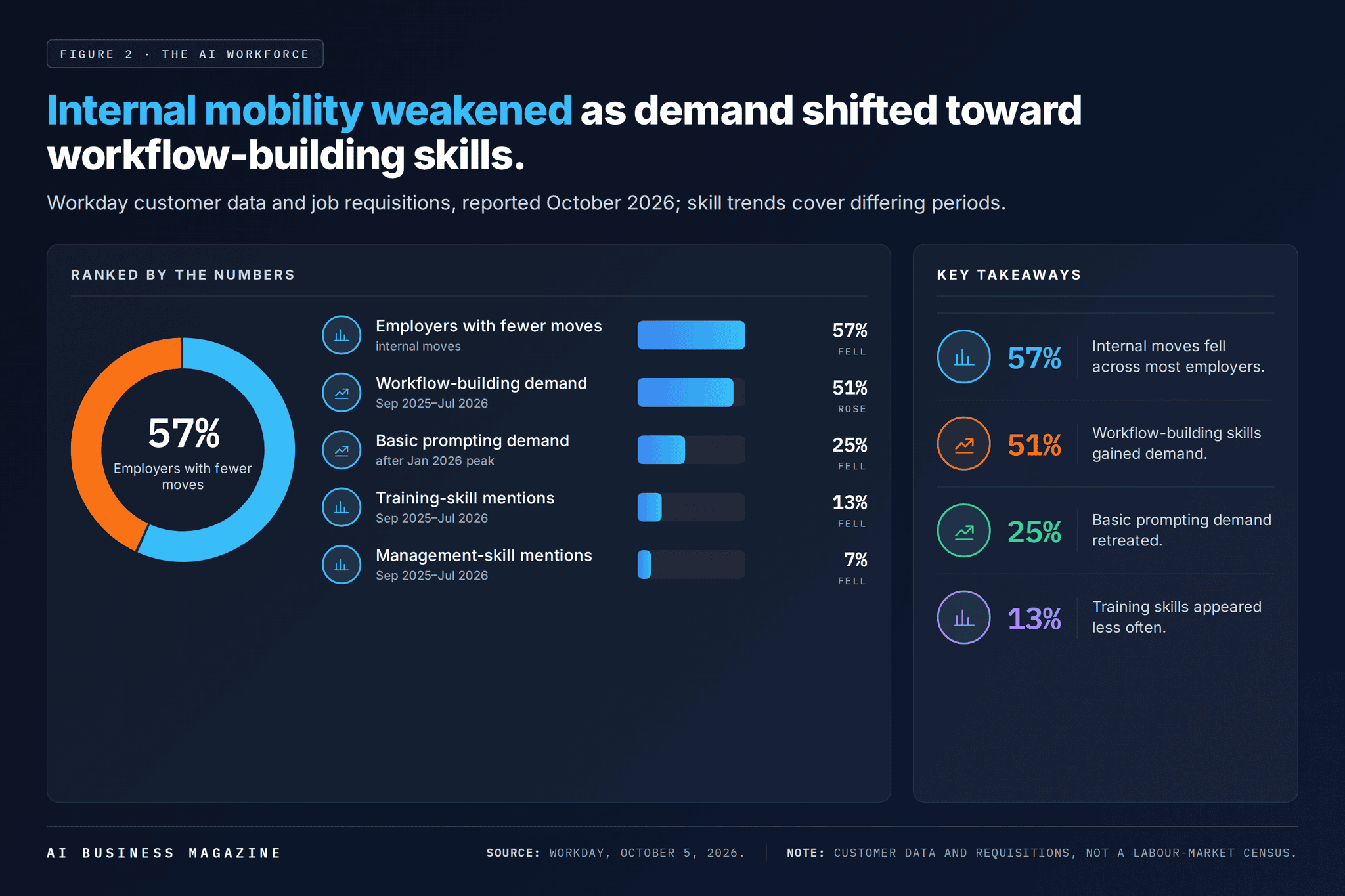

The apprenticeship gap: what builds judgment when agents take the routine work?
The Strategic Consequence
The documented cases link gains to process simplification, trusted data, staged training and workflow redesign rather than licences alone. Black & Veatch’s three-tier model of Adopters, Navigators and Builders was backed by a governance committee, peer communities and weekly “spark sessions”.
For workforce design, the plausible implication is harder. If organisations seniorise entry-level roles rather than create new training work, they will compete for a shrinking pool of people who already have judgment. PwC’s finding of faster wage growth in AI-exposed organisations is consistent with that scarcity, though it does not prove the cause.
For risk, agents that retrieve data and initiate transactions widen the attack surface. IBM reported in July 2026 that over 20% of surveyed organisations had experienced a breach targeting AI models or applications. Permissions and audit trails become workforce decisions, not IT housekeeping.
None of this is a forecast. It is what the evidence looks like if the gap between 90% and 1.8% closes the wrong way.
The Decision
For any organisation automating an expert’s work:
-
Audit the denominator before you publish the percentage. For every reported time saving, record the baseline, sample, licence and training cost, and where the freed hours went.
-
Simplify the workflow before deploying an agent on it. Microsoft’s sequence—map, simplify, connect data, then automate—produced a reported 75% cycle-time reduction across selected workflows.
-
Fund apprenticeship work deliberately. If agents absorb the routine tasks juniors learned from, assign exception-handling and evaluation duties that rebuild judgment, and track internal moves as a leading indicator.
-
Set agent authority thresholds with HR, legal and finance, not IT alone. Define which transactions run unaided, which need sign-off, and who owns the error.
Back to Providence
Providence’s 90% now reads differently. It may be entirely accurate. It is also silent on what implementation cost, where the released capacity went and which tasks the AI performed.
The counter-case is strong. PwC’s billion-advert dataset shows AI-exposed organisations growing headcount and wages faster than peers, not shrinking. The Richmond Fed found little near-term evidence of economy-wide AI-driven employment declines, while firms anticipated a 0.76% fall in the share of routine clerical workers in 2026.
The productivity gap may be lag, and the companies doing the organisational work may be reporting results the aggregates will eventually confirm.
If so, 1.8% is a snapshot of an early learning curve, not a verdict.
Either way, a board will soon be shown a slide claiming most of some expert’s administrative work has disappeared. The decisive question is not whether to believe it.
It is this: when your most experienced people retire, who in the building will still know what the agent got wrong?
References
-
IBM-reported figures; the research points to IBM’s newsroom rather than a specific audited release — https://newsroom.ibm.com/press-releases-artificial-intelligence?l=100
-
Microsoft customer story — https://www.microsoft.com/en/customers/story/27049-black-and-veatch-microsoft-365-copilot
-
Microsoft, 30 July 2026 — https://www.microsoft.com/en-us/microsoft-365/blog/2026/07/30/the-next-measure-of-ai-momentum-is-work-transformed/
-
Richmond Fed — https://www.richmondfed.org/research/national_economy/cfo_survey/research_and_commentary/2026/20260325_research_commentary
-
HBS — https://aiinstitute.hbs.edu/back-to-the-beginnings-of-ai-at-work/
-
IBM survey evidence, via IBM’s newsroom — https://newsroom.ibm.com/latest-news-artificial-intelligence
Frequently asked questions
How much time can AI save in the workplace?
AI implementations have reported savings like a 90% reduction in administrative effort, but actual productivity gains may vary significantly and remain unverified in financial data.
What challenges do companies face with AI productivity claims?
Companies often face challenges with measurement and verification of AI productivity claims, as large discrepancies exist between self-reported gains and actual economic indicators.
What should organizations do before deploying AI tools?
Organizations should audit their existing processes, simplify workflows, and define the roles of AI and human oversight to ensure AI tools enhance productivity effectively.
Why is there skepticism about AI's impact on productivity?
Skepticism arises from the observed lag between reported time savings from AI and the actual increases in economic output, suggesting that initial gains may not yet be reflected in overall productivity statistics.
What is the significance of training in AI implementation?
Training is crucial as it helps redefine roles and responsibilities; without it, saved hours may not translate into tangible productivity increases or might lead to skill erosion among employees.