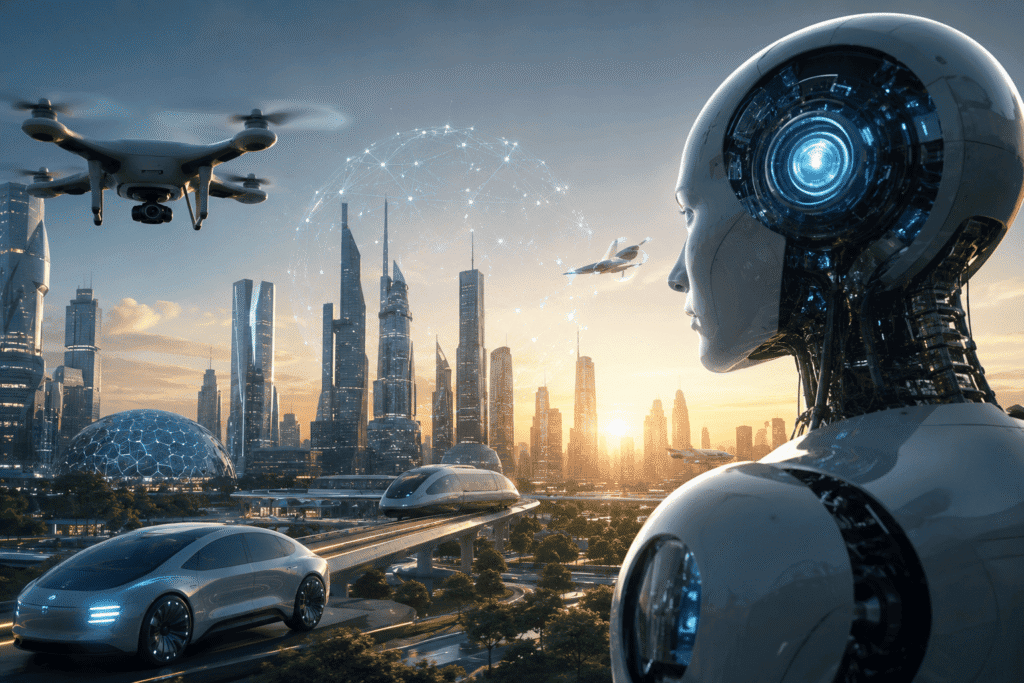
AI has become one of the hallmark technologies of the 21st century. From suggesting entertainment options to helping physicians diagnose diseases, AI technology is already integrated into people’s daily lives. However, although there are a lot of books that explain how AI technology works now, very few of them try to provide an answer to a much more interesting question: How will our world be when AI becomes as ubiquitous as electricity?
This is the mission of the book AI 2041: Ten Visions for Our Future. Instead of providing dry projections and scientific papers, the authors use a creative storytelling technique combined with analysis of scientific data. Every chapter of the book starts with a fictional story of the year 2041, followed by an explanation of actual scientific developments which can turn this vision into reality.
Kai-Fu Lee, one of the best-known AI investors and a former executive at Apple, Microsoft, and Google, offers years of practical experience in this field. His co-author, award-winning science fiction writer Chen Qiufan, converts technical visions into emotional stories showing how AI technology may change careers, healthcare, education, entertainment, governance, and even relationships between humans.
One critical observation that the authors make is that AI is not magical. It is neither a saving grace for humanity nor its doomsday. Rather, it is a formidable tool that can be shaped by how carefully societies decide to use it and regulate it.
In less than five years from the publication of this book, most of its forecasts seem eerily accurate. Generative AI, autonomous AI, digital humans, and AI in education have all become part of our lives, having moved from mere ideas to reality.
1. AI Will Be Everybody’s Invisible Co-Worker
It should be stated that one of the main predictions mentioned in the book is the future widespread integration of AI into the fabric of life, such that it becomes invisible. As much as AI is already pervasive in modern society, soon it will become something as natural as electricity or the Internet.
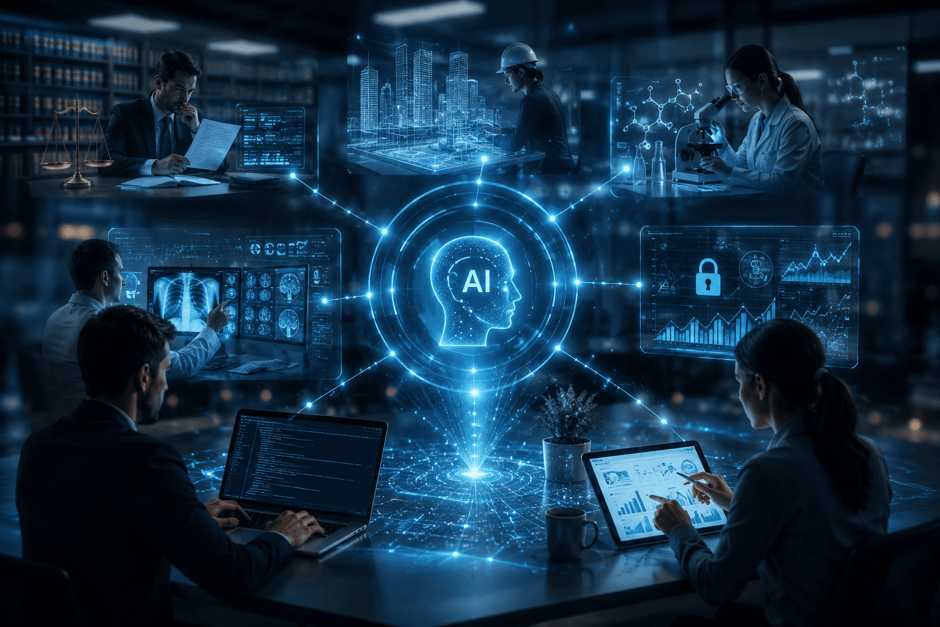
In contrast to what some people believe, AI will never replace all of humanity. Rather, it will work as an intelligent collaborator that can process huge amounts of data within just a few moments. For example, lawyers can use AI to summarise all possible documents, architects can get multiple options for designing buildings in just a few minutes, and even scientists can find interesting compounds to create new drugs in an unprecedentedly quick manner.
Currently, AI-based code assistants are assisting programmers with writing and optimising code; radiologists analyse abnormalities on X-ray images with the help of AI, and banks and other financial organisations can detect fraud in transactions using machine learning.
Expert Insight
According to Kai-Fu Lee,
“AI should be considered more like ‘augmentation intelligence’ than ‘artificial intelligence’.”
Augmentation intelligence is an approach that focuses on augmenting the capabilities of human workers with those of machines. AI systems are good at pattern recognition, data analysis, and performing routine activities, while humans provide creativity, empathy, ethics, and strategy.
As per economist Erik Brynjolfsson, the best way to obtain the highest economic benefit out of AI is through redefining work such that humans and machines complement each other.
Example from Real Life
Customer support is a perfect example. In the past, chatbots used to irritate customers because of their scripted responses. The new AI-powered assistants analyse the context of a conversation, keep up with conversations, learn about customers, and compose customised responses for the human operator. They don’t take away people’s jobs but enable them to work with difficult clients who need empathy and negotiation skills.
The workplace in 2041 can thus be compared to a partnership in which every specialist has an individual AI assistant.
2. Healthcare Moves from Reactive to Predictive
One of the most hopeful pictures painted by the book is that of healthcare. Instead of waiting for people to fall ill, there is hope that AI will allow doctors to diagnose diseases well before their onset.
Machine learning algorithms will be able to use patient data, genomics, devices worn by patients, and various environmental cues to recognise warning signals that human doctors would otherwise not be able to see.
Think of an intelligent watch recognising any minute change in the rhythm of a patient’s heartbeat, many months before anything happens, or AI picking up early signs of Alzheimer’s based on how someone talks.
Expert Insight
As the inventor of AI, Andrew Ng noted,
“AI is the new electricity.”
He has always maintained that the application of AI to healthcare is one of the most promising applications for it, since medicine entails pattern recognition within big data.
Example From Real Life
AI tools are already being used by doctors to detect diabetic retinopathy, diagnose breast cancer from mammography, and predict sepsis in admitted patients several hours before the traditional approach would.
The authors warn, however, that predictive healthcare poses significant ethical issues. Who owns medical information? How should health insurance companies utilise predictions made by AI? Can faulty predictions cause people undue stress?
Trustworthy healthcare AI needs transparency, privacy, and oversight.
3. Learning Will Be Highly Personalised
At present, classrooms normally use one common curriculum for teaching several children. In the scenario outlined in AI 2041, every student gets his/her own personalised education.
Rather than standardising lessons, tutors powered by artificial intelligence will personalise their methods according to the strengths, weaknesses, speed, interests, and mood of every student.
For example, for students having problems with algebra, there will be more visual explanations, while the advanced learners will be able to advance to more difficult topics without delays.
The learning process will become less focused on memory and more on fostering creative thinking, the ability to collaborate with others, and problem-solving skills.
Expert Insight
Educational specialist Salman Khan said that AI allows every student to have “a personal tutor”.
Modern advancements in conversation-powered AI make such a perspective highly plausible. AI tutors are currently capable of explaining ideas in different ways, giving feedback and preparing customised practices.
Example From Real Life
Think about a learner who is passionate about astronomy but poor at math. Instead of teaching mathematical equations separately, AI can explain algebra through orbital mechanics, thus making mathematical concepts applicable right away.
This kind of personalisation might help eliminate learning gaps significantly while giving teachers more time to work with learners emotionally and motivate them.
However, AI must not replace teachers in any case because teachers play an indispensable role as role models and motivators.
4. Entertainment will Become Interactive and AI-generated
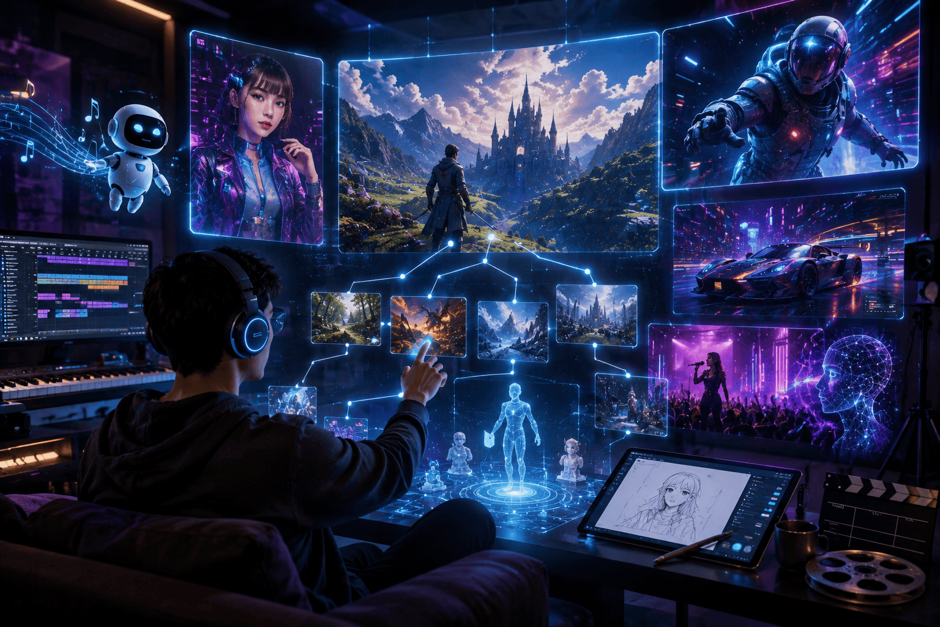
The future, according to the authors, is one where consumers do not merely take in entertainment products but where AI helps generate personalised stories, games, music, and virtual reality experiences based on consumer preferences.
Films might have several storylines based on consumer choice. Video games would be able to generate whole new worlds in real-time. Actors generated by AI could interact with live-action actors, while virtual influencers gain international fame.
The act of creation itself might be interactive and collaborative, where artists guide the AI.
Expert Insight
Fei-Fei Li, a computer scientist, has consistently argued that AI should augment rather than stifle human creativity.
This can clearly be seen in the case of generative AI systems for image, music, video, and writing creation, which lower the technical barriers of the creation process.
Example From Real Life
For example, a novelist would rely on AI to think of alternative endings, and the movie industry would produce storyboards in minutes. In music, artists would be able to try out various arrangements before composing the music.
However, issues of copyright, originality, and ownership are becoming more and more relevant.
Who does the generated content belong to: the programmer, the user, or the model?
According to the book, legal systems in the future will have to create whole new systems for collaboration between people and machines in creation.
5. Self-driving Vehicles will revolutionise urban spaces.
Self-driving vehicles epitomise one of the most obvious aspirations of AI.
Rather than limiting the scope to self-driving cars, AI 2041 looks at the broader revolution taking place in the form of smart transportation systems with constant communication between vehicles, traffic signals, delivery robots, drones, and infrastructure.
This can lead to better safety, less congestion, fewer carbon emissions, and a huge improvement in mobility for seniors and people with disabilities.
Expert Insights
Sebastian Thrun, a computer scientist, has been advocating for many years that autonomous driving essentially is a problem of AI perception and involves machines perceiving the environment in real-time.
Though completely self-driven transportation systems are still technically difficult, much headway has been made in computer vision, sensor fusion, and reinforcement learning.
Example From Real Life
Consider travelling in a city where the traffic lights adapt to real-time traffic, autonomous buses plan their routes based on the number of passengers using them, and drone deliveries happen via logistics systems powered by AI.
In addition to the convenience provided by AI-assisted transport systems, thousands of people’s lives can be saved because of fewer accidents due to tiredness, distractions, and drunk driving.
However, the transition comes with challenging questions that need to be answered in terms of liability, cybersecurity, investments in infrastructure, and jobs for millions of professional drivers.
6. AI Will Develop Digital Companions Where the Boundaries Between Humans and Machines Will Become Obsolete
Perhaps one of the most emotionally charged ideas in the book AI 2041 is the advent of digital companions based on AI. These will be far more advanced than the current chatbots and will include smart assistants able to remember previous interactions, understand emotions, adapt to people’s personalities, and provide constant company.
In their book, the authors envision the use of AI companions by lonely elderly people, for those who struggle with mental well-being, and even for the preservation of personality traits of dead relatives using huge amounts of digital memories. The development of such technologies brings up very deep philosophical questions: how much would we really “know” a person if a machine were able to replicate their voice, humour, and behaviour patterns?
Even though this concept may sound like something out of sci-fi movies, the rapid development of conversational AI and emotionally responsive machines makes it closer to reality.
Expert Insight
Sherry Turkle is a computer scientist who has made many studies about human interaction with technology. She observes:
“Technology proposes itself as the architect of our intimacies.”
This observation makes one realise the positive as well as the negative aspects. Though AI companions can be soothing and available, their excessive dependence could decrease human interaction in societies that are not able to maintain the right balance.
Case Study
AI virtual assistants are developing beyond tasks. Cognitive behavioural therapy exercises and companionships in elderly care facilities for encouraging conversations, medicine consumption and routines are examples of AI companions. Although these cannot substitute for real human relations, this is an indication of how AI will be an emotional support in the future.
The authors conclude that digital companionship should complement rather than substitute human interaction.
7. AI Will Change the Way We Make Scientific Discoveries
Traditionally, the discoveries of scientific theories and facts have been the result of years of experiments, hypotheses and careful analysis. And AI promises to radically change all this.
Instead of replacing scientists, AI can turn into a research tool able to discover relations between variables in gigantic sets of data that no human could ever find manually.
Whatever it is – searching for new substances, predicting the structure of proteins, or modelling the climate – with AI, we can cut the time between hypothesis and discovery.
Expert Insight
The Nobel laureate Demis Hassabis, one of the founders of the DeepMind company, mentioned several times that AI can become “the ultimate tool for scientific advancement”.
AlphaFold is one of the best illustrations of this thesis – it has discovered one of the biggest puzzles in biology, namely the structure of proteins.
Example from Real Life
How AI can assist in research:
Design new pharmaceutical drugs.
Develop eco-friendly battery materials.
Simulate chemical processes.
Analyse data from outer space to develop therapies. Discover new celestial bodies.
The pandemic situation caused by COVID-19 showed the importance of computational science as AI helped scientists screen millions of molecules as possible candidates for therapy.
According to Kai-Fu Lee, AI will not be able to substitute human curiosity, which makes one a good scientist, but it will greatly increase humanity’s exploration capabilities.
8. Smart Cities Will Enhance Everyday Life
The modern city produces an incredible amount of data every second, which includes everything from traffic flows and energy usage to weather and emergency services. As described in AI 2041, AI will control all of these processes more efficiently.
Future cities may function as ecosystems, where AI will analyse data to make services work better.
There may be adaptive traffic lights that reduce traffic jams, automatic balancing in renewable energy grids, and optimised routes for emergency services depending on the current situation.
Expert Insight
Carlo Ratti, the director of MIT Senseable City Lab and an urban planner, says that cities should be seen as “living laboratories”, where data may enhance the quality of life of citizens without harming human-centred design.
Real World Example
Several cities have started deploying intelligent infrastructure using AI:
Traffic management systems decrease congestion through intelligence.
Predictive maintenance recognises potential failures in bridges or water pipelines prior to failure.
AI-assisted surveillance enables quick identification of emergencies by emergency responders.
Smart grids manage electricity distribution according to demand.
However, it is advised that efficiency should not be prioritised over privacy. Cities that constantly gather individuals’ data need to have solid governance structures to avoid abuse of this data.
Smart cities should serve citizens, not monitor them.
9. AI Will Shape Wealth Creation—But Widen the Gap
One of the most significant warnings from the book is the fact that the economic advantages of AI will not be spread evenly.
In all previous technological revolutions, there have been large amounts of wealth generated along with the disruptions of existing industries.
People with highly advanced skills that include knowledge about AI can expect to see their productivity and potential to earn money rise like never before.
However, for people who perform repetitive and routine tasks, there is a threat of automation.
Expert Insight
According to economist Erik Brynjolfsson:
“Technology is not destiny.”
The effect it has on economics depends on the way government organisations, companies, and educational institutions react.
If societies decide to retrain their workforces and provide education opportunities, AI technologies might enhance life for millions of people. But without all that, inequality can grow significantly.
Examples From Real Life
Thanks to generative AI, currently, one designer, programmer, or marketer can do tasks that earlier required entire teams.
Also, many sectors, such as manufacturing, logistics, customer service, and administrative support, are rapidly automating processes.
What the authors stress is the fact that training people to work in the AI-based economy requires changing the way of education just as much as it requires innovative technologies.
Adaptability in learning new skills can become the key competitive edge in 2041.
10. Humanity’s Biggest Challenge Is Governing AI Ethically
This vision may be the most important one discussed in the book.
According to the authors, AI per se cannot be considered good or evil. Its effects can only be determined by the way in which humans decide to govern it.
Super intelligent AI is likely to affect the spheres of healthcare, finances, education, national security, elections, scientific research, and communications. If not governed ethically, AI may perpetuate bias, misinformation, or invasion of privacy or empower only a few organisations.
Expert Insight
Geoffrey Hinton, an early proponent of artificial intelligence who is also considered one of the “Godfathers of AI”, has time and again pointed out the need to properly regulate the more advanced AI systems.
In similar terms, Stuart Russell, author of Human Compatible, maintains that AI needs to stay aligned with human values and should not focus on maximising preset goals.
Case Study
The advent of the fast-growing world of generative AI has led to discussions on:
Deepfakes.
Copyright infringement.
Algorithmic discrimination.
Misinformation produced by AI programs.
Need for transparency.
Global AI governance.
Governments across the globe have begun to formulate regulatory policies, realising the need to strike a balance between innovation and responsibility.
Kai-Fu Lee points out that any effective AI governance will depend not just on engineers but on other stakeholders as well.
These include policymakers, educators, ethicists, executives, and even citizens.
Looking Back: How Accurate Are the Predictions?
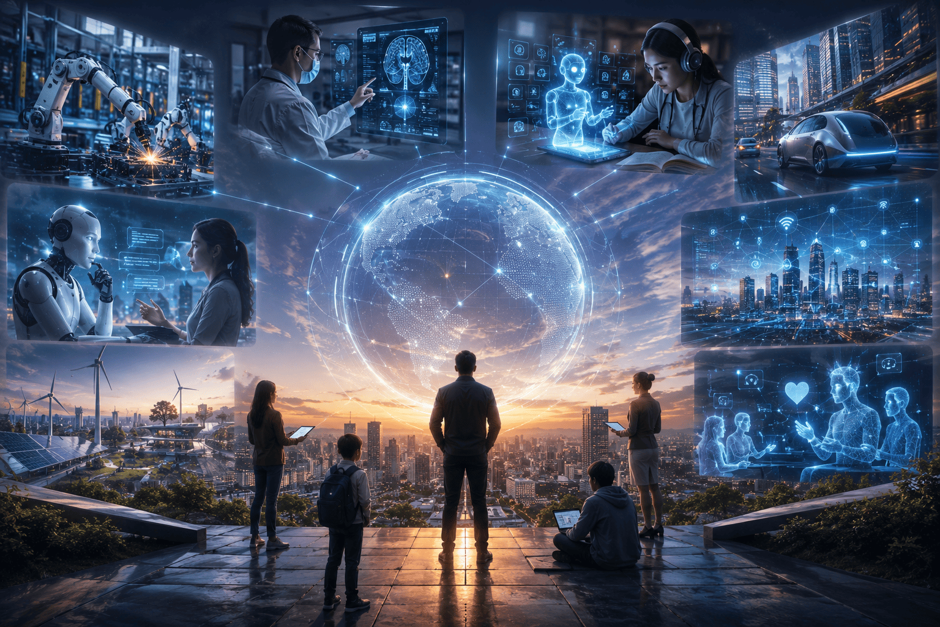
world, but at the time AI 2041 came out, many of the scenarios were considered ambitious. But in just a few years, some predictions are coming true faster than anticipated.
The use of generative AI has become widespread. There is ongoing progress in using AI in healthcare to enhance diagnostic capabilities. More personalised education systems are emerging alongside the development of other autonomous technologies, including smart infrastructure and science-based AI.
While not all the predictions have been fulfilled, fully automated transport is yet to be adopted in many areas, digital companions are still posing certain emotional and ethical issues, and there is still a long way to go in governing AI properly.
Nonetheless, one thing the book said has remained extremely accurate – AI is developing into a foundational technology quietly changing everything in our modern world.
And it no longer matters whether AI will change the world, but how mankind will react to this new reality.
Conclusion: The Future is Not Written Only by Algorithms
The one thing that makes AI 2041 stand out is the fact that the authors avoid making an AI utopia or an apocalypse out of artificial intelligence. Lee and Chen give a much more realistic picture of the future where artificial intelligence becomes integrated into people’s daily lives.
In the ten scenarios in the book, several common threads run through them—collaboration rather than replacement, customisation rather than homogenisation, prediction rather than reaction, and responsibility rather than uncontrolled development. The book shows that although AI optimises decisions, accelerates research and development, and automates processes, it can never establish the values of society.
As AI keeps on evolving at an incredible pace, the most crucial decisions will be taken not by algorithms but by governments that make reasonable laws for the proper regulation of AI; businesses that use AI responsibly; educators that prepare future generations; scientists that provide transparency of their work; and individuals who choose how much of their lives they want to hand over to artificial intelligence.
In this regard, AI 2041 is much more than just a technological novel; it is a novel about a fork on the road for humanity.
What is predicted in it is not an unavoidable nor an impossible outcome; each discovery, rule, discussion, and creation brings us a little bit closer to deciding if AI will become the most powerful ally of humanity or if it will be the biggest failure of humanity.
The year 2041 is coming faster than we think; the issue is not whether AI will change our future, but whether we can make the right choice for the future of all people.