
Since August 2026, Nvidia has been financing some of the infrastructure that consumes its chips. That changes what your AI compute costs and which contracts you should sign this year.
The supplier became the lender
Most boards treat AI compute as a rental. You pick a cloud, compare GPU-hour rates, sign a reservation, and file the line item under operating costs.
That habit assumes the chipmaker and the landlord are separate parties. As of October 2026, they increasingly aren’t.
Nvidia, the dominant maker of AI accelerators, reported $89.0 billion in data-center revenue for the quarter ended July 26, up 117% from a year earlier. It now also finances the facilities that consume those chips.
It has backed infrastructure for OpenAI’s Ohio lease, announced an intended investment of up to $100 billion in OpenAI, backstopped cloud providers’ unsold capacity and said it would invest in Meta’s equity raise.
For anyone deciding where a company’s AI workloads run, that dual role matters more than any price sheet. It concentrates compute in a few huge, expensive facilities, and the cost of financing them can land in your rates. The call in front of you this year is how much of your AI roadmap to tie to that stack, and on what terms.
Ohio, and a $105 billion promise
On August 17, Nvidia announced a $1.5 billion investment in SB Energy, the SoftBank-controlled developer building OpenAI’s planned campus in Pike County, Ohio. It also agreed to guarantee up to $105 billion connected with OpenAI’s lease there. The site is meant to reach as much as 8 gigawatts, with the first 800 megawatts expected online in 2028.
The structure is a residual-value guarantee on the initial roughly 4.25 gigawatts of IT capacity. If OpenAI can’t meet its obligations and the facility has to be re-leased or sold below an agreed value, Nvidia covers the shortfall up to the contractual limit.
Nvidia is also the campus’s exclusive chip supplier. It sells the equipment that creates the demand and stands behind the building that houses it.
A month later the tie got tighter. In September 2026, Nvidia and OpenAI announced a partnership to deploy at least 10 gigawatts of Nvidia systems. Nvidia said it intended to invest up to $100 billion in OpenAI progressively as each gigawatt is deployed, with the first targeted for the second half of 2026 on its Vera Rubin platform.
Read the fine print before you plan around it. The announcement was a letter of intent, and Nvidia itself labeled the investment, the deployment schedule and the expected benefits as forward-looking statements subject to execution and market risk.
OpenAI’s Sam Altman described compute infrastructure as the basis of the future economy in that announcement. Nvidia chief executive Jensen Huang presented the deal as the way to deploy the infrastructure the next phase of AI requires.
Both have reason to say so. A 10-gigawatt system needs long-term power contracts, substations, buildings, cooling, networking, storage and construction finance. Nvidia’s proposed capital helps make that package financeable, and it also deepens OpenAI’s dependence on one platform.
Buyer of last resort
The Ohio deal drew the headlines. A quieter mechanism sits in Nvidia’s quarterly filings.
Nvidia’s July 26 quarter included about $36 billion of cloud-service commitments or backstops for AI cloud companies, according to reporting based on its disclosures. In plain terms, Nvidia can act as buyer of last resort: if a specialized cloud provider can’t sell the capacity it built with Nvidia equipment, Nvidia may pay for some of it.
CoreWeave, a specialized GPU cloud that rents capacity to Microsoft and AI developers, is the clearest case. Nvidia agreed to buy up to $6.3 billion of its computing capacity if CoreWeave couldn’t find another customer, with the commitment running through April 2032.
The loop runs in a circle. CoreWeave borrows to buy Nvidia systems, leases space, secures electricity and rents out GPU time. Nvidia’s equity, guarantees or purchase commitments make lenders more willing to fund the next building, and the next building orders more Nvidia hardware.
Critics call this circular financing. Nvidia wins if the loop produces real end-user demand. If capacity runs ahead of that demand, the exposure flows back up the chain to Nvidia.
Those financing costs can flow into the rates paid by whoever rents the capacity.
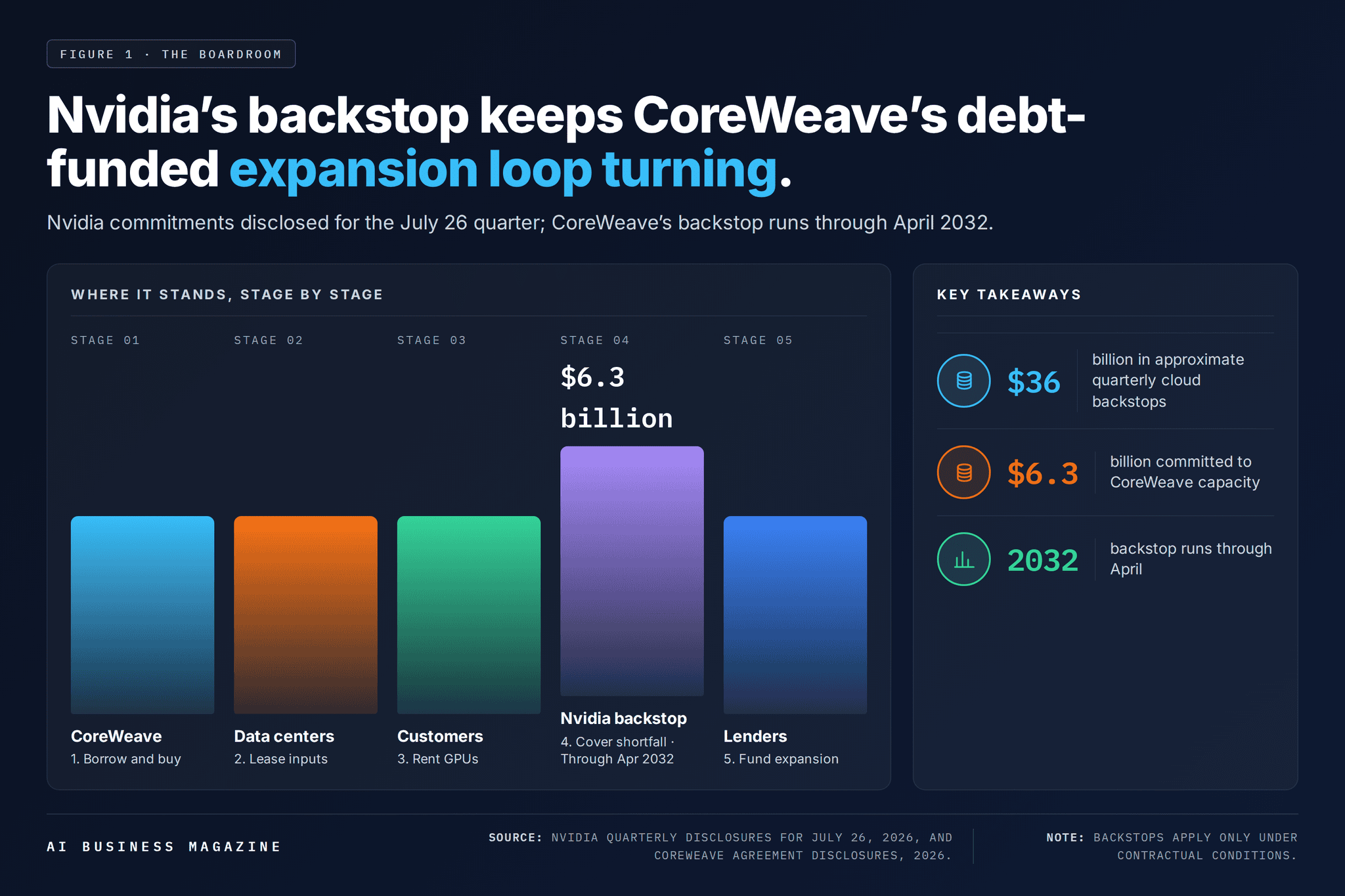
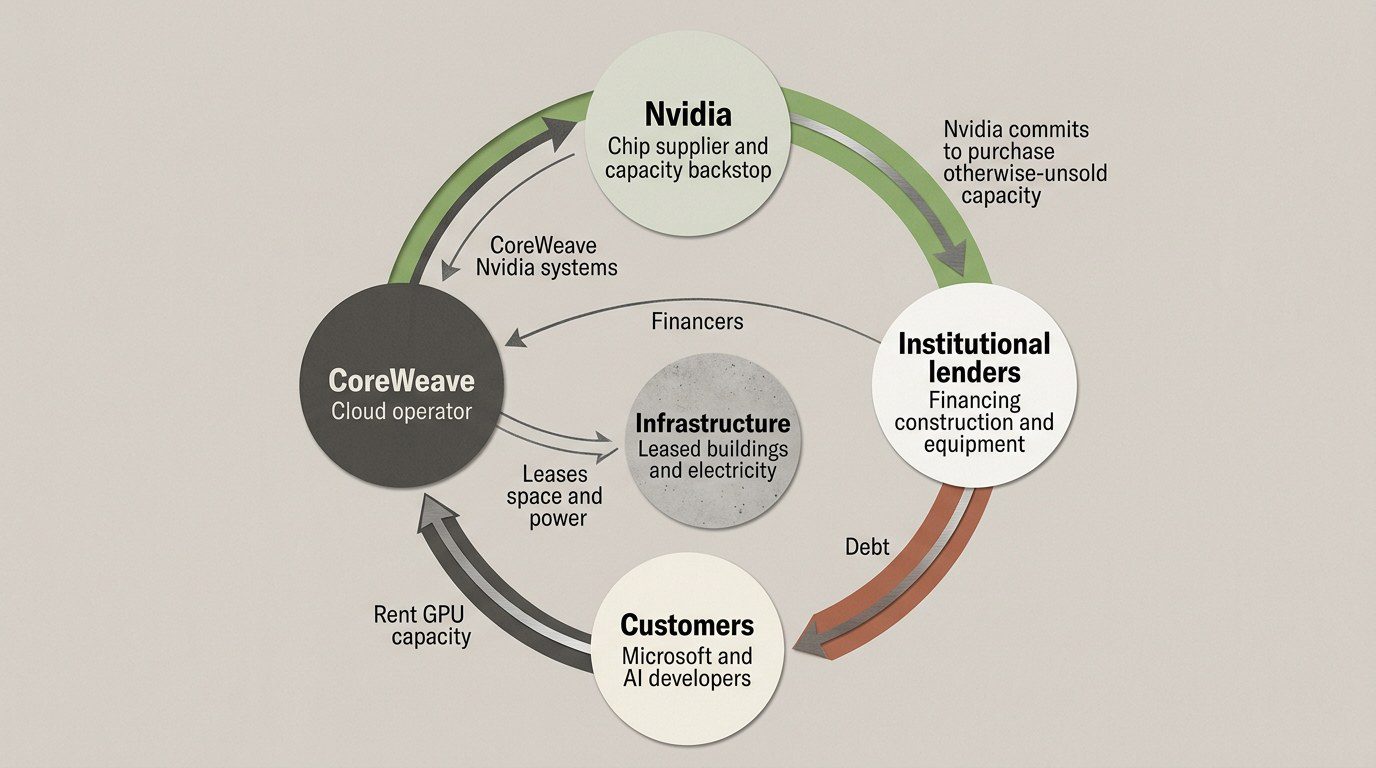
Nvidia’s backstop helps CoreWeave finance more capacity, but it also sends the risk of unsold GPU time back around the same loop.
Where the stress showed
October delivered the clearest stress test. Reuters, the news agency, reported that CoreWeave carried about $50 billion of debt and that the cost of insuring it against default had climbed to roughly 1,000 basis points. Under market assumptions at the time, that implied a nearly 63% chance of default within five years.
That figure measures fear in the credit market. It still deserves a place in your vendor review. Nvidia’s backstop through April 2032 helps, but CoreWeave’s obligations to lenders, landlords, power suppliers and equipment vendors stay on its books.
Huang rejected the idea that CoreWeave needed a Nvidia rescue package and argued in October that demand for specialized AI cloud capacity remained strong. Investors kept their eyes on other numbers: the debt load, the falling value of older accelerators as new generations arrive, and borrowing costs that could rise faster than AI revenue.
The middle item should worry a buyer most.
A cloud provider pays for chips and buildings before it knows how fully customers will use them. When a newer generation ships, the facility keeps running, but the older GPUs inside it get harder to rent at the original price. The provider may still owe debt on the older equipment.
If your provider carries that balance sheet, its lenders’ risk premium can become part of your price, whether or not the invoice shows it.
Bigger racks, fewer landlords
The hyperscalers are heading the same way at larger scale. In October, Google Cloud and Nvidia said Google’s A5X instances, built on Nvidia Vera Rubin NVL72 systems, would become generally available the following month. The package pairs Nvidia compute and ConnectX-9 networking with Google’s Virgo network and its liquid cooling.
Google planned to scale Vera Rubin to as many as 960,000 Rubin GPUs across multiple sites, according to Nvidia’s announcement. Its stated rationale covers training, inference and reinforcement learning for agentic systems, including European deployments that must meet local data-residency rules.
Look closely at what you’re renting now. The unit is shifting from a single accelerator instance toward an integrated rack of GPUs, CPUs, networking and cooling. Large training and inference jobs run better that way, and only providers able to fund concentrated, power-hungry sites can offer frontier-scale capacity at all.
Meta shows the owner’s version of the same bet. On October 27, Nvidia said it would invest $3 billion in Meta’s equity offering as the companies expanded work on Meta’s Muse models and agents. Meta planned to raise up to $95 billion in equity for AI infrastructure, according to reporting that day.
Meta said it would expand its use of Vera Rubin GPUs, Vera CPUs, Spectrum-X Ethernet and BlueField-4 networking, and evaluate Nvidia’s OpenShell and Sentry tools.
Meta’s Mark Zuckerberg described Muse as a route to personal AI agents for billions of people. Nvidia framed the collaboration as an effort to improve performance and total cost of ownership for Meta’s agents. That is a company objective, and it applies to Meta’s own fleet.
What a gigawatt costs
So what does all that concrete and copper add to your bill? Start with the building. A one-gigawatt facility was estimated in October at roughly $41 billion including data-center, power and computing infrastructure, according to a National Bureau of Economic Research working-paper analysis cited by the Boston Globe.
Huang put his own estimate at about $50 billion, counting land, buildings, computing equipment, networking, storage, power systems and cooling.
The two figures differ by scope and method. Either one explains why AI capacity can’t be priced like ordinary cloud CPU time.
Capital is the first channel into your rates. An AI cloud has to finance its GPU inventory before collecting customer revenue, so interest and lenders’ risk premiums can flow into hourly prices and long-term contracts. Every GPU-hour also carries the dedicated power and cooling behind it.
Lock-in is the second. Once a team standardizes on Nvidia GPUs, CUDA software, Nvidia networking and Nvidia systems, switching suppliers turns into a migration project. Rack-scale packages tighten that grip, because the networking and cooling arrive bundled with the silicon.
The sticker price leaves out a lot. Google Cloud advertises a wide range of Nvidia GPU options with per-second billing and up to eight GPUs per instance. Storage, data transfer, software, reserved capacity and the engineering needed to keep distributed jobs fed with data all sit on top of that rate.
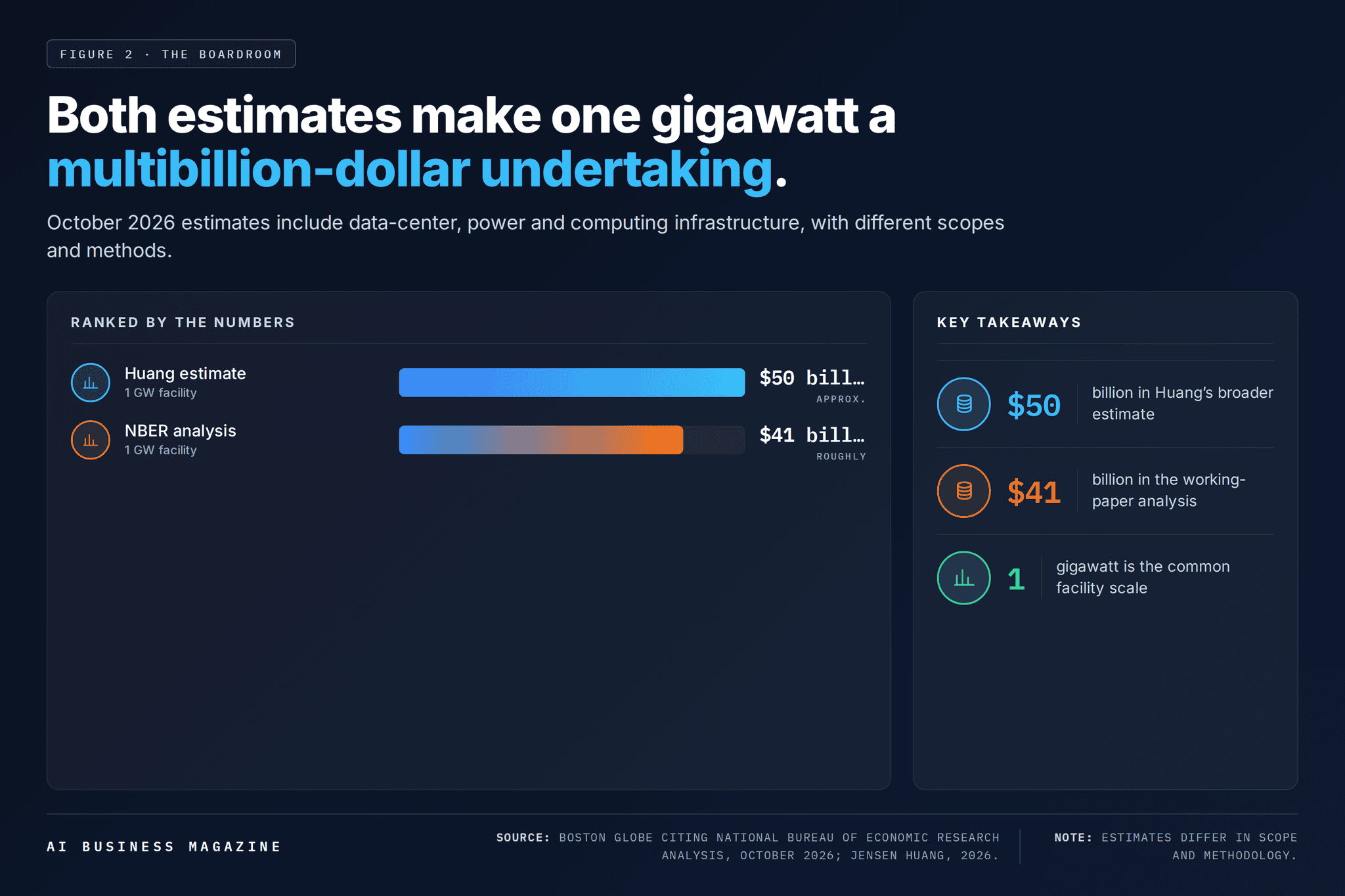
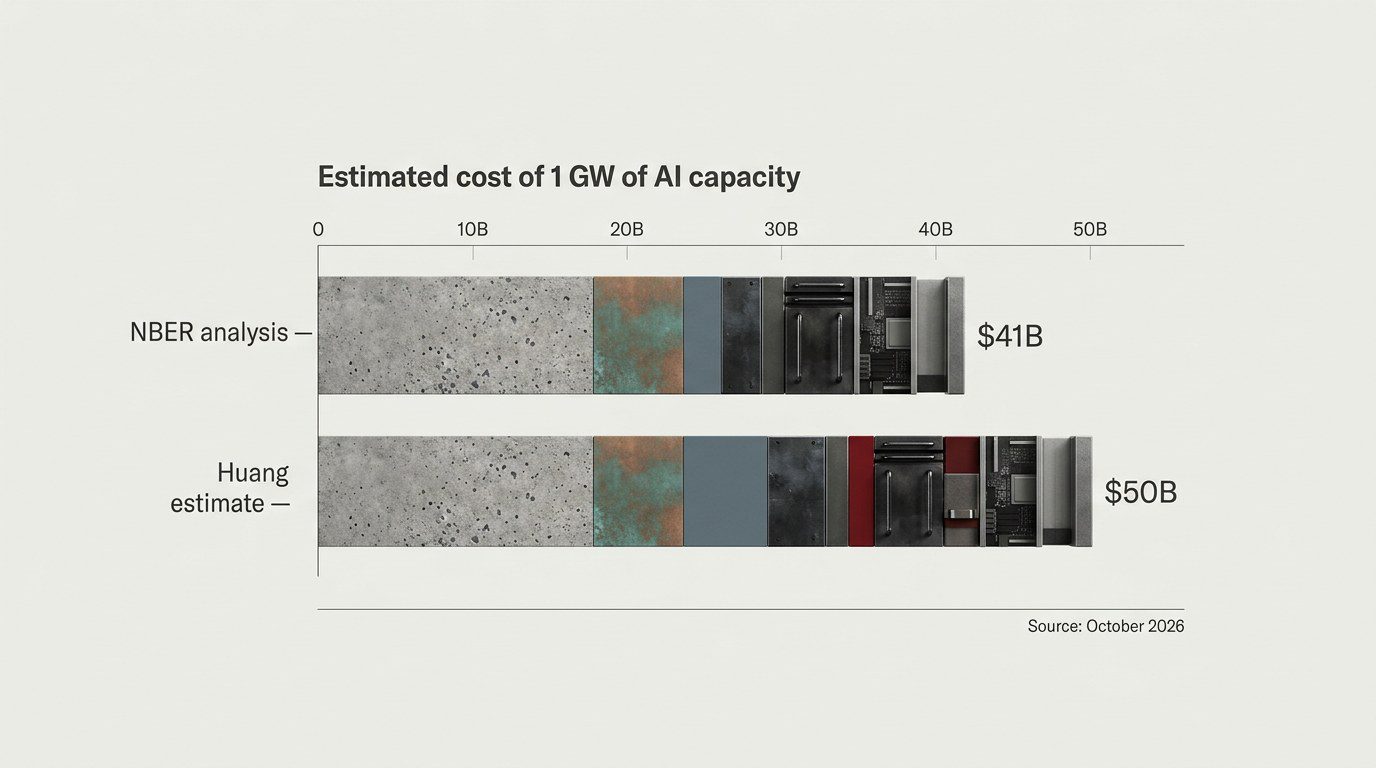
Estimates put a one-gigawatt AI facility at roughly $41 billion to $50 billion before customers begin paying for the capacity.
The calls to make this year
Nvidia’s financing expands supply. It also ties more of that supply to a few leveraged operators and one dominant vendor, so budget for compute that stays expensive and gets harder to leave. Five moves follow from that.
- Map your exposure to one operator. List which workloads run on specialized GPU clouds such as CoreWeave and what happens to them if that provider’s financing tightens. Credit markets priced a nearly 63% five-year default probability for CoreWeave in October, and a written contingency plan is cheaper than an emergency migration.
- Price the whole stack. Ask every provider to quote storage, data transfer, software and reservation terms alongside GPU-hour rates. Then compare total cost per workload, line by line.
- Match contract length to chip life. Older accelerators lose value as new generations arrive. Before you sign a multiyear reservation, find out which generation you’re locked into and what the provider offers when the next one ships.
- Fund one escape route. Pay for the engineering to keep at least one important workload runnable outside the Nvidia stack. That keeps a genuine price comparison on the table at renewal.
- Benchmark vendor cost claims yourself. When a supplier promises lower total cost of ownership, as Nvidia did for Meta’s agents, run your own workload on the new system before the promise reaches the budget.
Put the concentration question to your board directly. Several of the largest projects depend on OpenAI’s future usage and its ability to pay. If your AI strategy leans on the same handful of providers, the board should see that dependency stated in one sentence, with a named owner for the fallback.
Watch December
The next signal comes from Ohio. SB Energy was considering pushing its public offering to December 2026 or later, according to reporting on October 22. The first 800 megawatts in Pike County aren’t due until 2028.
Before you sign a multiyear compute deal this year, check whether that IPO happened, and at what price.
References
- NVIDIA and OpenAI Announce Strategic Partnership (NVIDIA Newsroom) — https://nvidianews.nvidia.com/_gallery/download_pdf/68d173273d633288cb44040b/
- Nvidia to invest $1.5 billion in SB Energy under OpenAI data center deal (Reuters) — https://www.reuters.com/business/media-telecom/nvidia-invest-15-billion-sb-energy-under-openai-data-center-deal-2026-08-17/
- What data centers cost (Boston Globe) — https://www.bostonglobe.com/2026/10/26/business/data-centers-cost/
- Nvidia Backs OpenAI’s Ohio Data Center Buildout With $105B Guarantee (Data Center Knowledge) — https://www.datacenterknowledge.com/data-center-construction/nvidia-backs-openai-s-ohio-data-center-buildout-with-105b-guarantee
- NVIDIA GPUs on Google Cloud (Google Cloud) — https://cloud.google.com/nvidia
- Nvidia GTC Berlin keynote: Jensen Huang (Yahoo Finance) — https://finance.yahoo.com/technology/ai/articles/nvidia-gtc-berlin-keynote-jensen-114237092.html
- NVIDIA and Meta to Expand Collaboration on Muse and Muse Family of Models Amid Robust Growth (NVIDIA Investor Relations) — https://investor.nvidia.com/news/press-release-details/2026/NVIDIA-and-Meta-to-Expand-Collaboration-on-Muse-and-Muse-Family-of-Models-Amid-Robust-Growth/default.aspx
- Nvidia to invest in Meta (CNBC) — https://www.cnbc.com/2026/10/27/nvidia-invest-meta.html?taid=2526c5e7-c6ed-4eea-911f-932adc15811f
- Nvidia’s web of AI bets: smart strategy or bubble risk? (The Straits Times) — https://www.straitstimes.com/business/nvidias-web-of-ai-bets-smart-strategy-or-bubble-risk
- Nvidia and the AI credit-risk question (Yahoo Finance) — https://finance.yahoo.com/markets/stocks/articles/nvidia-knows-could-trigger-credit-124547448.html
- Why CoreWeave is in the crosshairs of the AI scare (Reuters) — https://www.reuters.com/legal/transactional/why-coreweave-is-crosshairs-ai-scare-2026-10-16/
- Nvidia’s Huang signals on CoreWeave financials (Yahoo Finance) — https://finance.yahoo.com/markets/stocks/articles/nvidias-huang-signals-coreweave-financials-172500723.html
- Jensen Huang says neocloud demand remains strong (Yahoo Finance UK) — https://uk.finance.yahoo.com/news/jensen-huang-says-neocloud-demand-124427377.html
- SB Energy could wait until December for an IPO, The Information says (Business Insider) — https://markets.businessinsider.com/news/stocks/sb-energy-could-wait-until-december-for-an-ipo-the-information-says-1036657199
- OpenAI builder SB Energy weighs IPO delay with $430B backlog (FourWeekMBA) — https://fourweekmba.com/ai-openai-builder-sb-energy-weighs-ipo-delay-with-430b-backlog/
- Google Cloud and NVIDIA Vera Rubin infrastructure (NVIDIA Blog) — https://blogs.nvidia.com/blog/google-cloud-vera-rubin-infrastructure/
- NVIDIA GPU cloud computing on Google Cloud Platform (NVIDIA) — https://www.nvidia.com/en-us/data-center/gpu-cloud-computing/google-cloud-platform.md
- Nvidia Q2 fiscal 2027 earnings live updates (CNBC) — https://www.cnbc.com/2026/08/26/nvidia-nvda-earnings-report-q2-2027-live-updates.html