
The article discusses five AI startups that CFOs are monitoring, highlighting their funding, functionalities, and market potentials. Each startup addresses specific finance-related challenges, from automating bookkeeping to preventing fraud. The analysis emphasizes the evidence of customer adoption and operational maturity for evaluating their viability.
- Hyphenate offers an autonomous finance platform that automates broad finance operations for enterprises.
- Casap focuses on AI software for banking, tackling customer fraud and dispute automation.
- Nevis provides an AI operating system for wealth management, helping financial advisors scale operations.
- Simplismart is an AI infrastructure startup aiming to optimize model serving and reduce computing costs.
- BOB AI targets small businesses with an AI finance employee for routine bookkeeping and financial tasks.
October’s finance-AI deals landed in three parts: $56 million for bank fraud, $45 million for autonomous accounting, $70 million for wealth management. The useful signals aren’t demos. They’re budgets being spent, real customers, and who owns the workflow.
This list splits what a CFO could actually pilot from tech that still needs a business case. Which startups survive after the funding headline?
1. Hyphenate

What It Does
Hyphenate sells AI agents that run core finance work. It automates general ledger accounting, treasury, order-to-cash, procure-to-pay, and financial reporting across a company’s existing ERP, banking, and payroll systems.
Why It’s Trending
The former Maximor raised a $45 million Series A in October 2026, led by Nexus Venture Partners. Total funding hit $54 million. Six publicly traded customers are using it, including Groupon, Synthesia, HiBid, and Mini Melts USA Inc. One cybersecurity firm reported a live deployment in under four weeks.
Key Features
-
Autonomous finance platform spanning accounting, treasury, collections, payables, and reporting.
-
AI agents automate workflows and operate across ERP, bank, and payroll systems.
-
Replaces repetitive finance-operations work with software-driven execution.
Best For
-
Enterprises automating broad finance operations across existing systems.
-
Businesses reducing manual accounting, treasury, and reporting work.
-
Finance teams coordinating order-to-cash and procure-to-pay processes.
What Makes It Different
Its breadth is the play. Hyphenate is aiming to be an operating layer for finance, not just another point solution. That ambition means a higher trust burden.
Market Opportunity
It targets finance departments where accounting, treasury, and working-capital processes are fragmented. Six public customers show an enterprise market willing to test autonomous operations. The four-week deployment offers a concrete implementation signal.
Things to Consider
-
The October 2026 round values the broad autonomous-finance thesis, but it’s less proven than narrower solutions.
-
Six publicly traded customers provide stronger commercial evidence than an unqualified pilot claim.
-
It plugs into existing systems, but reporting didn’t establish independent security certifications or pricing.
-
Self-learning agents create a control risk: finance leaders must decide which actions run without human approval.
Our Verdict
A serious option for enterprise finance teams seeking to consolidate repetitive work, provided the vendor documents controls, security evidence, and approval boundaries before production.
Website: https://hyphenate.ai
2. Casap
What It Does
Casap builds AI software for banks to stop customer fraud and automate fraud and dispute workflows. A bank uses it to investigate suspicious activity, manage disputes, and cut the operational load from multiplying fraud cases.
Why It’s Trending
Casap announced a $56 million Series B in October 2026, led by Base10 Partners. Total funding hit $90 million since its 2023 launch. The company is pitched directly against the growing cost and volume of customer fraud, making it October’s clearest risk-budget story.
Key Features
-
Banking software for customer-fraud prevention and automated dispute handling.
-
AI-assisted fraud detection and workflow automation for investigations and disputes.
-
Helps banks manage rising fraud cases without scaling operations linearly.
Best For
-
Enterprises modernizing fraud and dispute operations.
-
Financial services firms reducing customer-fraud losses and casework.
-
Businesses automating high-volume fraud workflows.
What Makes It Different
Casap focuses on the bank’s operational response to fraud, not just transaction scoring. Its distinction is combining prevention with dispute and workflow automation against broader platforms.
Market Opportunity
Banks face expanding fraud that creates direct losses and expensive customer-service work. Casap’s $90 million total funding shows investor confidence in a financial-crime market where prevention, investigation, and resolution budgets increasingly overlap.
Things to Consider
-
The Series B provides runway, but the public announcement centered on the banking use case, not quantified customer outcomes.
-
Banking deployment requires strong controls around sensitive customer data; detailed security disclosures remain a procurement question.
-
The company launched in 2023, so buyers should test operational maturity against established fraud vendors.
-
The model must prove it improves loss rates and dispute handling in live bank workflows, not just detection accuracy.
Our Verdict
A credible watchlist candidate for bank CFOs funding fraud reduction, especially where dispute operations are costly; its position depends on named deployments, measurable loss reduction, and procurement-grade security evidence.
Website: https://www.casap.ai/
3. Nevis

What It Does
Nevis provides AI software for financial advisors, calling it an operating system for wealth management. Advisory firms use it to organize and automate advisor workflows, aiming to handle more client operations without matching manual support growth.
Why It’s Trending
Founded in October 2024 by former Revolut executives, Nevis raised a $70 million Series B in October 2026, led by EQT Ventures. Total funding reached $110 million in two years. Strategic investors included Charles Schwab Corporation and QuantumLight, and Nevis said it had roughly 20 customers.
Key Features
-
AI operating system for wealth-management and advisor workflows.
-
Automates operational work supporting financial advisors and wealth-management teams.
-
Gives advisory firms software to scale client and advisor operations.
Best For
-
Wealth-management firms modernizing advisor operations.
-
Financial services firms supporting advisor productivity and client workflows.
-
Businesses scaling wealth operations without matching headcount growth.
What Makes It Different
Nevis combines a young product with strong strategic signaling from Charles Schwab Corporation and a customer base that includes Focus Financial Partners, IEQ Capital, and United Capital.
Market Opportunity
Wealth managers are under pressure to support advisors and clients while controlling operating costs. Nevis’s roughly 20 customers and $110 million raised show a market willing to finance specialized AI software, though large wealth platforms could bundle similar capabilities.
Things to Consider
-
Charles Schwab Corporation’s strategic investment is a meaningful signal, but it doesn’t establish broad deployment.
-
Roughly 20 customers indicate early commercial traction, not category dominance.
-
October 2026 reporting didn’t establish compliance certifications, pricing, or integrations—key details for regulated wealth firms.
-
Large wealth-management incumbents could bundle advisor automation, creating platform risk for an independent vendor.
Our Verdict
A focused option for wealth-management executives seeking advisor-workflow automation. Adoption decisions should turn on integrations, compliance evidence, and whether the product delivers enough operating leverage to resist incumbent bundling.
Website: https://neviswealth.com
4. Simplismart
What It Does
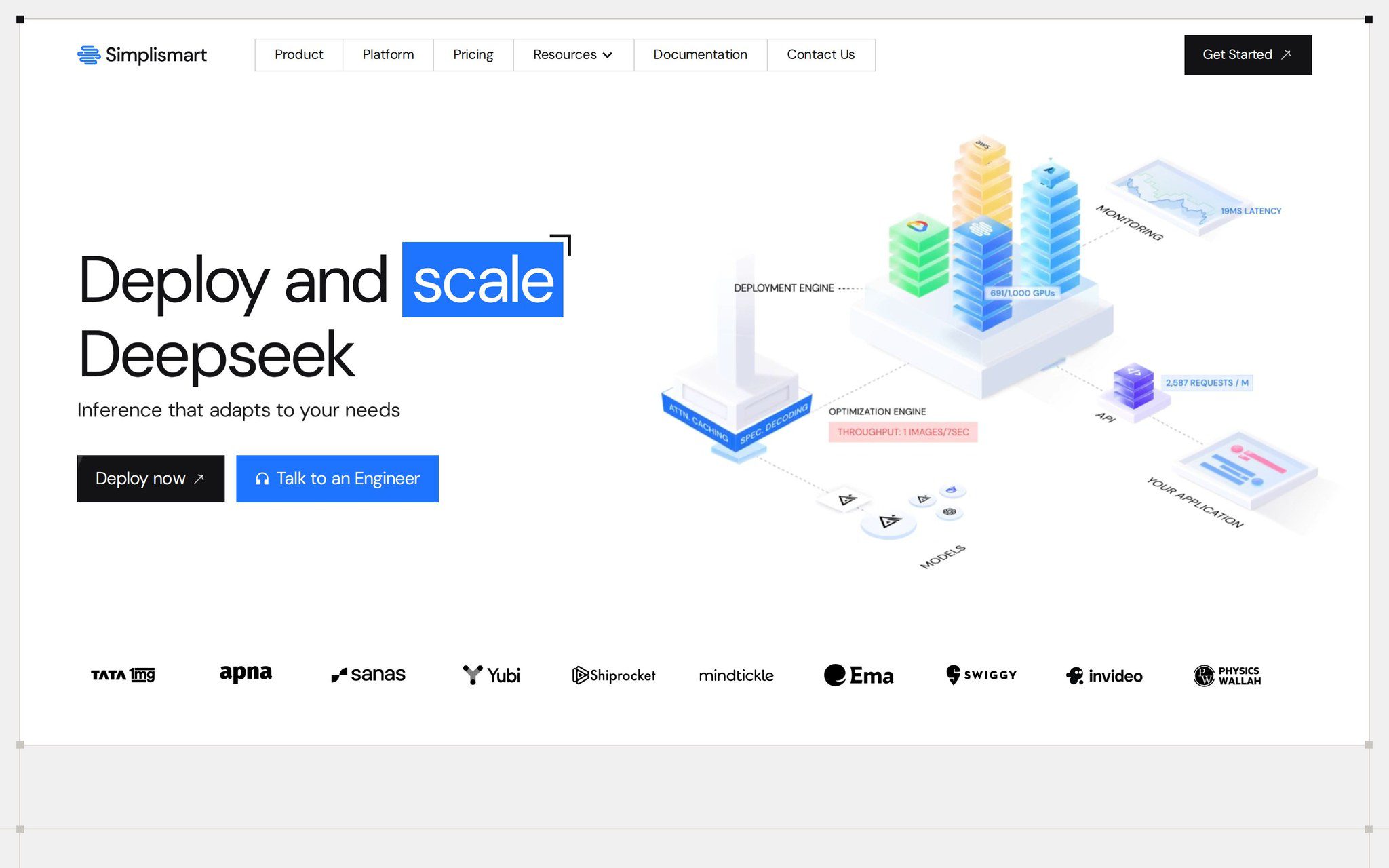
Simplismart sells infrastructure software that helps companies run AI models more efficiently, sometimes with fewer GPUs. Finance leaders use it to challenge rising model-serving costs, while technical teams optimize inference instead of buying more compute.
Why It’s Trending
The Indian AI infrastructure startup raised a $14 million all-primary Series B in October 2026, led by Dallas Venture Capital. Nvidia, Accel, Shastra VC, and Micromax participated. Nvidia’s involvement puts the company inside the most important AI cost conversation: how much inference hardware each workload actually requires.
Key Features
-
AI model-serving and infrastructure software for more efficient execution.
-
Inference optimization designed to reduce GPU requirements in some workloads.
-
Lowers the compute cost of deploying and operating production AI models.
Best For
-
Enterprises controlling AI infrastructure and inference spending.
-
Developers optimizing model serving for production workloads.
-
Businesses reducing GPU-heavy operating costs.
What Makes It Different
Simplismart’s pitch is economic, not model-centric: better serving efficiency and potentially fewer GPUs.
Market Opportunity
As companies move models from experimentation into production, inference becomes a recurring operating expense. The October funding round and Nvidia participation show investor interest, but the evidence doesn’t establish customer savings or deployment scale.
Things to Consider
-
The $14 million round is all-primary, giving the company capital to expand in a competitive market.
-
Nvidia’s participation is strategically notable, but cloud vendors and model-serving platforms may bundle similar efficiency gains.
-
The product claims efficiency and, in some cases, fewer GPUs; buyers should validate those gains on their own workloads.
-
Customer traction, pricing, implementation detail, and enterprise integrations remain central diligence questions.
Our Verdict
A relevant pilot for CIO-CFO teams facing rising inference bills, provided engineering can benchmark it against existing cloud and serving tools. Without workload-level savings, the funding signal alone isn’t a business case.
Website: https://www.simplismart.ai
5. BOB AI
What It Does
BOB AI is building an AI finance employee for small businesses, focused on financial capabilities and customer onboarding. It targets routine bookkeeping and basic finance operations owners handle manually or can’t staff economically.
Why It’s Trending
BOB AI raised $5.5 million in seed funding in October 2026, led by Mischief. Peter Thiel, Codie Sanchez, Mark Pincus, Karman Ventures, and others participated. The round followed a private beta launch in September 2026 and funds customer onboarding.
Key Features
-
AI finance employee for small-business financial operations.
-
Automates selected finance capabilities and customer-onboarding tasks.
-
Reduces manual bookkeeping and basic finance-ops work for small companies.
Best For
-
Businesses handling routine finance operations with limited staff.
-
Small businesses improving bookkeeping and financial workflows.
-
Owner-operators managing business finances.
What Makes It Different
BOB AI is aimed at the small-business finance employee category, not enterprise finance transformation. Its advantage, if the private-beta proposition holds, is a simpler product motion than platforms built for large ERP estates. Its challenge is proving reliability with less room for human oversight.
Market Opportunity
Small businesses often need finance support before they can justify a full accounting team. The $5.5 million seed round gives BOB AI capital to scale onboarding, but the private-beta stage places it earlier than the other startups here.
Things to Consider
-
The product was in private beta in September 2026, so maturity and repeatable onboarding are immediate tests.
-
The October seed round funds scaling, but early-stage financing makes future capital needs part of the risk profile.
-
It targets manual bookkeeping and basic finance work, a market crowded by accounting software and services.
-
Buyers should establish how financial errors are reviewed before an AI employee handles consequential tasks.
Our Verdict
A speculative fit for small-business operators seeking relief from routine bookkeeping. It’s not yet an enterprise procurement candidate. Its next proof point is dependable onboarding and finance accuracy beyond the private beta.
Website: https://www.getbob.ai
The ranking favors workflow ownership over raw model ambition. Hyphenate has the strongest enterprise case; Casap has the sharpest risk-budget logic. Nevis is a focused vertical bet, Simplismart a cost-control wager, and BOB AI an early small-business experiment.
CFOs should ask for controls, customer evidence, and workload economics before treating any October round as proof of maturity.
Frequently asked questions
What are the main AI startups CFOs are watching this quarter?
CFOs are watching Hyphenate, Casap, Nevis, Simplismart, and BOB AI. Each startup specializes in different areas such as automating finance operations, preventing fraud, enhancing wealth management, optimizing AI infrastructure, and supporting small businesses in bookkeeping.
How much funding have these AI startups received?
In October 2026, Hyphenate raised $45 million, Casap secured $56 million, Nevis obtained $70 million, Simplismart received $14 million, and BOB AI raised $5.5 million in seed funding. This funding highlights the growing interest in AI solutions for finance.
What unique features do these startups offer?
Hyphenate automates core finance tasks, Casap combines fraud prevention with dispute management, Nevis provides an operating system for wealth management, Simplismart optimizes AI model execution, and BOB AI acts as an AI finance employee for small businesses.
What should CFOs consider when evaluating these startups?
CFOs should assess the operational maturity, customer evidence, and specific controls offered by each startup before treating their funding announcements as proof of product maturity and reliability.
Why is customer evidence important for these AI startups?
Customer evidence is crucial as it demonstrates real-world application and acceptance of the technology, offering insights into effectiveness, reliability, and the potential return on investment compared to traditional methods.