Agentic AI is no longer a thought experiment. Across finance, supply chain, customer experience, and IT, autonomous agents are gaining traction in end-to-end workflow execution and business-process support. The enterprise-grade platforms making this possible are more capable and more competitive than ever.
Over the last decade, “automation” has meant many things. It began with scripted robotic process automation to handle repetitive clicks and data entry, then broadened to include intelligent document processing and chatbots. Now, in 2026, agentic AI has made modular, interoperable automation possible. An AI agent, or a multi-agent system within an agentic orchestration layer, receives a goal, reasons through a complex, multi-step plan, coordinates with other agents or APIs, and executes tasks on live enterprise data without human supervision at every touchpoint.
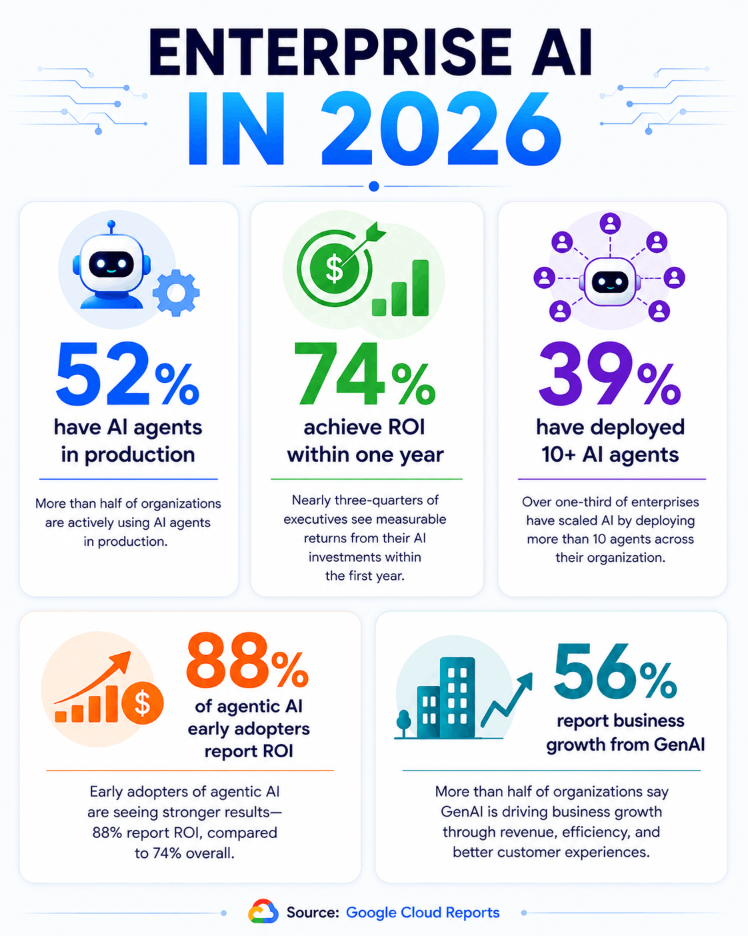
In a 2025 report, Gartner estimated that 40% of enterprise applications will include task-specific AI agents, compared with less than 5% in 2025. Major technology companies and conglomerates have been quick to adapt to evolving enterprise demand. At its May conference, SAP unveiled an end-to-end Autonomous Enterprise program. Google repositioned Vertex AI as an agent-native development environment. ServiceNow positioned itself as “the AI agent of agents,” while Salesforce crossed $1 billion in Agentforce annual recurring revenue (ARR).
These tools offer enterprise-grade foundations for agentic AI solutions, with many serving more than 1,000 enterprise clients or supporting Fortune 500 deployments. Each platform listed below has AI-native orchestration capabilities for automated workflow support, data retrieval, and built-in governance and security, including role-based access control and audit-log functionality. All offer varying levels of evaluation frameworks, although the clearest golden-set evaluation documentation appears in Gemini Enterprise and LangGraph.
A Guide for Developers And Technology Strategists
SAP Business AI Platform
Best For: Organizations running SAP S/4HANA, BTP, or SuccessFactors who want agents deeply integrated with their existing ERP data model and governance framework.
The innovation announcements at Sapphire 2026 in Orlando included SAP’s Business AI Platform and CEO Christian Klein’s emphasis on SAP’s transformation into a business AI company. SAP is betting heavily on Joule as its orchestrator, evolving it from a conversational copilot into a system that coordinates a wide range of role-specific agents across finance, supply chain, procurement, HR, and customer functions. SAP offers Joule Assistants, AI coordinators designed for specific roles. A financial manager has a Cash Management Assistant, while a supply chain specialist has a Production Planning Assistant. These coordinators use more than 200 specialized Joule Agents for task execution. Because the agents are grounded in SAP’s Knowledge Graph and Business Data Cloud, they operate on meaningful enterprise data rather than generic knowledge sources.
Joule Studio Agent Builder allows customers and SAP partners to use low-code and pro-code tools, along with frameworks such as LangGraph, AutoGen, and LlamaIndex, to create and tailor the agents they need. Customer benefits are already emerging. Global fashion retail group LC Waikiki uses Joule across its sales and procurement to increase operational productivity by 70%, shrinking a 10-minute manual process to three seconds. SAP’s Cash Management Agent, which uses automated analysis and reconciliation of bank account statements, helps reduce the effort involved in manual cash-positioning management. SAP’s Autonomous Close Assistant could also reduce financial close periods from weeks to days. SAP is aiming to generate $30 billion in annual subscriptions by 2030 and expects AI to contribute more than 30% of the company’s total annual contract value.
Microsoft Copilot Studio & AI Foundry
Best For: Microsoft 365-native organizations that want to layer agents into existing workflows quickly via Copilot Studio while maintaining the option to graduate to Foundry for mission-critical, custom AI pipelines.
Microsoft deliberately employs a two-layer agent strategy. The low-code surface is Copilot Studio, which serves business makers; this allows non-developers to build and deploy conversational agents using drag-and-drop flows, over 1,000 connectors, and deep integrations with Teams, SharePoint, and the broader Microsoft 365 environment. The pro-code surface is Azure AI Foundry (formerly Azure AI Studio and increasingly just Microsoft Foundry), a cloud-native platform on which engineering teams oversee the entire AI lifecycle, from choosing from 1,900+ curated models, to tuning those models, to building and running production-grade RAG pipelines and observing their performance.
In May 2026, Microsoft announced that it had entered its “agentic era.” CEO Satya Nadella described Microsoft’s strategic blueprint as comprising three elements: a wide range of open AI models, a consistent agent runtime, and an AI-centric application development approach. By April 2026, Copilot Studio multi-agent systems, supported by its agent-to-agent (A2A) communication protocol and new Microsoft Purview governance, were generally available. More than 80,000 enterprises, including 80% of Fortune 500 companies, rely on Azure AI Foundry. The 2026 release of Foundry IQ, the smart layer that replaces manually implemented RAG pipelines, enables enterprises to connect their data from Fabric, Azure SQL, and MCP through a single knowledge layer backed by an SLA-protected retrieval endpoint. The discourse around agent security is now one of Microsoft’s chief enterprise sales tools, thanks to features that control resource usage at the per-agent and per-project levels. It offers the AI Cost Governance Kit, with per-project token budgets, and the Microsoft Agent Trust Council, a quarterly review of agent reliability. Both indicate how closely the vendor is listening to enterprise IT teams when they discuss the governance and funding needed to scale agentic systems.
ServiceNow AI Platform
Best For: Enterprises with complex cross-functional workflows in IT, HR, finance, and legal who want a governance-first approach to deploying agents across a heterogeneous technology environment.
ServiceNow has taken a different strategic bet from its hyperscale rivals. Instead of pushing customers to move their entire stack to a new platform, it is positioning itself as a governance and orchestration layer on top of other in-market models and applications. CEO Bill McDermott made this clear at Knowledge 2026, saying ServiceNow “wants to be the AI agent of agents — connecting any model, any cloud, and any data source.” The company processes more than 100 billion workflows each year, and its AI platform is designed to provide governance for the agents that act on behalf of human workers.
ServiceNow “Australia,” the codename for its 2026 release, added three major capabilities. Workflow Data Fabric unifies enterprise data sources, with 30 new integrations across AWS, Google Cloud, Azure, SAP, Oracle, and Workday into a real-time context layer that grounds every agent decision. AI Control Tower, now strengthened with Traceloop’s observability technology, offers live runtime monitoring of agents, reasoning paths, and continuous reviews. The third feature, Action Fabric, opens the platform’s workflows, playbooks, and approval processes to external AI agents through an MCP server, allowing a Copilot or Claude agent to act in ServiceNow. At Robinhood, ServiceNow AI deflects 70% of internal employee inquiries across IT, HR, and legal issues, reducing the equivalent of 2,200 hours of manual employee effort every month. The company also claims that AI resolves 1,300 tickets while maintaining a 94% employee satisfaction rate. By 2030, ServiceNow expects annual subscription revenue to exceed $30 billion, with more than 30% of new deals driven by AI-related services.
UiPath Agentic Automation Platform
Best For: Organizations with existing RPA investments looking to extend into agentic automation without abandoning proven automations, particularly in financial services, healthcare, and insurance.
UiPath’s evolution into the agentic era is one of the most calculated repositioning plays in enterprise technology in recent years. Having built its business on rules-based RPA, UiPath spent two years adding capabilities to compete in the agentic era. It also has an advantage that rivals cannot easily replicate: an existing automation platform that runs in more than 10,000 enterprises and automates known processes with high reliability. The newly announced UiPath Platform for agentic automation expands this estate with AI agents that can handle probabilistic and judgment-intensive tasks.
The central piece is UiPath Maestro, which orchestrates AI agents, traditional robots, and humans across complex, long-running business processes. Maestro handles exceptions and case management (pre-built for claims, loans, disputes, and investigations), offering real-time visibility into processes through Process Apps. Agent Builder provides an intuitive visual canvas to build agents with auto-optimization and reusable templates. An AI Trust Layer offers real-time security through guardrails, PII masking, and vulnerability assessment. The open architecture strategy is evident through integrations with Google Cloud, LangChain, and Anthropic. Johnson Controls saw $18 million in savings and 900,000 hours annually through automation of 6,500 daily invoices, while Omega Healthcare achieved a 50% faster invoice turnaround and doubled its productivity. Industry analyst firm Bloor Research observes UiPath’s Maestro represents a transition from simple, static task automation to more intelligent and adaptive decision-making, with AI and RPA used as layers that complement each other.
Salesforce Agentforce
Best For: Salesforce-native organizations in sales, service, and commerce who want agents grounded in CRM and operational data, with low integration complexity and proven ROI benchmarks across industries.
The commercial success of Salesforce Agentforce, its “first digital labor platform for enterprises,” launched in October 2024, is evident. In the first quarter of FY2027, Agentforce achieved more than $1 billion in annual recurring revenue and delivered 3.8 billion Agentic Work Units (AWUs), a Salesforce metric representing tasks completed by AI agents. More than 70% of Salesforce’s Fortune 100 clients are customers of both Agentforce and Data 360. The company reported a surge in customer demand during Q4 FY2026, which it expects to reflect in ACV growth through the second half of the following fiscal year.
Agentforce architecture integrates tightly with Salesforce Data Cloud, which processed 112 trillion records during the company’s fourth quarter of fiscal 2026, a 114% year-over-year increase. Salesforce’s agentic infrastructure was further strengthened by its November 2025 acquisition of Informatica, which added enterprise data catalog, data governance, and master data management capabilities. The investment reflects CEO Marc Benioff’s view that an agent is only as powerful as the data it can access. Salesforce is signaling its intent to own both the agent and data layers for enterprise clients, while arguing that this creates a strong competitive advantage. Examples of Agentforce in action can be seen across several industries. Southwest Airlines deployed customer service agents within four months that now independently handle 20% of 20 million annual requests. Siemens’ sales agents can qualify more than 500 leads per day, reducing team members’ workload by 1,200 hours annually. SharkNinja is using Shopper Agent capabilities to support more than 250,000 consumer interactions, while Lennar has automated numerous home tour bookings with what it calls “the ultimate front door to home buying.”
Google’s Gemini Enterprise Agent Platform
Best For: Google Cloud-native development teams building framework-agnostic, multi-agent systems that need a full managed stack from model access to agent deployment, governance, and cross-platform A2A interoperability.
On April 21, 2026, at Google Cloud Next in Las Vegas, Google announced the rebrand of its artificial intelligence platform as the Gemini Enterprise Agent Platform. The move represented more than a product upgrade. Google Cloud CEO Thomas Kurian called it “owning the full stack from chip to inbox,” distinguishing Google’s approach from rivals that, in his words, “hand you the pieces, not the platform.” All new capabilities now ship through Agent Platform. The platform rests on four pillars: Build, Scale, Govern, and Integrate. Google supports more than 200 foundation models in Model Garden, including its own Gemini 3.1 Pro, Claude, Llama, Mistral, and DeepSeek.
Business users can use the no-code Workspace Studio to translate natural-language workflows into A2A-compliant agents approved by IT through a centralized Agent Registry. Developers can use the stable Agent Development Kit (ADK) version 1.0, available for Python, Go, Java, and TypeScript. The Linux Foundation-governed Agent2Agent (A2A) protocol, version 1.0, is built in natively and supported by LangGraph, CrewAI, AutoGen, and Semantic Kernel, allowing Google agents to hand tasks over to Salesforce or ServiceNow without custom code. Early usage supports Google’s productivity claims: Danfoss automated 80% of transactional decisions for order handling over email and reduced reply times from 42 hours to near real time. Suzano developed a Gemini agent, VagaLúmen, that converts natural-language requests into SQL code querying the Cortex Framework and BigQuery directly for all 50,000 employees, reducing query response time by 95%. Comcast rebuilt its Xfinity Assistant on Google ADK and moved away from scripted automation toward generative capabilities that offer personalized assistance.
AWS Bedrock AgentCore
Best For: AWS-native engineering teams running multi-framework agent workloads that need enterprise-grade security, per-second cost control, and framework portability without platform lock-in.
While other hyperscalers, such as Google and Microsoft, are building tightly integrated platforms with opinionated toolchains, Amazon Bedrock AgentCore “can be a production infrastructure that you just drop into any existing framework your teams prefer to use,” said Suman Putrevu, director of product management at Amazon Bedrock. AgentCore is a generally available service with private network access through VPC and PrivateLink, orchestration through CloudFormation, and full support for resource tagging and security features. It is structured as a suite of five pluggable microservices that can be used individually or stitched together into a complete system.
AgentCore Runtime offers secure Firecracker-based microVM environments charged on a per-second, pay-as-you-go basis, helping enterprises avoid paying for idle capacity during irregular workload demand. AgentCore Memory handles both short-term session context and long-term semantic memory with built-in retrieval strategies. AgentCore Gateway converts existing APIs, Lambda functions, or MCP servers into agent-ready tools. AgentCore Identity manages incoming and outgoing authentication with services such as Slack, Salesforce, and GitHub. Finally, AgentCore Observability captures end-to-end traces of agent execution, including latency, custom scores, and tool-call metadata. Framework independence is one of AgentCore’s key architectural strengths, allowing developers working with LlamaIndex, LangGraph, CrewAI, or AWS’s own Strands Agents SDK to use existing agent logic with managed AgentCore services rather than retooling for a platform-specific execution environment. This is especially important for companies that have already invested heavily in open-source agent frameworks and want the benefits of managed infrastructure without rebuilding their architecture.
Automation Anywhere Agentic Process Automation
Best For: Enterprises with complex multi-system processes spanning several platforms who need process-centric orchestration rather than model-centric agent deployment.
One of the biggest gaps that few enterprise AI platforms fully address is how difficult it is to orchestrate work across multiple systems. Enterprise processes often move between databases and platforms such as Salesforce, ServiceNow, SAP, custom approval applications, retrieval systems, and multiple API integrations. Toward the end of May, Automation Anywhere revealed new capabilities built for cross-enterprise orchestration, including task sequencing, decision routing, handoff monitoring, and governance across the entire process surface.
The 2026 standout addition to the platform is AAI Code, a visual low-code editing platform that enables automation teams to rapidly build enterprise-grade applications with UI, process logic, agents, business context, and security controls in as little as one week. While many tools automatically generate code, AAI Code plans first and builds second, accepting natural-language process commands, business briefs, existing operating procedure manuals, or workflow diagrams before designing governance and moving agents into execution. The platform also introduced universal orchestration, a feature that enables the loading, sequencing, and execution of agents across users, systems, and AI within a single process. This addresses a common weakness in many RPA-era automation programs: siloed deployment patterns. Mihir Shukla, CEO of Automation Anywhere, summarized the motivation for agentic process automation: “The Autonomous Enterprise depends on more than individual AI agents — it requires a system that can coordinate how work runs within departments and across the organization.” For enterprises with multifunctional, process-driven workflows, the coordination layer becomes the missing piece between AI pilots and production-ready AI systems.
Tray AI
Best For: Mid-market businesses that need rapid SaaS-to-SaaS integration automation with embedded AI, without the implementation overhead of a full RPA platform deployment.
Tray AI offers an AI-ready integration and automation platform to solve the core enterprise issue: coordinating AI agents over hundreds of applications while keeping them in check. Many point-to-point automation platforms stitch workflows together in a fragmented and often messy way, while the platform offers an orchestration hub that unifies AI agents, data pipelines, and business process execution in a single place.
At the heart of the platform is the MCP Gateway, which orchestrates Model Context Protocol (MCP) server integrations and exposes hundreds of connectors as governable tools with audit trails and OpenTelemetry-compatible observability. Developers can build enterprise-grade agents from natural-language inputs using Merlin Agent Builder, which supports extensible tool libraries and built-in safety guards. Tray also offers Agent Accelerators to jump-start solutions for ITSM incident automation, knowledge management, customer service tickets, and HR onboarding. Tray’s AI Palette provides an easy way to incorporate drag-and-drop text classification, intelligent document processing (IDP), and LLM generation through pre-built prompts that can be customized for any use case. Tray includes enterprise-grade governance features such as RBAC, audit trails, instrumentation, SOC 2 Type II compliance, and GDPR capabilities with data residency controls. The platform also offers AI operations services, including fine-grained step isolation to support testing, debugging, and prompt engineering. In its 2025 platform update, the company added in-flight data transformations with SQL syntax, improving data quality and preparing information for AI applications without requiring separate ETL tools. Tray AI was recently identified by Nucleus Research as an iPaaS leader for its ability to build enterprise-grade AI agents that adhere to rigorous governance policies and demonstrate composability.
LangGraph Platform
Best For: Enterprises that need maximum control over agent behavior, explicit state management, and self-defined human-in-the-loop interruption points for regulated organizations where reproducibility and auditability are requirements.
One outlier on this list is LangGraph Platform: it is the only tool that began as an open-source developer framework and, pushed by adopter demand, evolved into an enterprise-managed deployment platform. LangGraph’s graph-based orchestration model, in which each node is a function representing a standalone agent and the edges determine conditional control flow, is one of the most common architectures engineering teams have adopted in production. With this approach, at least 6 trillion tokens are consumed every month by Gemini models through ADK workflows that implement LangGraph patterns. AWS Bedrock also has multi-agent workflows that default to using LangGraph for orchestration.
The unique architectural aspect of LangGraph is its StateGraph abstraction. Developers create shared state data structures that flow through the graph, enabling persistent memory, human-in-the-loop interruption points, time-travel debugging, and deterministic reproduction of agent runs. This makes it well-suited to production systems that require predictable behavior and auditability, such as financial workflows, compliance processes, and regulated data automation. LangGraph Studio provides a visual IDE with graph visualization, execution monitoring, and deterministic replays of agent runs for debugging. LangGraph Platform is the managed deployment layer, providing stateful agent hosting, scalability, and reduced operational overhead for teams that want the control of an open-source framework without managing the infrastructure themselves. Because LangGraph has A2A protocol support, as confirmed at Google Cloud Next 2026, it provides a natively integrated framework that allows agents built with LangGraph to be part of a cross-platform network with agents built on Gemini Enterprise, Copilot Studio, and Agentforce.
Conclusion
The enterprise automation market is moving from isolated AI assistants toward governed, multi-agent operating layers that can observe, reason, plan, act, and hand off work across business processes. The most credible platforms are no longer competing on models alone; they are competing on orchestration, enterprise context grasp, security, live evaluation, and integration depth. In addition to cost and capabilities, make sure you consider AI tools for agent life-cycle management, memory across sessions, protocol management, durability for longer tasks, and governed integration at the data level.