
This month’s five-course list separates strategic fluency from delivery capability. One program helps leaders judge use cases and ROI; two address agents and multi-agent systems; two provide the technical grounding needed to specify, evaluate and govern language-model work. The ranking favors decision leverage first, hands-on deployment second, and theory where it materially improves hiring, vendor selection or quality control.
The question worth sitting with: which skills should stay in-house?
1. AI for Business

What It Teaches
Wharton Executive Education’s online program teaches business leaders the fundamentals of big data, artificial intelligence, machine learning and generative AI. Learners can connect those concepts to organizational strategy and assess where AI might support the business before commissioning a build or selecting a vendor.
Why It's Trending
The program appeared in October 2026 tracking as a decision-maker-focused course on AI utility and strategic application. Its current relevance is practical rather than technical: leaders still need a disciplined way to distinguish a useful AI use case from an expensive demonstration.
Key Learning Areas
- AI fundamentals — distinguish big data, AI, machine learning and generative AI
- Business utility — connect AI capabilities to organizational strategy
- Strategic deployment — assess how AI can support business objectives
Best For
- Business leaders — framing AI opportunities before approving projects
- Beginners — building a working vocabulary for AI investment decisions
What Makes It Different
Its advantage is executive framing rather than engineering depth. Compared with a developer course, it is better suited to deciding what should be built, bought or rejected; the trade-off is that it does not take learners through shipping a working AI system.
Duration & Format
Self-paced, online — approximately 4–6 weeks; learners can enroll immediately.
Pricing
Paid — $850 tuition; CEU credit eligible.
Things to Consider
- Practical component: the official description emphasizes fundamentals and strategy, not a build project
- Certification value: CEU credit eligibility is stated
- Course freshness: the program was current in October 2026, but its page carries no recent public benchmark or third-party praise
Our Verdict
A sensible choice for business leaders who need to screen AI opportunities and brief technical teams, provided they do not mistake strategic fluency for the ability to build or deploy systems themselves.
Course: https://executiveeducation.wharton.upenn.edu/for-individuals/all-programs/ai-for-business/
2. Agentic AI
What It Teaches
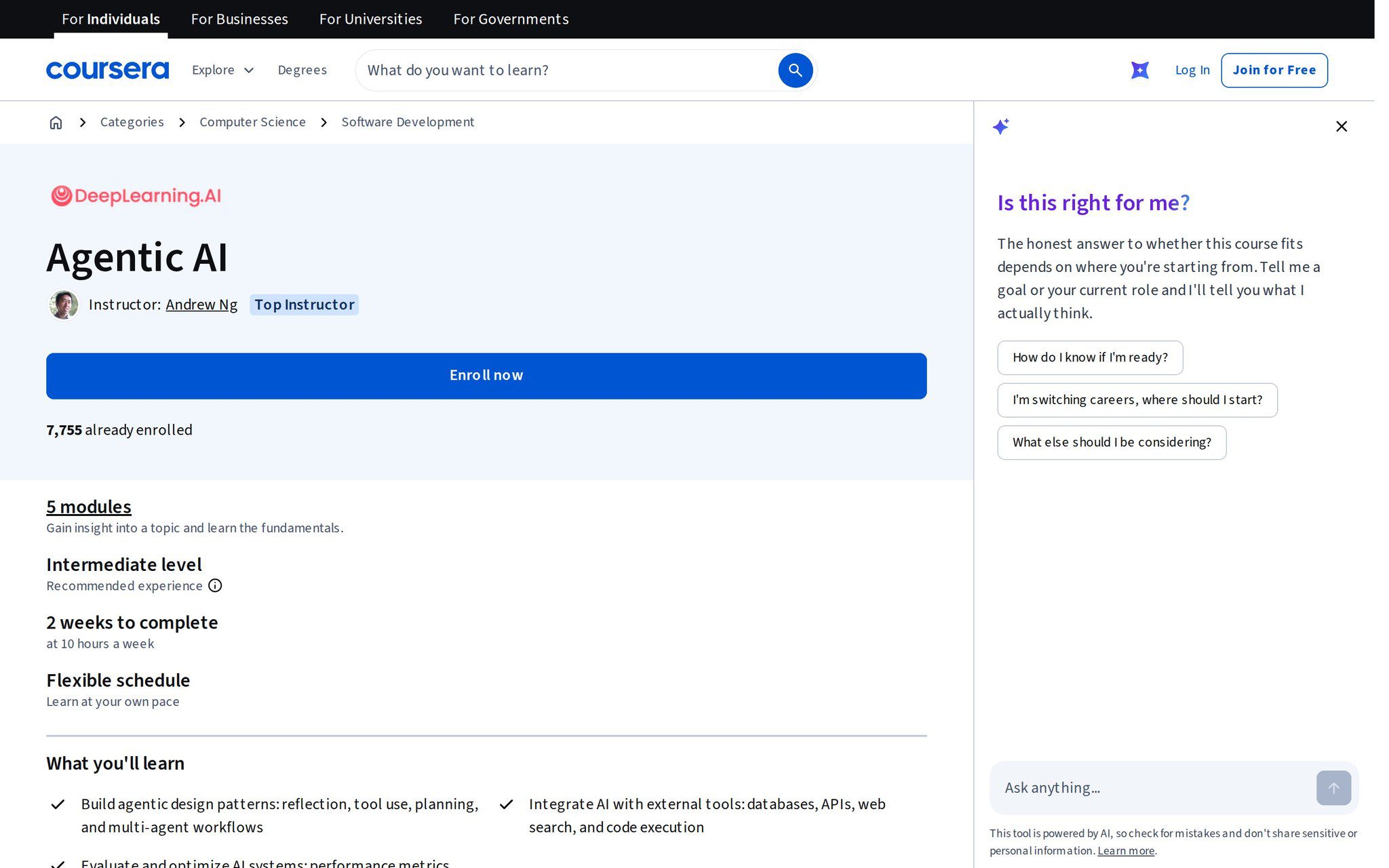
This six-course specialization takes learners from core large-language-model concepts to designing, building and operating autonomous AI agents. The practical payoff is a clearer path from an agent idea to an evaluated, deployable system rather than a strategy presentation about agents.
Why It's Trending
The specialization spans six courses and 20 modules released across September and October 2026, putting agent construction and production operation at the center of a fast-changing capability area. It earns a high ranking because implementation—not merely agent terminology—is the stated outcome.
Key Learning Areas
- LLM concepts — establish the technical foundation for agent work
- Agent design — turn autonomous-agent requirements into system designs
- Agent operations — build, evaluate and deploy AI agents
Best For
- Developers — building and operating autonomous AI agents
- AI professionals — moving from LLM concepts into production-oriented agent work
- Business leaders — understanding the delivery skills an agent initiative requires
What Makes It Different
The breadth is the differentiator: six courses and 20 modules connect fundamentals, construction, evaluation and deployment. It is more operational than an executive overview, although the official page is a Coursera specialization rather than a course explicitly branded Agentic AI Courses.
Duration & Format
Online, six-course specialization — the payload does not state a total duration or weekly-hour commitment.
Pricing
Paid — the official page does not state a price in the available course details.
Things to Consider
- Practical component: the stated outcomes include building, evaluating and deploying agents
- Course freshness: the modules span September–October 2026, making the material relatively current
- Time commitment: six courses and 20 modules imply a substantial commitment, but no weekly estimate is stated
Our Verdict
A strong fit for developers and AI professionals who need to move from LLM knowledge into agent deployment; business leaders should use it mainly to assess internal capability and hiring needs, not as a quick executive primer.
Course: https://www.coursera.org/learn/dlai-agentic-ai
3. Google ADK Training 2.0
What It Teaches
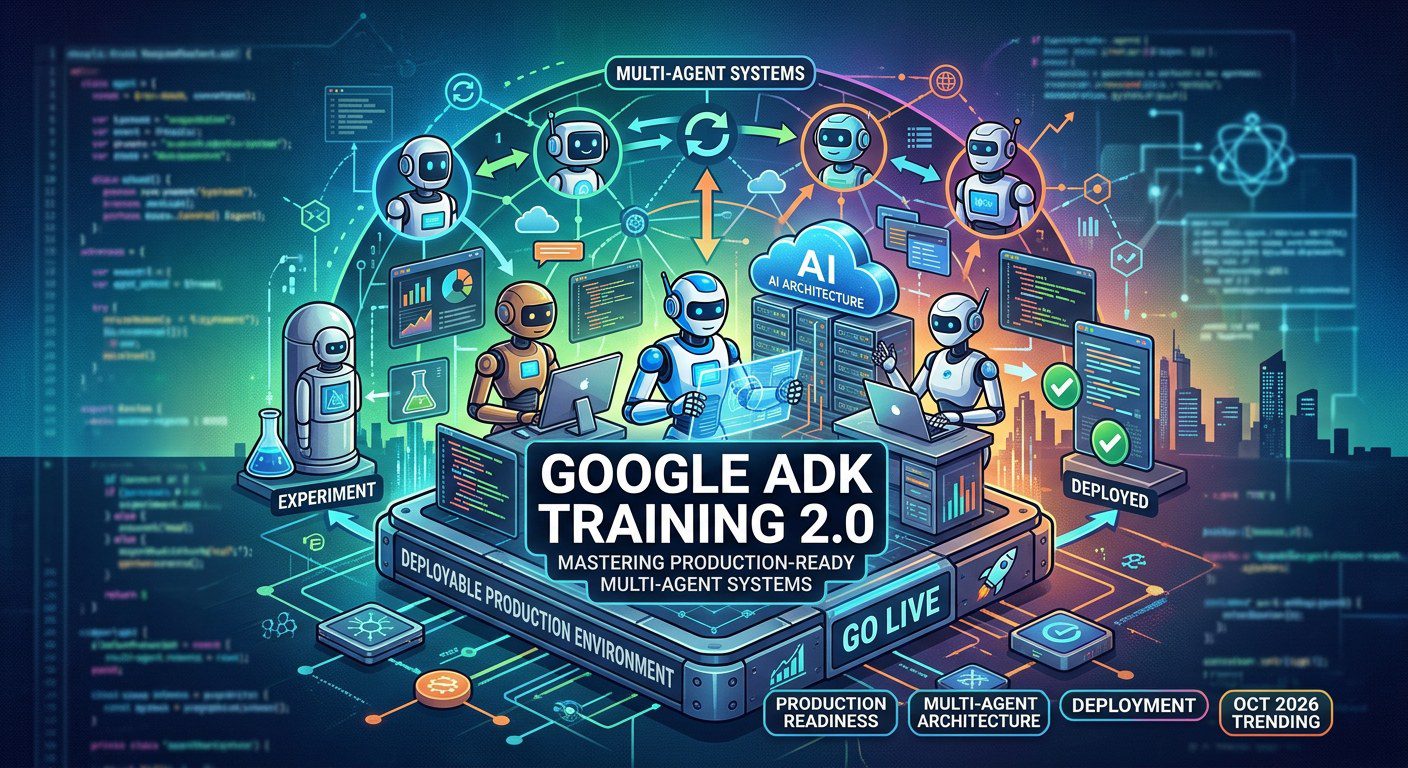
Google ADK Training 2.0 focuses on mastering production-ready multi-agent systems. For a technical team, its stated value is understanding how several AI agents fit into a deployable system rather than treating an agent as an isolated experiment.
Why It's Trending
The course’s updated 2.0 framing places multi-agent deployment in front of teams evaluating a growing class of AI applications. Its place on the October 2026 list reflects demand for training that addresses production readiness, not just the novelty of autonomous agents.
Key Learning Areas
- Multi-agent systems — understand the architecture behind coordinated agents
- Production readiness — focus on systems intended for deployment
- Deployment — examine how multi-agent applications move beyond experimentation
Best For
- Developers — evaluating multi-agent application architecture
- AI professionals — studying production-oriented agent systems
- Business leaders — testing whether a proposed multi-agent initiative is technically credible
What Makes It Different
Its specific distinction is the production focus attached to multi-agent systems. That makes it more relevant than a general introduction for teams already considering coordinated agents, but the available description does not establish the depth of its exercises or the level of implementation support.
Duration & Format
The available course description does not state the format, duration or weekly-hour commitment.
Pricing
The available course description does not state pricing or certificate terms.
Things to Consider
- Practical component: the stated emphasis is production-ready multi-agent systems, but the available description does not detail projects
- Course freshness: version 2.0 presents it as an updated training
- Certification value: certificate terms are not part of the available course description
Our Verdict
A relevant option for technical teams assessing multi-agent deployment, conditional on confirming the hands-on depth, delivery format and commercial terms before assigning it a serious training budget.
4. Stanford lecture series on LLMs and Generative AI
What It Teaches
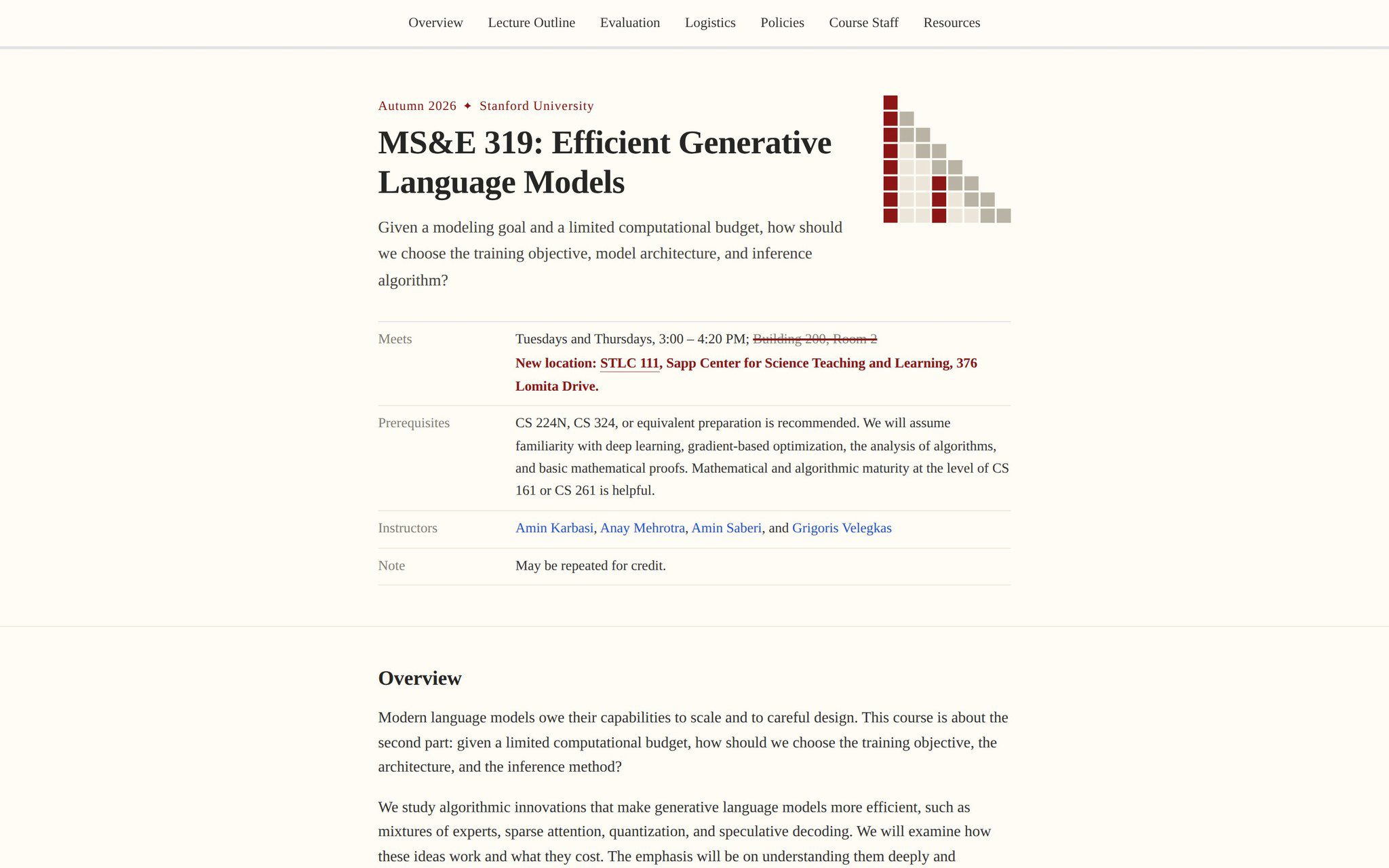
Stanford’s nine-session lecture series gives learners technical grounding in large language models and generative AI. It helps an executive evaluate vendor claims, ask better questions of engineers and understand where model capabilities may fail; it is not positioned as a route to shipping code.
Why It's Trending
The series was highlighted in late October 2026 as a comprehensive nine-session guide to LLMs. That makes it a useful slow-burn pick for leaders who need enough technical understanding to evaluate opportunities without pretending that executive education replaces an engineering team.
Key Learning Areas
- Large language models — build technical understanding of LLMs
- Generative AI — examine the technology behind current AI applications
- Model limitations — improve the questions used to evaluate claims and risk
Best For
- Business leaders — evaluating generative-AI opportunities and vendor assertions
- AI professionals — reinforcing conceptual grounding in LLMs
- Students — following a structured nine-session lecture series
What Makes It Different
The nine-session structure and Stanford academic setting offer depth that a short business primer is unlikely to provide. Its limitation is equally important: the available description supports technical grounding, not a hands-on production project.
Duration & Format
Online lecture series — nine sessions; the available course details do not state weekly hours or a total duration.
Pricing
The available course details do not state pricing or certificate terms.
Things to Consider
- Practical component: the course is described as a lecture series rather than a build-and-deploy program
- Time commitment: nine sessions establish the scale, but no weekly-hour estimate is stated
- Certification value: certificate terms are not stated
Our Verdict
A good fit for business leaders who need to challenge technical claims and hire intelligently, provided the goal is informed oversight rather than independent implementation of an LLM system.
Course: https://web.stanford.edu/class/msande319/
5. NLP with Deep Learning
What It Teaches
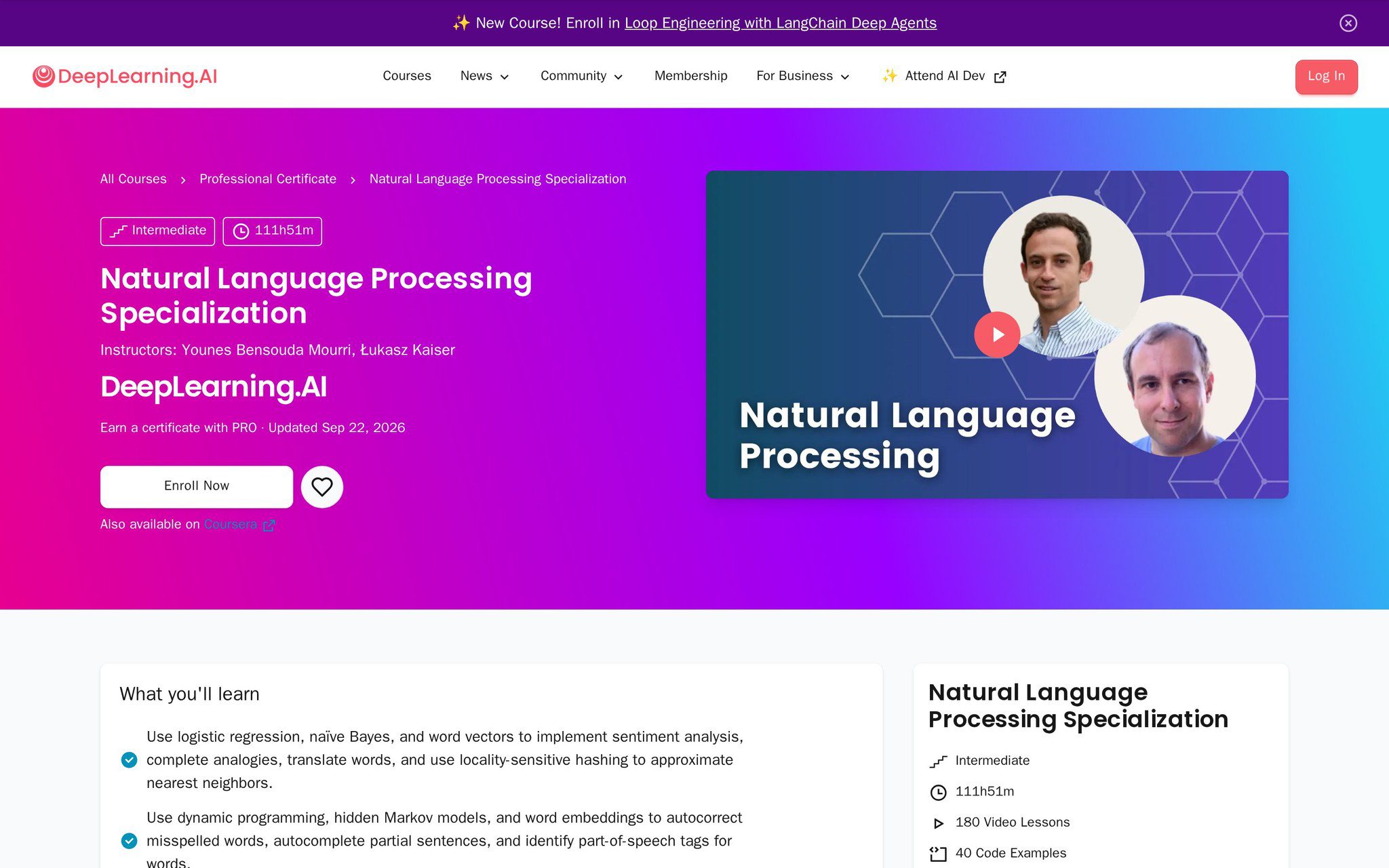
This specialization covers natural language processing with deep learning, giving learners a foundation for understanding language-processing systems used in AI products. Its business value is indirect but material: leaders can better specify, evaluate and quality-check NLP work delivered by internal teams or vendors.
Why It's Trending
It remains a slow-burn selection rather than a newly launched item, earning its place because NLP continues to sit beneath many language-driven business strategies. The October 2026 reference reinforces its continuing relevance, but does not establish a new benchmark or major update.
Key Learning Areas
- Natural language processing — understand the core language-processing problem
- Deep learning — connect neural methods to NLP systems
- NLP strategy — assess the technical basis of language-focused AI initiatives
Best For
- Business leaders — specifying and evaluating NLP capabilities
- AI professionals — strengthening language-model and NLP foundations
- Students — developing structured knowledge of NLP with deep learning
What Makes It Different
Its specialization format gives NLP a dedicated treatment rather than leaving language systems as one topic inside a general AI course. That specialization is useful for teams building or buying language features, though the available description does not establish an executive format or a production project.
Duration & Format
Online specialization — the available course details do not state the duration, weekly hours or delivery format beyond the specialization listing.
Pricing
The available course details do not state pricing or certificate terms.
Things to Consider
- Practical component: the available description supports NLP and deep-learning coverage, but does not detail a deployment project
- Course freshness: it is presented as a continuing staple rather than a newly announced course
- Certification value: certificate terms are not stated
Our Verdict
A useful foundation for leaders overseeing language-processing products, especially when they must specify quality requirements; it is less suitable for executives seeking a short, strategy-only course or immediate deployment skills.
Course: https://www.deeplearning.ai/specializations/natural-language-processing
The ranking’s dividing line is operational. Wharton helps leaders choose and frame work; the agent courses address construction and deployment; Stanford’s offerings improve technical judgment. Budget accordingly: training can sharpen decisions, but it does not remove the need for engineering ownership, evaluation and governance.