
For many organizations, the promise of AI is clear—but the path to implementing it is far less straightforward. Questions around data security, compliance, governance, and accountability often slow down projects long before the technology itself becomes the challenge.
These are the problems Todd Barr, CEO of Axonis, spends his time thinking about. With leadership experience spanning companies such as GitLab, Red Hat, Ansible, Alfresco, and Chainlink Labs, Todd has helped scale some of the technology industry’s most influential organizations. At Axonis, his focus is on helping enterprises adopt AI without losing control of their data or decision-making processes.
Axonis approaches AI differently from many vendors in the market today. Rather than requiring organizations to move data into centralized repositories, the company enables AI to work where the data already exists. The result is a model that aims to balance innovation with the realities of security, compliance, and enterprise governance.
In this conversation, Todd discusses why data movement is often the wrong starting point for AI initiatives, the growing importance of decision transparency, and what businesses should be doing now to prepare for an increasingly AI-driven future.
Artificial intelligence has moved beyond experimentation. Today, organizations are looking for ways to deploy AI across critical business functions, from customer service and financial operations to healthcare and compliance. Yet as adoption accelerates, many leaders are discovering that the biggest challenge is not the AI itself—it’s trust.
Todd Barr, CEO of Axonis, believes businesses are asking the wrong question. Instead of focusing solely on which AI model to use, organizations should be thinking about where their data lives, how decisions are made, and whether those decisions can be explained months or even years later.
With leadership experience spanning GitLab, Red Hat, Ansible, Alfresco, and Chainlink Labs, Barr has spent decades helping technology companies scale. Today, he is leading Axonis with a mission to help organizations use AI without sacrificing governance, security, or accountability.
In this interview, Barr discusses why “moving AI to the data” may be smarter than moving data to AI, why decision transparency is becoming a business necessity, and what leaders should do to prepare for the next phase of enterprise AI.
Q: What is the biggest misconception organizations have about implementing AI?
Todd Barr: Many companies assume they must centralize all of their data before they can effectively use AI. In reality, that approach can create new security, compliance, and operational challenges.
At Axonis, we take a different view. Instead of moving data into a single location, we bring AI to where the data already resides. This allows organizations to work with sensitive information while maintaining control over it.
For many enterprises, especially those operating in regulated industries, that can dramatically reduce complexity and risk.
Q: What makes Axonis different from other AI platforms?
Todd Barr: Two things.
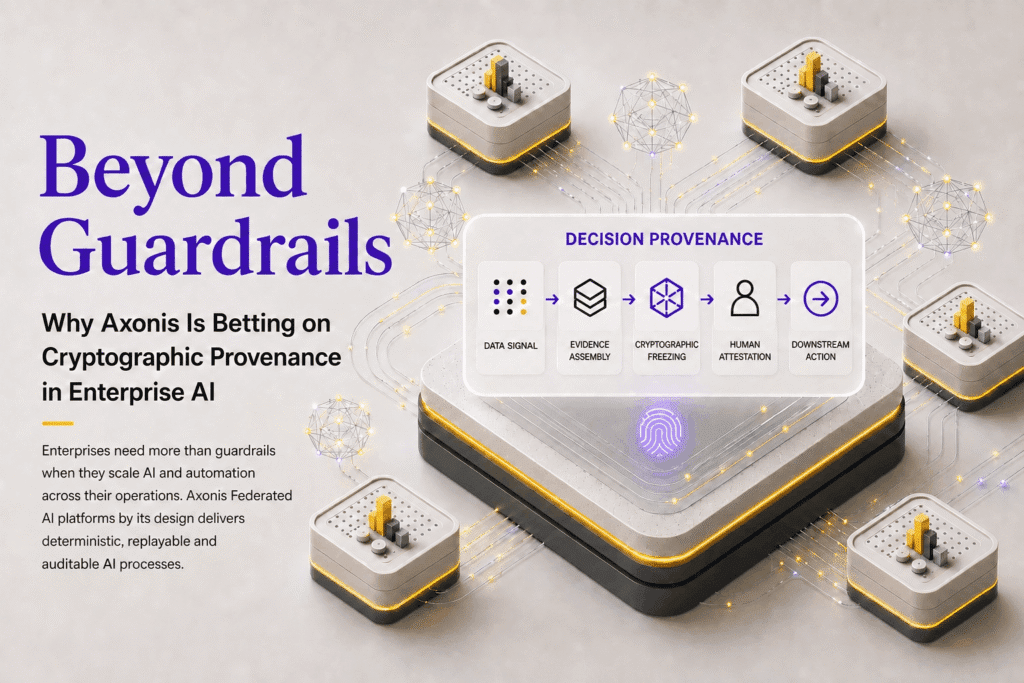
First, our federated architecture allows data to remain in its existing systems while AI operates across it. Second, every AI-assisted decision creates a verifiable record showing how that decision was reached.
Most AI platforms provide an answer. We focus on helping organizations understand and prove why that answer was generated.
Q: You often talk about “decision provenance.” What does that mean in simple terms?
Todd Barr: Think of it as a digital paper trail.
If an AI system recommends approving a loan, flagging a transaction, or prioritizing a customer issue, organizations need to know what information was used, who reviewed it, and why the final decision was made.
Today, reconstructing that history can take weeks. We believe every important AI-assisted decision should come with a clear record that can be reviewed later by managers, auditors, regulators, or customers if necessary.
As AI becomes involved in more business-critical processes, that level of transparency becomes increasingly important.
Q: Many organizations focus heavily on selecting the right AI model. Are they focusing on the wrong problem?
Todd Barr: Not entirely, but often the bigger challenges lie elsewhere.
The real questions are: Where can sensitive data legally reside? Who is accountable for AI-driven decisions? Can those decisions be explained and defended if challenged later?
Those governance questions often become bigger obstacles than the technology itself.
Q: Why are regulators paying increasing attention to AI governance?
Todd Barr: As AI begins influencing decisions in areas such as finance, healthcare, insurance, and public services, regulators want to ensure organizations can explain how those decisions were made.
Businesses should expect greater emphasis on transparency, accountability, and record-keeping. In many cases, organizations will need to demonstrate not only why an AI system approved something, but also why it rejected or declined something.
That requires much stronger decision tracking than most companies have today.
Q: What skills and leadership qualities are essential for building an AI-driven organization?
Todd Barr: Curiosity is critical.
Leaders need to encourage experimentation and learning because AI is evolving rapidly. At the same time, it’s important not to get distracted by hype.
The companies that succeed will be the ones that stay focused on solving customer problems while thoughtfully integrating AI into their operations.
Technology changes quickly. Strong customer relationships remain one of the most durable competitive advantages any organization can have.
Q: What technology trend are you most excited about right now?
Todd Barr: Open-source AI.
We’re seeing open models become more capable while requiring less computing power. That creates opportunities for organizations to run sophisticated AI systems on more affordable hardware rather than relying entirely on large cloud providers.
Over time, I believe more businesses will want greater ownership and control over their AI capabilities, and these advances will help make that possible.
Q: Looking ahead, what should business leaders be doing right now?
Todd Barr: Build governance alongside innovation.
Many organizations are moving quickly to deploy AI, but governance often comes later. I think the most successful companies will be the ones that treat trust, transparency, and accountability as foundational requirements rather than afterthoughts.
The future of AI won’t simply be determined by who has the most powerful models. It will be shaped by who can use those models responsibly and confidently at scale.
Final Thoughts
The conversation around AI often focuses on model performance and technological breakthroughs. Todd Barr believes the next major challenge is different: trust.
As organizations integrate AI deeper into their operations, questions around governance, accountability, and transparency will become increasingly important. Through its federated architecture and emphasis on auditable decision-making, Axonis is positioning itself at the intersection of innovation and trust—helping organizations adopt AI without losing control of their data or decision processes.
For businesses navigating the rapidly evolving AI landscape, that balance may prove just as important as the technology itself.