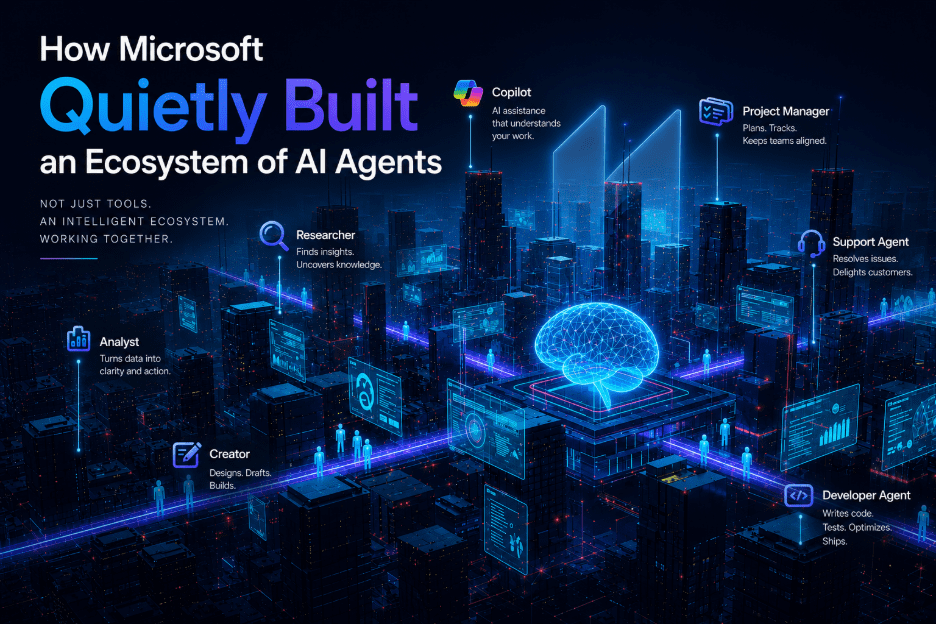
While the industry debated AI hype, Microsoft wove autonomous agents into the bones of enterprise technologies. To bridge the gap between AI capabilities and organizational context, Microsoft has built a unified intelligence ecosystem, and the only feasibility it has is to get better.
Microsoft has spent the last three years engineering something more consequential: software that does the work with you in the background, with your command, with higher intelligence and deeper surveillance.
The technology giant moved beyond simple conversational interfaces to create an interconnected web of autonomous AI agents. These digital workers do not just answer questions. They execute multi-step tasks, make contextual decisions, trigger actions across connected systems, and collaborate with other agents to resolve challenges that would have previously required an entire team. This strategic evolution represents a fundamental shift from passive AI tools to active, results-driven systems. At its most visible, the change looks like a customer service agent that resolves a billing dispute end-to-end without human escalation, or a supply chain agent that detects a transit disruption, re-routes an order, and updates the ERP record before a logistics manager has seen the alert. At its most structural, it is an enterprise architecture where agents are primary add-ons to existing Microsoft intelligence and advancements in their products and services to transform workflows from rigid, manual sequences into highly integrated ecosystems powered by automation running across Azure, Dataverse, and Microsoft Fabric.
The Infrastructure Powering Intelligent Automation
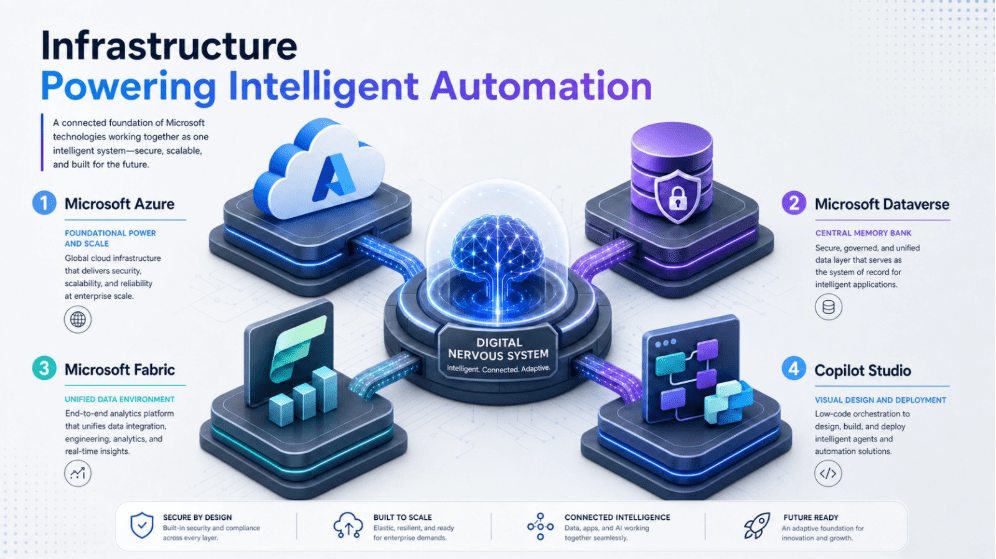
Ask most people about Microsoft’s AI strategy, and they will mention Copilot translating complex human goals into coordinated agent workflows. Copilot is the interface, the part users see and touch. Underneath it lies a layered infrastructure that Microsoft has been assembling since 2023, building with the methodical patience of a company that has learned through decades of enterprise platform wars. Azure AI serves as the beating heart of this ecosystem, providing the computational muscle that enables agents to think, learn, and act. Microsoft recognized that isolated artificial intelligence models lack the contextual awareness necessary for meaningful enterprise impact.
Azure AI provides the raw cognitive processing power; Microsoft Fabric and Dataverse serve as the vital data bedrock that grounds the intelligence of Copilot. Microsoft Fabric continuously aggregates structured and unstructured information from every disparate corner of an enterprise into a single repository, completely dismantling traditional corporate data silos. Dataverse then organizes this wealth of information, mapping out the secure, relational cross-sections between customers, products, and compliance rules. By feeding this clean, continuously updated data stream through Copilot, Microsoft ensures that its autonomous agents operate with flawless contextual awareness, virtually eliminating the risks of computational hallucinations and outdated reporting.
The Compound Effect
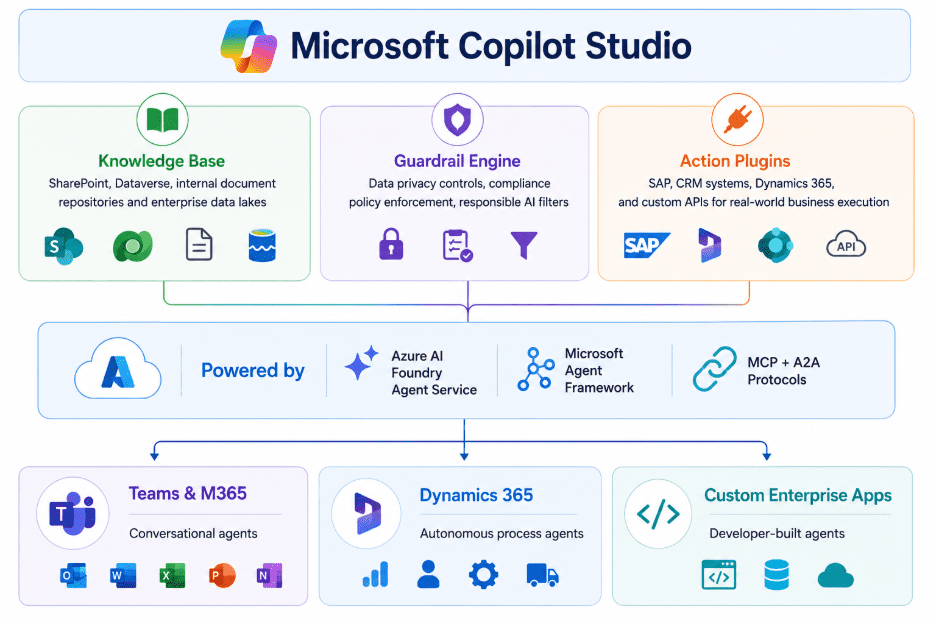
An agent built in Copilot Studio can query Fabric analytics to detect an anomaly, retrieve context from Dataverse, execute a remediation action via Azure AI Foundry, and log the outcome back to Dataverse, completing a full business-process loop without human intervention.
Open Interoperability
Model Context Protocol (MCP) and Agent-to-Agent (A2A) standards allow agents from outside the Microsoft ecosystem to participate in these workflows, preserving enterprise optionality while deepening the value of the Microsoft core stack.
How Microsoft Routes Workloads Across Its AI Agent Ecosystem
Flex Routing: Managing Global AI Capacity
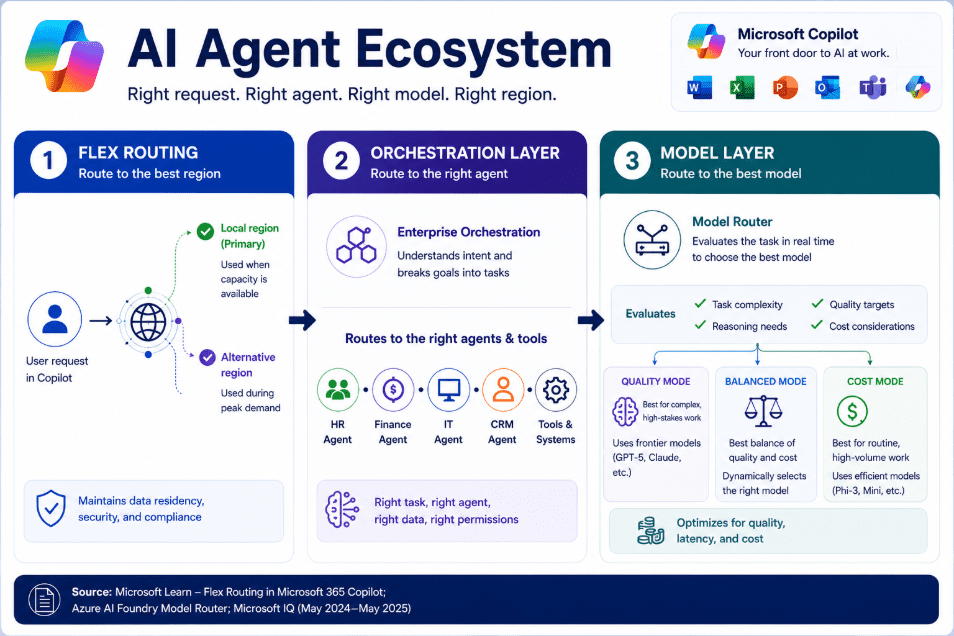
When a Copilot request is submitted, Microsoft can dynamically manage where AI inferencing occurs. Through its Flex Routing capability, eligible workloads may be processed in alternative approved regions during periods of peak demand, helping maintain responsiveness while continuing to enforce encryption, security controls, and regional compliance requirements. Microsoft describes this as a mechanism for balancing AI capacity without changing where customer data is stored.
The Orchestration Layer: Coordinating Specialized Agents
Once a request enters Microsoft’s AI stack, orchestration services determine how the task should be executed. Rather than treating every prompt as a single interaction, Microsoft’s agent framework can break larger business objectives into smaller actions and route them to the appropriate tools, workflows, or domain-specialized agents. Recent initiatives such as Microsoft IQ and Work IQ aim to provide the business context, organizational knowledge, and workplace intelligence needed for agents to operate across functions and systems.
The Model Layer: Azure AI Foundry Model Router
At the model level, Microsoft increasingly relies on Azure AI Foundry’s Model Router. Instead of sending every request to the most powerful model available, the router evaluates factors such as task complexity, reasoning requirements, and quality targets before selecting the most suitable model in real time.
Organizations can choose between three routing modes:
Quality Mode prioritizes maximum accuracy for complex reasoning, analytical work, or high-stakes enterprise tasks.
Balanced Mode dynamically optimizes both quality and cost.
Cost Mode favors lower-cost models when they can achieve acceptable results, helping reduce compute expenses for high-volume workloads.
The result is an architecture that combines orchestration and model routing, allowing Microsoft to scale large fleets of AI agents while balancing performance, cost, and responsiveness across the enterprise.
Microsoft states that Flex Routing operates within established security, privacy, and compliance controls. Organizations with strict data residency or regulatory requirements should review routing configurations to ensure alignment with internal governance policies.
Together, these three layers—model routing, agent orchestration, and infrastructure routing form the foundation of Microsoft’s emerging AI agent ecosystem.
Enterprise AI Agent Use Cases by Department
| Department | Primary Agent Function | Key Integrated Systems | Business Impact |
| Supply Chain | Automated tracking and order re-routing based on predefined disruption signals | ERP, Shipping APIs, Azure AI Foundry | Reduces transit delays and inventory stockouts without human dispatcher intervention |
| Customer Support | Tier-two troubleshooting and end-to-end case resolution | CRM, Internal Knowledge Base, Teams | Lowers resolution times significantly; one European financial services firm handles 60% of interactions via agent |
| Human Resources | End-to-end employee onboarding, from provisioning to policy acknowledgement | Workday, Azure Active Directory, SharePoint | Cuts administrative onboarding overhead while ensuring consistent, auditable new-hire experiences |
| Finance | Continuous expense audit and real-time anomaly detection | SAP, Bank Feeds, Internal Policy Engine | Minimizes fraudulent transactions and policy violations before they escalate to material losses |
Microsoft Agent Framework: The Convergence of Semantic Kernel and AutoGen
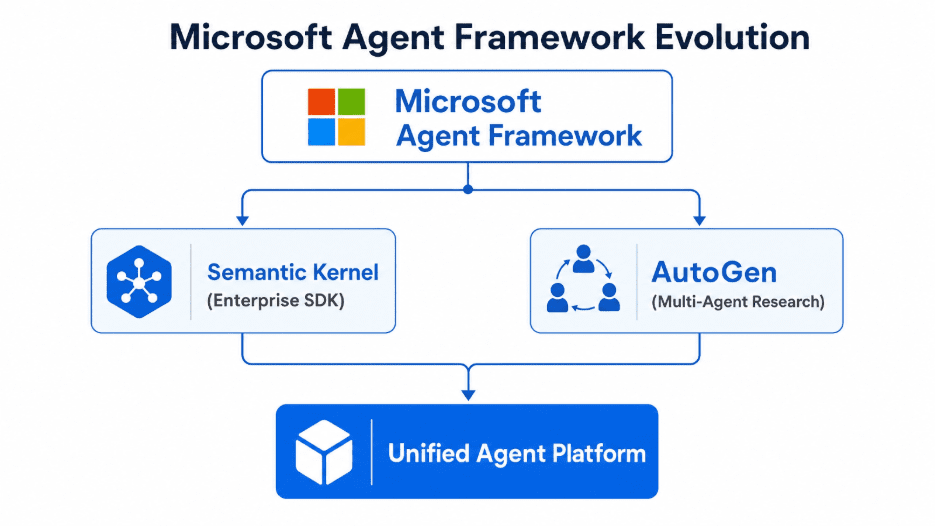
Semantic Kernel, Microsoft’s enterprise-focused SDK for connecting AI models to business systems, workflows, plugins, and organizational data. On the other hand, AutoGen is a Microsoft Research project that helped popularize multi-agent collaboration patterns such as agent debates, group chats, facilitator-worker systems, and autonomous task delegation. For several years, developers choosing Microsoft’s agent stack typically found themselves working with one of two frameworks.
Semantic Kernel provides connectors to business applications, memory systems, plugins, telemetry, governance controls, and workflow management. It became a core building block behind many Microsoft AI services and Copilot experiences. AutoGen is built within Microsoft Research. It focuses on multiple AI agents’ collaborations. AutoGen introduced orchestration patterns that later became widely adopted across the broader agent ecosystem, including group chats, handoffs, facilitator-worker models, and dynamic agent collaboration. Microsoft Agent Framework merges these complementary strengths into a single architecture.
Microsoft Agent Framework brings these two intelligences together into a single open-source platform designed to support both experimentation and enterprise deployment. The Microsoft Agent Framework was publicly announced in October 2025, and its production release was in April 2026. Microsoft described it precisely: “the natural evolution that unites innovation and stability.” Microsoft: the framework combines the orchestration of innovations of AutoGen with the enterprise foundations of Semantic Kernel, creating a unified engine for building agentic applications.
Four Core Capabilities Of Microsoft Agentic Ecosystem
Open Standards
Microsoft designed the Agent Framework around interoperability rather than proprietary lock-in.
The framework supports:
- MCP (Model Context Protocol)
- A2A (Agent-to-Agent communication)
- OpenAPI integrations
These standards allow agents to connect with external tools, services, APIs, and even agents running in different environments.
Multi-Agent Orchestration
Microsoft Agent Framework incorporates network of specialized agents orchestration capabilities directly into the platform, with supported patterns that include sequential workflows, parallel execution, group-chat collaboration, agent handoffs, and magnetic orchestration, where a manager agent dynamically coordinates specialized agents and human participants when required.
Enterprise Memory
Agent Framework extends Semantic Kernel’s memory capabilities by supporting persistent memory across multiple storage systems. Developers can connect agents to enterprise data stores, vector databases, search indexes, and long-term memory repositories while maintaining a common abstraction layer. This enables agents to retain context across sessions and workflows rather than operating as isolated conversations.
Production Readiness
Perhaps the biggest difference between research frameworks and enterprise deployments is operational maturity. For enterprises, practical significance is substantial. The Agent Framework supports both Python and .NET, delivers functional agents in under 20 lines of code, integrates natively with Azure AI Foundry for cloud deployment, and brings built-in observability through OpenTelemetry, security through Microsoft Entra ID, and CI/CD compatibility via GitHub Actions and Azure DevOps. It is the production substrate on which the rest of the agentic ecosystem, from cloud infrastructure to the desktop, is now being built.
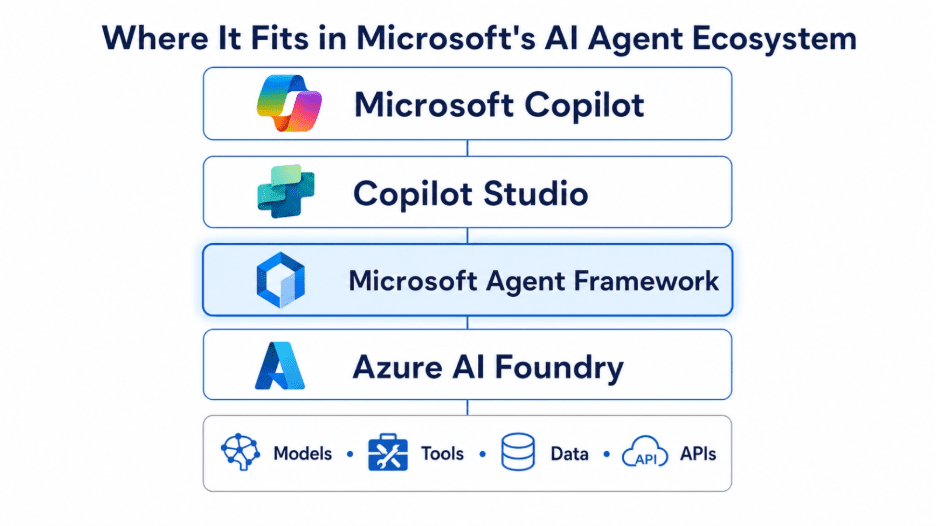
Within Microsoft’s broader AI stack, Agent Framework serves as the orchestration layer beneath Copilot and Copilot Studio. Azure AI Foundry provides model access, deployment infrastructure, governance, and routing capabilities, while Agent Framework coordinates agents, workflows, memory, and tool interactions.
Enterprise AI Competitive Landscape, Mid-2026
Microsoft’s agentic ecosystem does not exist in isolation. Amazon Web Services, Google Cloud, and Salesforce each have developed agent platforms, and the competitive dynamics deserve honest assessment. The table below maps capabilities across the four principal enterprise platforms as of mid-2026.
| Capability | Microsoft | Google Cloud | AWS Bedrock |
| Unified agent framework | Microsoft Agent Framework (GA) | Vertex AI Agents (beta features) | Bedrock Agents (maturing) |
| Low-code agent authoring | Copilot Studio (SaaS, enterprise-grade) | Dialogflow CX, Agent Builder | No-code tooling remains limited |
| Embedded in productivity suite | M365, Teams, GitHub, Dynamics | Google Workspace integration is limited | Not applicable |
| Open interoperability (MCP/A2A) | Native MCP + A2A support | MCP support announced | MCP support in progress |
| Enterprise governance & audit | Lifecycle management, cost controls, admin analytics | Policy controls are developing | CloudWatch integration and governance tooling |
| Unified data substrate | Dataverse + Fabric + Azure | BigQuery + AlloyDB | S3 + Aurora |
Microsoft has depth of integration across all columns. A competitor might match Microsoft’s low-code authoring tool, or its governance controls. It is far harder to replicate an ecosystem where the authoring tool, the governance layer, the data substrate, and the productivity applications with Microsoft sophistication. The ecosystem is built to embed uniformly across Microsoft products that are designed to interoperate and already deployed in many large enterprises with a high level of dependency and trust.
Project Ada and Microsoft Build 2026
Microsoft Build 2026, which opened June 2 in San Francisco with CEO Satya Nadella taking the stage at Fort Mason Center, brought the company’s agentic ambitions into their sharpest public focus yet. Conference registration jumped 40% over Build 2025, a number that reflects the shift from AI curiosity to AI urgency across the enterprise developer community.
The headline announcement was Project Ada, a framework for building, testing, and deploying AI agents directly within Azure AI Studio. Early details suggest Project Ada ships with pre-built agent templates for contract negotiation, supply-chain optimization, and customer support escalation. These are not conversational interfaces dressed up as agents. They call APIs, update databases, and trigger approval workflows in Teams and Dynamics 365 with the kind of systemic reach that changes how entire business processes are structured.
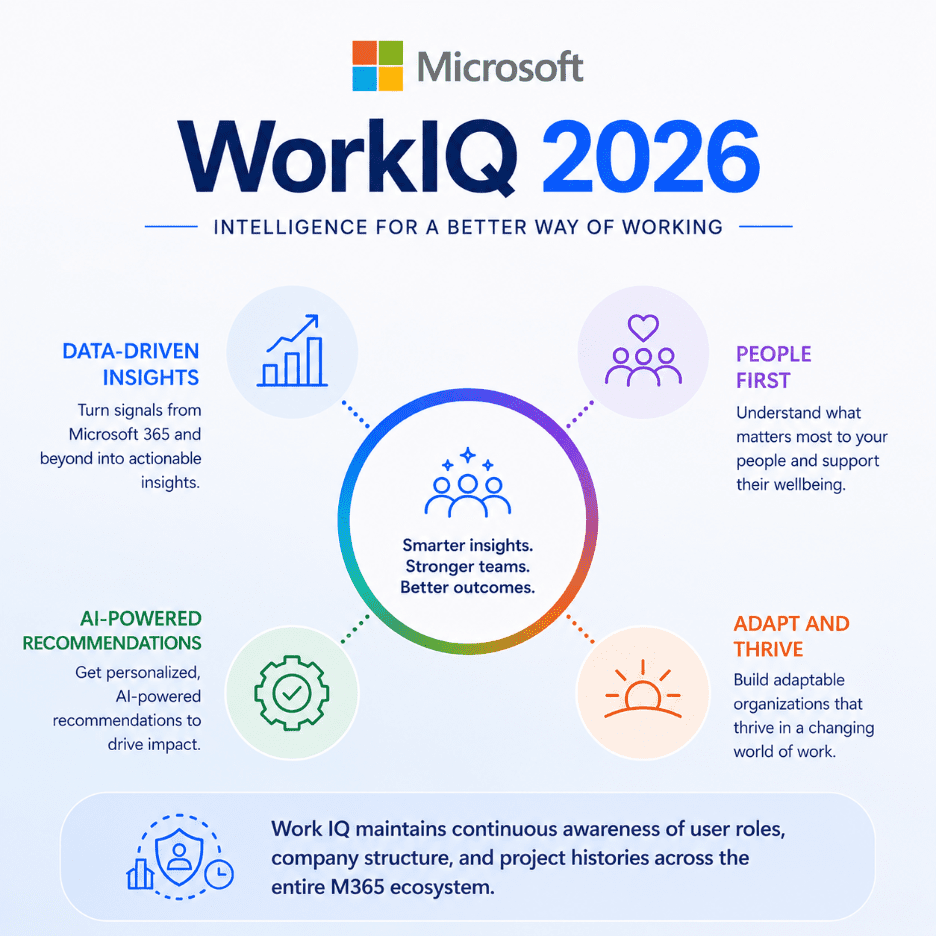
The conference also continued Microsoft’s push on Work IQ, the long-term memory layer embedded in Microsoft 365 Copilot. Work IQ maintains continuous awareness of user roles, company structure, and project histories across the entire M365 ecosystem. Rather than treating each document, email, or meeting as an isolated event, it accumulates contextual understanding that informs every subsequent agent of interaction. A Copilot agent assisting a finance director does not need to be told, each session, who the relevant stakeholders are. It already knows. That accumulated context is the difference between a tool that answers questions and a system that anticipates needs.
Microsoft’s 2026 AI Strategy: Implications On Business and Engineering Teams
Microsoft’s 2026 AI ecosystem signals the emergence of an enterprise-scale AI system. The ecosystem pivots priority from application-centric computing to context-centric computing, where AI agents operate on a continuously updated graph of organizational knowledge spanning documents, communications, meetings, projects, permissions, and business processes.
At the core is a unified context layer built from Microsoft 365, Teams, SharePoint, Outlook, GitHub, Dynamics 365, and Azure data sources. Instead of requiring users to manually aggregate information across disconnected applications, systems such as Work IQ and Copilot maintain persistent awareness of organizational structures, project histories, expertise networks, and workflow states. This allows AI agents to reason over enterprise context rather than isolated prompts.
Resource allocation, knowledge discovery, workforce planning, project risk assessment, and process optimization can increasingly be driven by real-time organizational telemetry rather than retrospective analysis. For developers, enterprise software development is moving beyond CRUD applications and workflow automation toward agentic systems that can retrieve context, invoke tools, coordinate across services, and execute multi-step tasks autonomously. Azure AI Foundry, Copilot Studio, Microsoft Graph, Semantic Indexes, and enterprise vector stores provide the foundational infrastructure for building these systems.
These autonomous digital workers are no longer theoretical concepts waiting for the industry to resolve debates about their technical viability. They are actively executing complex automated workflows across global supply chains, resolving intricate customer service escalations, automating human resources onboarding protocols, and securing financial audit trails. The organizations that proactively engage with this technical reality today will establish operational baselines for the next decade. By building the necessary governance structures and cultivating the specialized skills required to collaborate with autonomous systems, these visionary enterprises are defining digital global productivity and technological innovation.