

The $15 billion revolution is no longer theoretical. From banking giants to fast-fashion unicorns, AI agents are handling millions of customer interactions daily with results that are reshaping our future of work and customer interactions.
In 2026, AI has pivoted fundamentals of companies managing their customer support and it happened faster than most industry analysts predicted. AI agents are not experimental pilots sitting on the periphery of operations but acting as business frontline workers. They answer the phone, resolve disputes, process refunds and closing service tickets without customer service representatives interacting with customers.
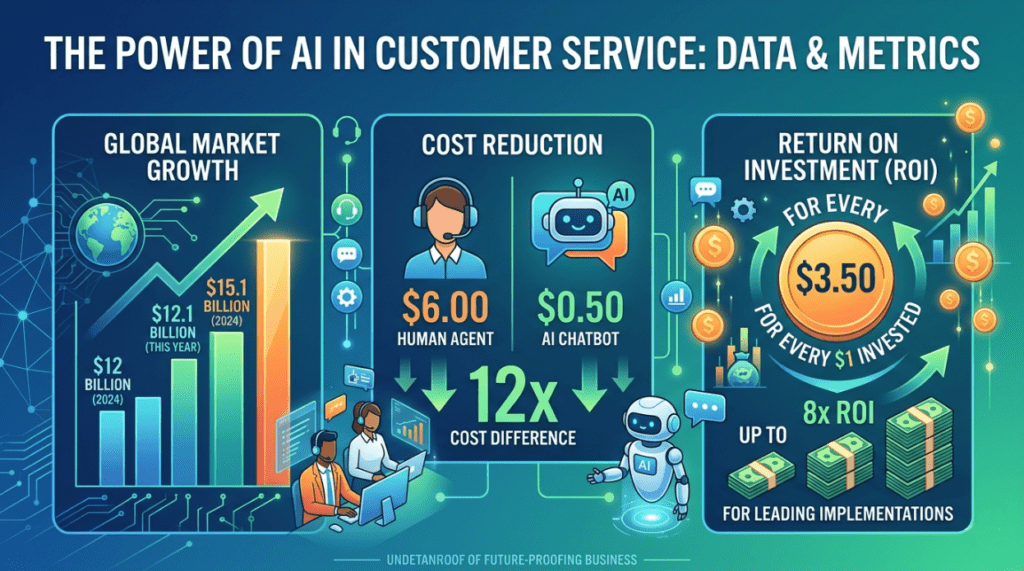
Behind every striking AI headline figure lies a more complex story that involves genuine breakthroughs, honest limitations and organizations wrestling with changes impact of putting a machine on the front lines of customer relationships. This report examines the companies getting it right, those learning hard lessons, and what the real-world data tells us about where this technology stands today.
The Numbers That Changed the Conversation
For years, AI in customer service was associated with frustrating chatbots that could not understand plain questions and kept looping customers back to FAQ pages. That era is functionally over with help of combination of large language models, improved intent recognition and years of training data has turned AI systems capable of handling genuinely complex support requests at scale. In real production environments, AI is consistently resolving between 55% and 70% of incoming support volume without human involvement. This is a significant gap from the 90% in demos automation figures that some software vendor companies advertise but it represents a genuine and commercially transformative capability.
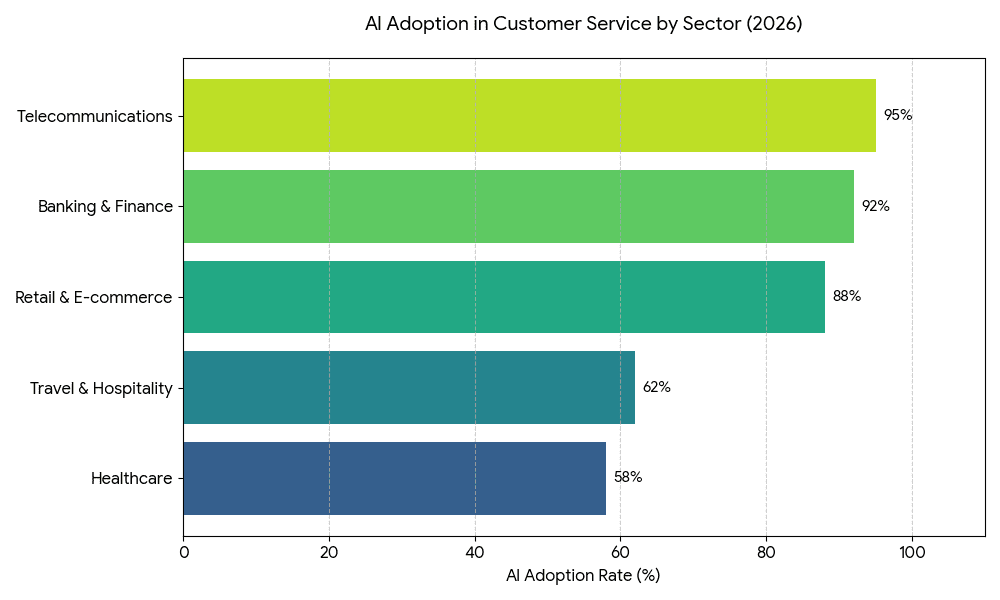
The speed gains are equally dramatic. Across industries, AI has reduced first response times from an average of over six hours to under four minutes. Resolution times have fallen from 32 hours to 32 minutes that is an 87% improvement which changes customer expectations about how quickly problems can be solved and business they trust are connected with them.
Case Study 1: Bank of America’s ‘Erica’ an AI Virtual Financial Assistant
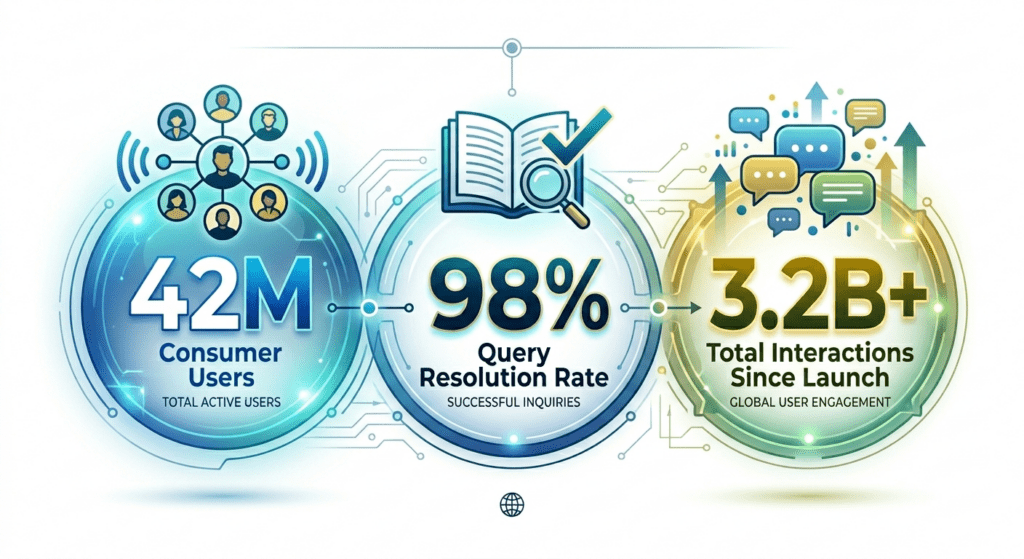
No case study in AI customer service is more extensively documented than Bank of America’s virtual financial assistant, Erica. Launched in 2018 and continuously refined over seven years, Erica has become one of the most convincing arguments that AI can serve as a primary service channel. Erica provides proactive insights, helps customers manage their accounts and seamlessly connects bank customers to financial advisors.
Bank of America’s Erica has been used by 42 million consumers and 95% of the bank’s 213,000 employees. Two million consumer interactions occur with Erica every single day. This volume is stated by the bank during January 2026 investor day – Erica’s workload is tracked equivalent to the daily work output of 11,000 staff members. The system resolves 98% of customer inquiries without requiring further human involvement and queries are answered within 44 seconds on average. More strikingly, 60% of Erica interactions are now proactive where Erica initiates conversation with customers outreach rather than waiting to be contacted. On the enterprise side, Erica was integrated into Bank of America’s CashPro business banking platform in 2023, reducing live chat volume by 42%. The internal employee version, Erica for Employees handles IT and HR queries with results showing 55% drop in calls to the internal help desk.
What makes the Erica case instructive is not just the scale Banks approach to AI capabilities. The system has undergone many updates since launch and is continuously trained on new data. For instance, when Erica encounters an emotionally sensitive query of a customer in financial distress the system is designed to recognize the context and transfer the conversation over to a human agent with the full transcript of conversation leading human to pick up without the customer repeating themselves.
“Erica understands that’s an emotionally important conversation. The best course of action is to create a connection right back to a human agent.”
— Jorge Camargo, Head of Digital Platforms, Bank of America
In 2026, Bank of America will invest $13 billion in technology across every line of business. The AI and machine learning patent portfolio has more than doubled since 2022. More than 270 AI and machine learning models are currently in production mode across the bank’s operations.
Case Study 2: Klarna’s OpenAI Automated AI Customer Service Agent
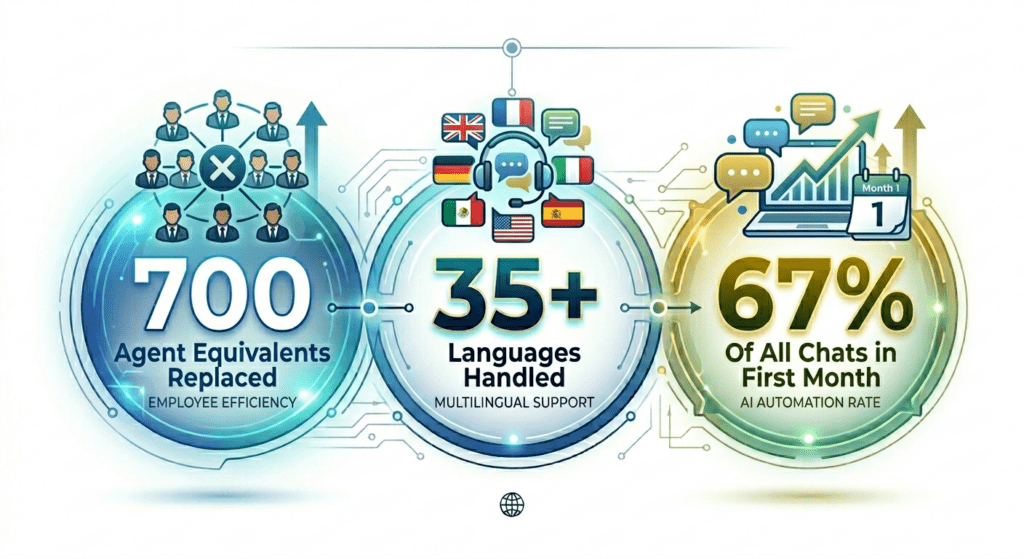
No company became more synonymous with aggressive AI adoption in customer service than Klarna. The Swedish buy-now-pay-later fintech made global headlines in early 2024 when it announced that its OpenAI-powered AI assistant was doing the work of 700 customer service representatives by handling two-thirds of all customer service chats in its first month of operation. The system showed measurable improvements in key metrics: customer satisfaction scores improved, significant average resolution time fell and the system managed to handle issues in over 35 languages effectively removing language barriers that had previously required specialist staffing.
However, Klarna story grew more nuanced by the years of 2025-2026. CEO Sebastian Siemiatkowski publicly acknowledged that their workforce reduction had created quality issues in complex dispute resolution and the company indicated it would invest in rebuilding human expertise in targeted areas while maintaining AI as the primary first-contact layer. Klarna also stated 90% of Klarna’s employees are using generative AI tools powered by OpenAI daily.
The Klarna arc — rapid automation followed by partial course correction — mirrors a pattern Gartner predicted would emerge across the industry. Gartner’s research indicates that by 2027, 50% of organizations that expected to significantly reduce their customer service workforce will abandon those plans, as the complexity of real-world support becomes apparent and customer satisfaction metrics signal the limits of full automation.
Case Study 3: NIB Health Insurance’s AI Digital Assistants
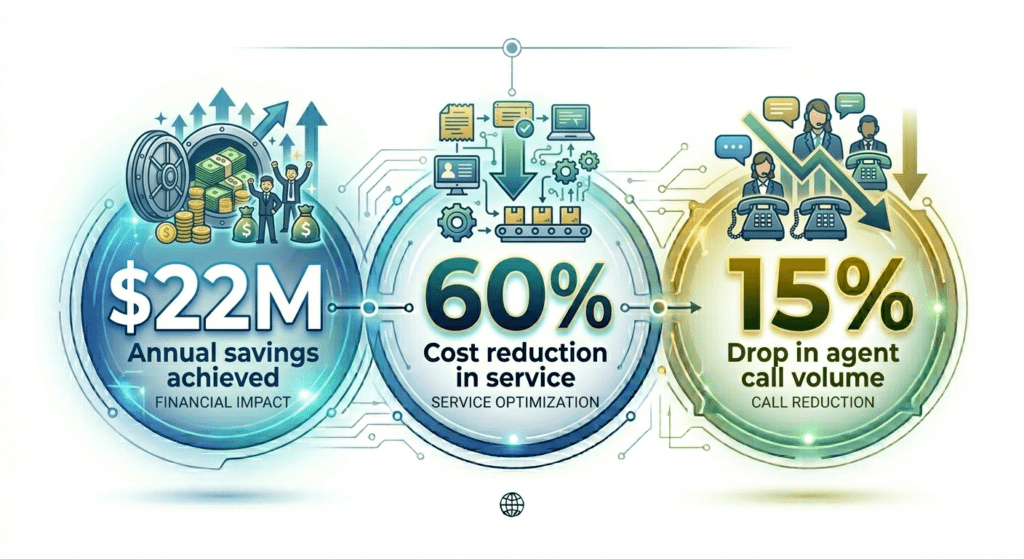
Australian health insurer NIB Health Insurance deployed AI-driven digital assistants across its customer service operations is cost transformation for the insurance company with impressive results that became one of the most-cited figures in the industry. The implementation produced $22 million in savings through AI-driven automation, reducing customer service costs by 60% and decreasing the volume of calls routed to human agents by 15%.
The NIB case is notable because health insurance generates some of the most complex, emotionally charged customer interactions in any industry as customer service has conversation with members on dispute claim decisions, seeking clarity on policy coverage and navigating the anxiety of medical situations. The company’s success demonstrates that AI can even handle sensitive human queries when the system is designed according to client needs and business knowledge base is rigorously maintained. NIB has launched AI assistant for clients to check their health symptoms and connect members with right care pathways or book GP telehealth appointment. These virtual AI-powered services enhanced AI customer service competence beyond a tier-1 deflection layer.
Case Study 4: Virgin Money’s Redi a 24/7 virtual assistant
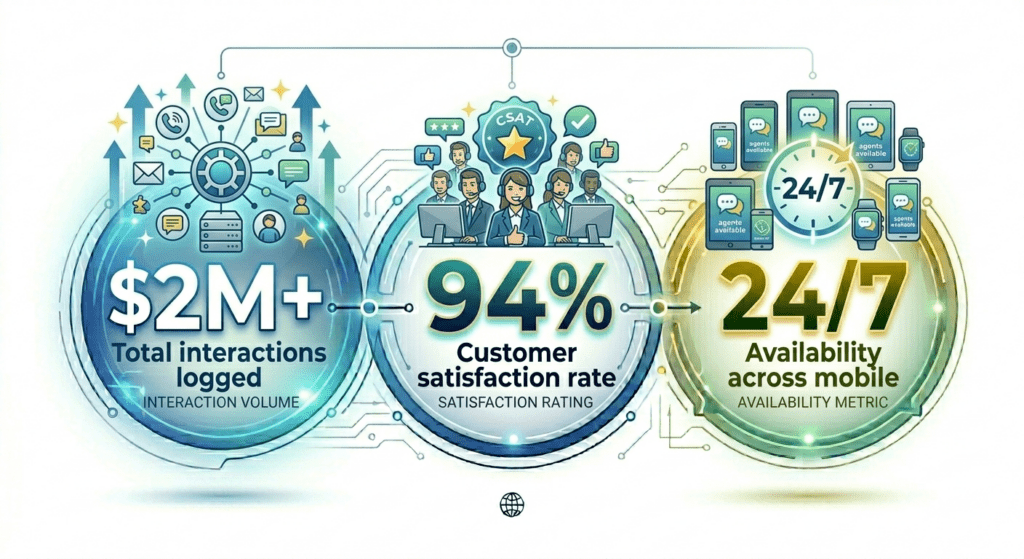
Redi is developed in collaboration with IBM Consulting AI experts using Microsoft Co-pilot studio. Virgin Money’s AI-powered conversational assistant having Natural Language Understanding (NLU) capabilities and accessible to clients through the bank’s mobile app. 24/7 agent availability enables immediate assistance with client’s bank account asks. Redi is built to support users while educating them on steps to complete their personal banking requests, such as ordering a replacement card, setting up a direct debit and other 68 common credit card customer queries. Since its launch in March 2023, Redi has supported more than one million customer interactions and achieved a 94% customer satisfaction rate among surveyed users. Virgin’s money vision to make itself UK’s best digital bank with their innovation in conversation banking with its interactive AI deployment.
The Virgin Money case is significant because it demonstrates that high customer satisfaction is achievable with AI not just cost efficiency. For years, skeptics of AI customer service argued that even if automation cut costs, customers would feel shortchanged by the experience and Redi’s satisfaction data challenges that assumption directly.
What’s Actually Working in 2026
Across these case studies and broader industry data, three specific applications are delivering measurable, repeatable results that justify investment:
- Tier-1 FAQ deflection is the foundation of every successful implementation. AI reliably resolves between 55% and 70% of support volume for questions with documented answers: order status, return policies, account information, billing queries, product availability, and shipping timelines. Zendesk’s 2025 CX Trends report found an average 18% improvement in CSAT within 90 days of deploying effective tier-1 deflection — suggesting that customers actually prefer fast, accurate AI responses to waiting for human agents on routine queries.
- Multi-channel ticket routing is delivering consistent 35–45% reductions in escalation handling time. When AI routes and pre-classifies tickets correctly, human agents receive conversations with context attached — customer history, classification, sentiment assessment, and suggested resolution paths — allowing them to resolve issues faster and with less friction.
- Proactive service and personalized insights represent the frontier of value creation. Bank of America’s finding that 60% of Erica interactions are now proactive — where the AI initiates the conversation — points toward a model where customer service becomes predictive rather than reactive.
The Workforce Reality
The question that hangs over this entire transformation is what it means for human workers. The data here is more nuanced than the “AI is eliminating jobs” narrative that dominates media coverage.
According to a Gartner survey of 321 customer service leaders conducted in late 2025, 20% of organizations reported reduced agent headcount due to AI — indicating that AI’s current impact on employment remains more modest than either the optimistic projections of AI vendors or the alarming headlines of tech critics. Nearly 80% of organizations plan to shift at least some agents into new roles and 84% plan to add new skills to frontline positions. The emerging picture is of a workforce transformation rather than wholesale replacement: AI handling routine volume while human agents migrate toward higher-complexity work, quality assurance for AI outputs, training and tuning AI systems, managing customer service data and handling the emotionally engaging interactions.
“Organizations aren’t cutting agents because AI is fully ready to take over. They’re cutting agents to fund AI. Instead of replacing the workforce, leaders should prioritize reshaping it.”
— Emily Potosky, Senior Director Analyst, Gartner Customer Service & Support
Forrester’s 2026 customer service predictions strike a similarly cautious tone. While forecasting that one in four brands will see a 10% increase in successful self-service interactions, the analyst firm warns that service quality will dip at many organizations as they wrestle with the operational complexity of AI deployment and the need for robust change management. The organizations that will lead in 2027 and beyond are those investing now in data quality, knowledge base infrastructure, and workforce development — not just model selection.
The Hidden Prerequisite of Data Quality
Perhaps the most practically important finding from 2026’s AI implementations is this: 62% of underperforming AI customer service projects fail because of insufficient data preparation, not because the technology doesn’t work. The winning pattern is consistent across case studies — companies that invested heavily in building clean, structured knowledge bases before selecting an AI tool performed dramatically better than those that selected a tool first and assumed the AI would learn on its own.
The lesson for organizations considering AI customer service investment is that the work that determines success or failure happens largely before any AI software is deployed. Building and maintaining the knowledge infrastructure that AI draws on is unglamorous, time-intensive work — but it is the actual implementation challenge, not platform selection.
2026 Best Picks: Build Scalable AI Customer Service Support
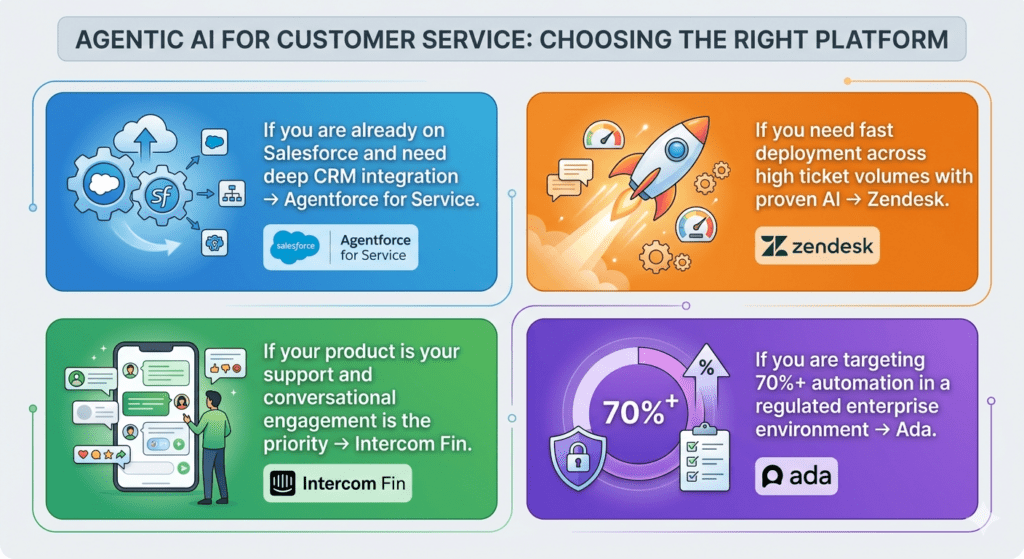
Choosing the wrong platform is the second most common reason AI customer service implementations fail — after poor knowledge base preparation and data quality. The market has matured significantly in 2026 and the right answer depends on your company’s scale, existing tech stack and AI complexities you are willing to manage within our current operational processes. Below are the platforms with the strongest verified track records this year.
Zendesk Resolution Platform
Best Overall · Mid-Market to Enterprise · From $19/agent/month
Zendesk remains the most broadly validated platform in 2026 for teams that need proven, scalable AI without a multi-month implementation project. Its AI is trained on over 18 billion real service interactions — the largest training corpus of any dedicated customer service platform — and in 2026 alone, 1.7 billion people used Zendesk to connect with a business or organization.
The platform’s no-code flow builder lets admins build multi-step automated workflows — routing a VIP complaint to a senior agent while simultaneously creating a Jira issue — without writing a line of code. AI agents can be launched in minutes by connecting directly to an existing knowledge base with no scripting or predefined conversation flows required. Native QA, workforce management, and omnichannel support (email, chat, SMS, voice, WhatsApp, social) are all included in a single thread without platform-switching.
Best for: SaaS companies, high-volume support teams, multi-brand enterprises, and teams with 20+ agents needing sophisticated routing. Zendesk handles complex compliance requirements and supports 80+ languages out of the box.
Watch out for: Pricing escalates at scale as Suite Enterprise runs $115/agent/month and advanced AI features sit behind higher-tier plans. Large implementations can still require significant configuration time.
Salesforce Agentforce
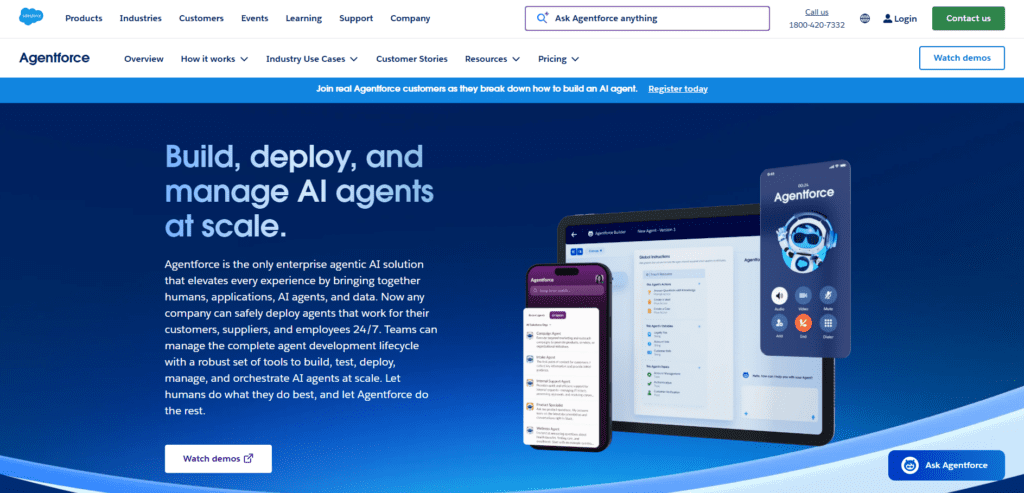
Package for CRM-Integrated Enterprises · Industries add-ons $150/user/month
For organizations already running on the Salesforce ecosystem, Agentforce for Service is available since late 2024 and significantly matured in 2026 as a strongest enterprise AI option for deep CRM integration. It delivers a 360-degree customer view that pulls data across sales, marketing and service into a single unified layer, something no standalone customer service platform can replicate. Agentforce’s autonomous service agents are built on the Einstein 1 Platform and Data Cloud meaning they can reason across Salesforce-native data with customer service cases, client accounts, opportunities and latest knowledge articles enabling context-aware resolutions. The platform serves over 150,000 customers worldwide including Spotify, Toyota and American Express.
Best for: Large enterprises with dedicated Salesforce administrators, complex multi-department workflows, and organizations where service, sales, and commerce data must be correlated in a single intelligence layer.
Watch out for: Implementation is a multi-layered infrastructure project, not a plug-and-play deployment. Agentforce requires navigating Data 360 for full value, which demands specialized technical teams. The Agentforce 1 Service plan reaches $550/user/month at the top tier. Best avoided by teams without dedicated Salesforce admin resources.
Intercom Fin AI Agent
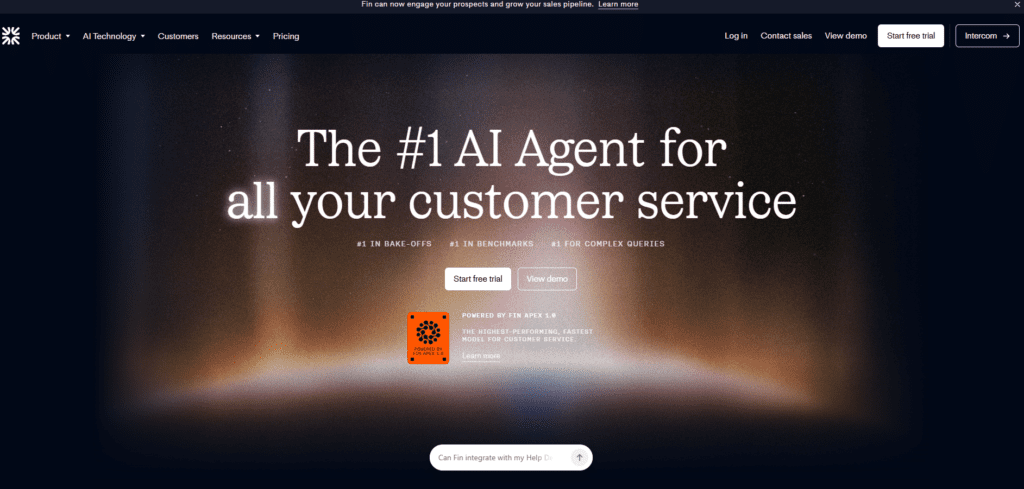
Ideal go to for Conversational & Product-Led Companies · $29/seat + $0.99/resolution + optional add-ons
Intercom pioneered conversational support and its Fin AI agent remains the leading choice for companies where the support experience needs to feel like a product feature, not a help desk. Fin handles automated resolutions through natural language processing while maintaining the human-feeling engagement that software and product-led companies need for retention. Its in-app messaging design is unmatched in the market for matching a product’s look and feel precisely.
Intercom’s marketplace spans over 450 integrations including Salesforce, HubSpot, Zoho, and Slack, and its Workflow builder allows no-code automation with triggers, conditions, and AI capabilities. The platform’s strength is balancing AI power with fast deployment — teams that want conversational AI without full autonomous transformation overhead.
Best for: Tech startups, product-led growth companies, SaaS firms focused on user onboarding and proactive in-app engagement. Particularly strong when real-time messaging and personalized proactive outreach matter more than traditional ticketing.
Watch out for: Per-resolution pricing ($0.99 per Fin resolution) can escalate unpredictably as volume grows. SLA management sits only on the Expert tier ($132/seat/month). No native QA or workforce management tools — third-party additions are required for enterprise-grade operations.
Ada’s AI Agents
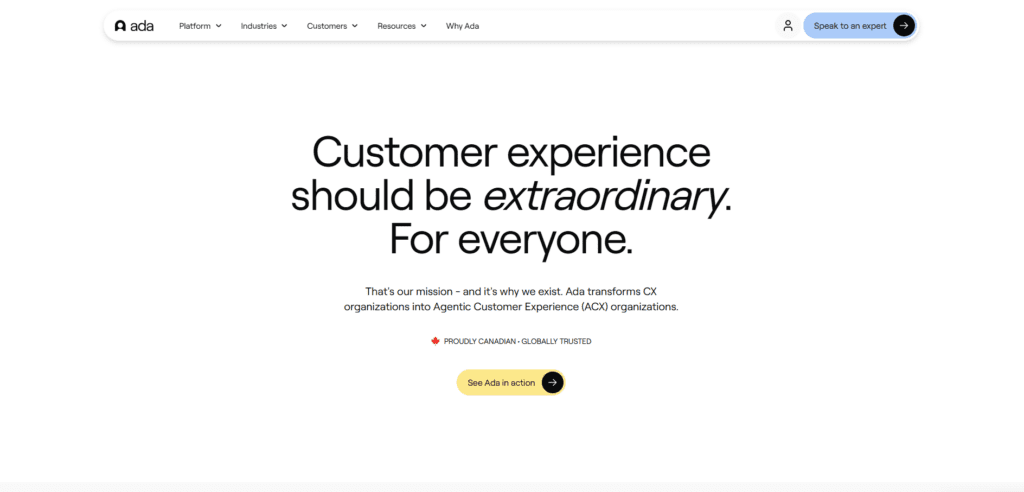
Agency for Enterprise Automation at Scale · Custom pricing from ~$50K/year
Ada is the platform most consistently recommended by enterprise deployment specialists for organizations targeting the highest possible automation rates. Built on the Ada Reasoning Engine that is a generative AI engine launched in 2024 orchestrating API calls across connected systems. Ada publishes an average automated resolution rate of 70% across its customer base, the highest verified figure among dedicated AI customer service platforms in 2026.
Ada’s enterprise clients include Meta, Square, and Verizon. Its strongest native integrations are with Zendesk, Salesforce, and Oracle Service Cloud. The visual no-code builder allows non-technical teams to configure resolution flows and the platform holds HIPAA, SOC2, GDPR, and AIUC-1 compliance certifications which is strong plus for organizations in regulated industries. Zero data retention policies with LLM providers add another layer of enterprise security.
Best for: Large enterprises in regulated industries (financial services, healthcare, telecoms) targeting genuine full-stack automation. Organizations replacing declarative chatbots with generative AI and needing validated, compliance-grade infrastructure.
Watch out for: Ada is not a self-serve product and contracts start at approximately $50,000 annually for mid-market and scale into six figures for enterprise volume. Not suited for teams wanting a quick, low-cost deployment.
The Bottom Line for 2026
AI is genuinely transforming customer service — not in the overnight-revolution way of vendor presentations, but in the compounding-improvement way of serious operational technology. The case studies from Bank of America, Klarna, NIB Health Insurance, and Virgin Money demonstrate that 50–70% automation rates, 85%+ cost reductions per interaction, and high customer satisfaction scores are simultaneously achievable. The organizations succeeding are those that treat AI as a workforce reshaping tool rather than a headcount elimination strategy, invest heavily in knowledge infrastructure before selecting platforms, and maintain human expertise for the interactions that determine customer loyalty. The $15 billion market is real with documented ROI and the transformation is happening as you read.