The business next door isn’t growing faster because of luck, bigger budgets, or better people. They’re growing because they built an AI strategy — and you haven’t.
While you’re still deciding whether AI adoption is “right for your business,” your competitors have already automated their workflows, accelerated decision-making, and scaled output — without a single new hire. That’s not luck. That’s a clear, deliberate AI adoption strategy in action.
AI competitive advantage is the defining business differentiator of this decade. From solo consultants to mid-market companies, those who implement AI intelligently are outperforming peers in efficiency, quality, and growth. And those who don’t? They’re asking the wrong question — “Is AI ready for us?” — instead of the right one: “Are we ready for AI?”
This article breaks down exactly where you’re falling behind, why your competitors are pulling ahead, and what you need to do to close the gap before it becomes permanent.
Why Are Smart Companies Going All-In on AI?
It is worthwhile to know why AI adoption has taken top priority for corporate executives in every sector before determining your deficiencies.
The solution is easy: results. AI increases output, refines decision-making, raises accuracy, and lowers the expense of repetitive, low-value work. Using conventional techniques, generating the same result is slower, more expensive, and progressively impractical in a competitive economy.
Time is the most limited resource in the digital-first world in which we live. Using artificial intelligence technologies for efficiency is not optional anymore; it is the minimum requirement for remaining relevant. AI can save your team hours every day by automating simple chores, creating excellent content, and quickly structuring huge volumes of data. One thing common among the companies winning today: They view artificial intelligence as an integrated system, not as a quick fix.
Smart actions produce effective outcomes. Your rivals are not working harder; they are working smarter, and artificial intelligence is the engine that drives every wise decision.
Where You’re Really Dropping Behind
The harsh reality most business owners don’t want to hear is as follows: Companies are not failing at artificial intelligence since the technology is excessively sophisticated. Poor AI deployment tactics, internal opposition, and a lack of a defined AI roadmap are all contributing causes to their failure. We will go over every gap in great depth.
1. Your progress is being quietly hampered by resistance to change
Technically, the most lethal AI application error is not psychological.
Fear that artificial intelligence would take our place is paralyzing us in businesses of every scale. Teams slow down adoption. Decision makers hold off. Months go by without anything altering. Meanwhile, your innovative rivals are acting the other way precisely. They are actively embracing new technologies, applying artificial intelligence at every level of their workflow, and viewing change as a competitive tool instead of a danger.
The following is the essential attitude change: AI replaces inefficiency, not people. It improves the quality of your output, accelerates your decision-making, and keeps your team concentrated on tasks that really provide value. Companies fighting this change are not safeguarding employment; rather, they are losing market share one sluggish quarter at a time.
Honestly, ask yourself: Is the dread of AI adoption within your team costing you clients right now?
2. You’re Overlooking Continuous AI Learning
Artificial intelligence isn’t an investment you can set and forget. The tools, models, and best practices change at an unparalleled rate. AI six months ago is already obsolete today. You’re not standing still if you’re not always learning and refining your strategy; you’re going backward.
Your rivals who are exploiting AI for competitive advantage are regularly performing three actions:
Regularly trying out fresh artificial intelligence technologies to identify quicker and more effective answers. As fresh features become available, upgrading their processes. Keeping one step ahead of developing technology so that the following wave never surprises them.
Staying current with AI is no longer just for the technology sector. Business executives, marketers, salespeople, and operations managers all require a functional understanding of what artificial intelligence can and cannot accomplish. The firms that are increasing their lead each quarter are those that are making investments in artificial intelligence literacy throughout their business.
Stop asking, “Why are my competitors ahead in AI?” Start inquiring: What am I doing this week to bridge the knowledge gap?
3. You Have No Clear AI Strategy
This is arguably the most critical failure point — and the most common.
Many businesses are technically “using AI,” but without any structure or plan. They pick up tools reactively. They deploy AI for one task here, another task there, with no connective tissue holding it together. There is no clear answer to the fundamental questions every business must address:
Where should AI be applied in our operations? How should AI tools integrate into existing workflows? When is the right moment to use AI versus human judgment?
A lack of a clear AI strategy is worse than not using AI at all, because it creates the illusion of progress without delivering real results. Half-knowledge produces half-results, and in a competitive market, that’s the same as failure.
Your rivals who are pulling ahead are focused on three non-negotiable pillars: effective planning, strategic implementation, and continuous optimisation. These three pillars don’t just improve efficiency — they compound it. Their precision, work quality, and output consistency improve every month because the system is built to get better over time.
Without a structured AI roadmap, you’re treating AI like a toy. With one, you transform it into a growth engine.
4. You’re Underestimating the Speed Advantage
Your competitors are expanding quickly — not because they’re luckier or more talented — but because speed is now a direct function of AI adoption.
When AI can analyse thousands of data points, draft proposals, answer customer queries, and iterate on strategies in a matter of minutes, businesses operating without it are structurally disadvantaged. Quality without AI takes hours. Quality with AI takes minutes. That difference, repeated across every department, every day, becomes an insurmountable lead.
Without AI, you’re likely to struggle with time management as manual tasks pile up, slower decision-making because analysis takes too long, reduced productivity as your team spends peak hours on low-value work, an inability to focus on high-impact tasks due to constant operational pressure, and hours wasted on quality checks that AI could perform instantly.
With AI properly integrated, your competitors are automating repetitive tasks to reclaim hours each week, making faster and data-backed decisions using AI-powered analytics, operating at higher productivity levels with the same headcount, directing their best thinking toward strategy rather than administration, and maintaining quality and accuracy at scale without burning out their teams.
The speed gap is real, and it compounds. Every week you operate without a strong AI adoption strategy is another week your competitors extend their lead.
You vs. Your AI-Powered Competitors: The Productivity Gap
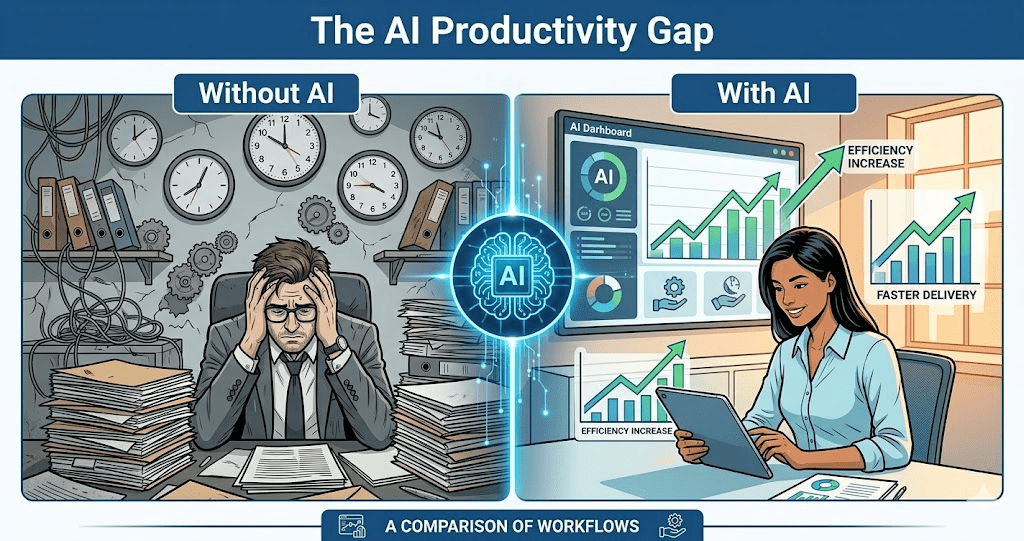
| Without AI | With AI |
| Struggling with time management | Automated task management |
| Slower, reactive decision-making | Fast, data-backed decisions |
| Hard work with low leverage | Smart work with high output |
| Focus lost to operational noise | Focus reserved for critical tasks |
| Hours spent checking quality | AI-maintained accuracy at scale |
| Reactive problem-solving | Proactive, AI-assisted strategy |
This is not about replacing human intelligence. It’s about amplifying it. The businesses using AI correctly are not less human — they’re more strategic, more focused, and more effective.
How AI Directly Boosts Productivity — and Why It Matters Now
The business case for leveraging AI tools for productivity is no longer theoretical. Here’s what it looks like in practice.
AI automates the tasks that drain your team. Repetitive, low-skill work — data entry, scheduling, content formatting, customer query routing — consumes enormous amounts of human time. AI handles these in seconds, freeing your team to focus on work that actually creates competitive value.
AI accelerates content and communication. From email campaigns to product descriptions to internal reports, AI produces high-quality first drafts that your team refines and approves. This alone cuts content production time by 50 to 70 percent for most teams.
AI sharpens decision-making. When AI can surface patterns in thousands of data points and highlight the signals worth acting on, your leadership team makes better calls, faster. This is where true AI competitive advantage is built — not in content generation, but in strategic clarity.
AI scales what’s already working. Found a winning customer acquisition approach? AI helps you scale it faster than any traditional team. Identified a bottleneck in customer service? AI can be deployed across that touchpoint in days, not months.
The most intelligent approach is to blend AI with your existing skills and human judgment. AI is not a replacement for expertise — it is a force multiplier for it. Used correctly, it takes what you’re already good at and makes it extraordinary.
The Time to Act Is Now, Not Later
Your competitors are not waiting for AI to be perfect. They are learning by doing, adapting in real time, and building advantages that will be extremely difficult to overcome twelve months from now. The businesses that will lead their industries are not necessarily those with the most resources — they’re the ones with the most intentional AI adoption strategies, the strongest culture of continuous learning, and the clarity to stop resisting change and start leveraging it.
You have access to the same AI tools. The only variable left is whether you choose to use them strategically.
The gap is real. The time to close it is today.
Every day without a structured AI strategy is a day your competitors gain ground. Every week of resistance to AI adoption is a week of compounding disadvantage working against you. Audit your workflows. Identify your bottlenecks. Build your AI roadmap. Commit to continuous learning. AI rewards not the fastest adopters, nor the biggest spenders — it rewards the most strategic ones. Be strategic. Be consistent. Use AI the way your best competitors already do: as the backbone of everything that drives growth.