
The founders who will dominate the next decade are not waiting for AI to mature. They are building companies where AI is not a feature — it is the foundation.
In 2026, the rules of company-building have changed permanently. The best AI startup today is not the one with the most funding or the largest team — it is the one that has made every layer of its business machine-legible, agentic, and relentlessly automated. Whether you are a solo founder in Bengaluru or a growth-stage team in San Francisco, the playbook is the same: build AI-first or get built over.
This guide breaks down the three defining trends reshaping how companies are structured in 2026, draws lessons from two founders who got it right, and gives you a concrete framework to build — or rebuild — your company around artificial intelligence from day one.
Why this moment is different for startups
The surge of generative AI in 2024–2025 boosted every team’s output by providing faster code, better writing, and quicker research capabilities. Helpful, but not revolutionary. The change taking place in 2026 is fundamentally distinct: the transition from AI as a task accelerator to AI as an independent operational layer.
Agentic artificial intelligence, which includes systems that plan, reason, and carry out multi-step processes without continuous human intervention, has gone from being experimental to being ready for use in real-world settings. Early-stage teams benefit most from this structural advantage in a generation. A five-person business that constructs around agentic processes will function with the production capacity of a twenty-person crew. When a bigger rival purchases more tools, that gap does not narrow. It only shuts if they start anew, which most businesses that have been around for a while will not do.
The chance to create this edge is now. One thing that early-stage businesses have in common with established companies is that they have no history to protect. There are no previous processes to safeguard. No cultural opposition has built over the decades. Your most treasured possession is that clean slate. Use it purposefully.
The 6 pillars of an AI-first startup
Pillar 1: Machine-legible operations
Every procedure your team executes has to be documented, organized, and understandable to an artificial intelligence tool. An agent cannot carry out a workflow that exists in someone’s head, in a Slack conversation, or in an unorganized Google Doc. As your base, you need organized SOPs, concise decision trees, and API-connected tools.
Your assignment this week is to go through your top 10 chores that you have to do over and over again. Record each as a numbered, step-by-step procedure that a new employee—or an AI agent might follow without asking any questions. That documentation is not superfluous work. It is the basic architecture supporting your automation stack.
Pillar 2: Exclusive data moat
Generic artificial intelligence is a product. Every competitor has access to the same fundamental models, the same APIs, and the same pre-made tools. The information only you possess is your sustainable advantage: user behavior, transaction patterns, domain-specific indicators, support conversations, and product usage history. The single most high-leverage investment an early-stage team can make is gathering, organizing, and owning this data from day one.
Most startups see data as a side effect of the product. AI-first companies view data as the product. List the unique signals your product creates that no rival can copy. Create a pipeline to grab it from your first user.
Pillar 3: Automate before hiring
Run what AI-first entrepreneurs refer to as the automation test before every recruit: Is an AI agent able to manage 80% of this work? Tools available today can automate a large portion of customer support, content creation, onboarding sequences, outreach, reporting, quality assurance, and fundamental financial operations at a fraction of the cost of a full-time employee.
This does not imply you never rent. That signifies you rent at a higher level. You hire a support strategist who runs the AI that sorts the tickets rather than a support agent. Rather than hiring a content writer, you hire a content director who edits and develops strategy while artificial intelligence handles first drafts at scale. Save human capital for judgment, relationships, and creative direction. Let AI manage volume and execution.
Pillar 4: Measurement based on outcomes
Prompts supplied, hours spared, and tools accepted are vanity indicators. They say that AI is being used by your team. They don’t let you know if it is operational. AI-first teams track income affected, cost per production, time-to-close, churn rate, support resolution time, and engineering velocity.
An AI investment that cannot be linked straight to one of these business metrics within sixty days of implementation is a cost centre disguised as strategy.
The key here is brutal simplicity. For every AI tool your team utilises now, list the one obvious business statistic it ought to be enhancing. If you cannot identify it, the tool probably does not deserve a spot in your stack.
Pillar 5: Hybrid human-AI team design
Early-stage teams with the most impact in 2026 are hybrid by conscious choice, neither all-human nor all-AI. People create strategy, manage exceptions, maintain crucial connections, and exercise judgment in uncertain circumstances. AI agents manage volume, repetition, consistency, execution, and round-the-clock availability without exhaustion.
The majority of teams err by allowing this division to occur naturally. Convenience drives task allocation to either artificial intelligence or humans rather than deliberate design. The outcome is duplication, dropped balls, and uncertainty regarding responsibility. Clearly outline your team’s weekly workload. Classify every activity as human-only, AI-only, or human-supervised artificial intelligence. Your automation road map for the following 90 days is the middle classification: human-supervised AI.
Pillar 6: Accountable AI and Governance
Startups that neglect governance early on suffer for it later in terms of regulatory exposure, trust from customers, and damage to their reputation. Your team needs a one-page AI use policy, even for five individuals, spelling out what data agents can view, how AI-driven choices are recorded, when a person has to be in the loop, and how errors are discovered and corrected.
Good government prevents severe repercussions afterwards. As you grow, customers, particularly business clients, will inquire about your artificial intelligence policies before they sign. It’s a competitive advantage to have clear, recorded answers; it’s not merely a compliance checklist item.
Your AI-first tools stack
This is not a comprehensive list. It is a curated stack designed for teams without corporate funding and linked to the six pillars stated above. Cursor and GitHub Copilot are the norm for development and construction. By automating the generation, refactoring, and debugging of code in real-time, both transform small engineering teams into highly productive ones. Using these tools, a two-person engineering team consistently ships at the speed of a typical five-person team.
The AI-powered tiers of n8n, Make, and Zapier are fundamental for agentic processes and automation. These low-code and no-code systems let you create multi-step automated processes that operate without human intervention by connecting tools and specifying triggers. They are where your documented SOPs from Pillar 1 become living, executing systems. Intercom Fin and Bland AI manage inbound inquiries, lead qualification, and follow-up sequences automatically for customer experience and support. When implemented well, a two-person business may offer enterprise-grade support responsiveness free from a support staff behind it.
Notion AI and Rows AI convert your internal papers and spreadsheets into queryable, machine-readable knowledge bases for internal knowledge and data. These are the systems that allow agents to read about your business, the infrastructure layer for Pillar 1. Claude, ChatGPT, and Perplexity are always-on thinking partners, research engines, and first-draft generators for content, research, and go-to-market. The key is to integrate them as embedded collaborators into your daily workflows, rather than relying on them as sporadic tools opened only when you’re stuck.
PostHog and Mixpanel’s AI-powered insight layers link your product consumption data to the corporate metrics that let you know whether your AI expenditures are really paying off for analytics and ROI monitoring. One thing to keep in mind for all of the above is not to add any more tools. Unless you can identify the particular business indicator, it will move within thirty days. Tool sprawl, ten tools used sometimes, is much less effective than five tools used often and extensively every single day.
Your 30-day AI-first sprint plan
Week 1: Audit and document.
List every recurring task across the team. Document the top 10 as structured, numbered processes. Identify which are repeatable and rules-based. Those are your automation targets.
Week 2: Automate one workflow end-to-end.
Pick the single most painful, high-frequency task from your audit. Build a full automation using your chosen platform. Deploy it to production — not a sandbox. Measure the before and after against a real business metric.
Week 3: Build your data pipeline.
Define what proprietary data your product generates. Set up structured collection across user events, support interactions, and sales conversations. This is the raw material for every AI advantage you will build from this point forward.
Week 4: Measure, cut, and double down.
Review every AI tool and workflow against real business metrics. Cut anything that cannot demonstrate impact. Double resources on what is working. Write your one-page AI policy. Set the next 30-day targets and repeat the cycle.
The 5 mistakes that kill AI-first ambitions early.
Mistake 1: Piloting everything, shipping nothing.
The most common failure mode in early-stage AI adoption is running five experiments simultaneously and completing none. Pilots create the feeling of progress without the reality of it. AI advantage comes from production deployment and iteration, not sandbox testing. One automation at a time, fully deployed, before moving to the next.
Mistake 2: Building on bad data.
Putting artificial intelligence on disorganized, unstructured, or isolated data yields inaccurate results that undermine team trust in the technology. Teams then drop artificial intelligence because they missed the infrastructure development. Not because the technology failed. Before scaling any AI process, spend actual time on data structure.
Mistake 3: Letting only one person own AI.
Adoption stays limited and shaky when one founder or team member becomes the de facto AI leader. If that individual departs, the capacity goes with them. The competitive edge of AI-first operations comes from team-wide fluency: everyone using AI effectively in their own field, not one person doing it for everyone else.
Mistake 4: Measuring the wrong things.
Teams that monitor artificial intelligence use by counting installed tools or dispatched prompts will always believe they are doing better than they are. The only criteria that count are company results. You are operating a costly experiment, not a strategy, if your AI use cannot be related to income, retention, speed, or cost.
Mistake 5: Waiting for the perfect tool.
Every quarter, AI tools get better. Delaying construction because a better model or more competent agent might be available in six months causes teams to lose six months of compounding benefit. Build using what is available now, create systems that are model-agnostic, and upgrade as more suitable choices emerge. The design counts more than the particular tool you begin with.
Your AI-first readiness checklist
Use this with your team this week. Every “no” is a gap to close before you scale.
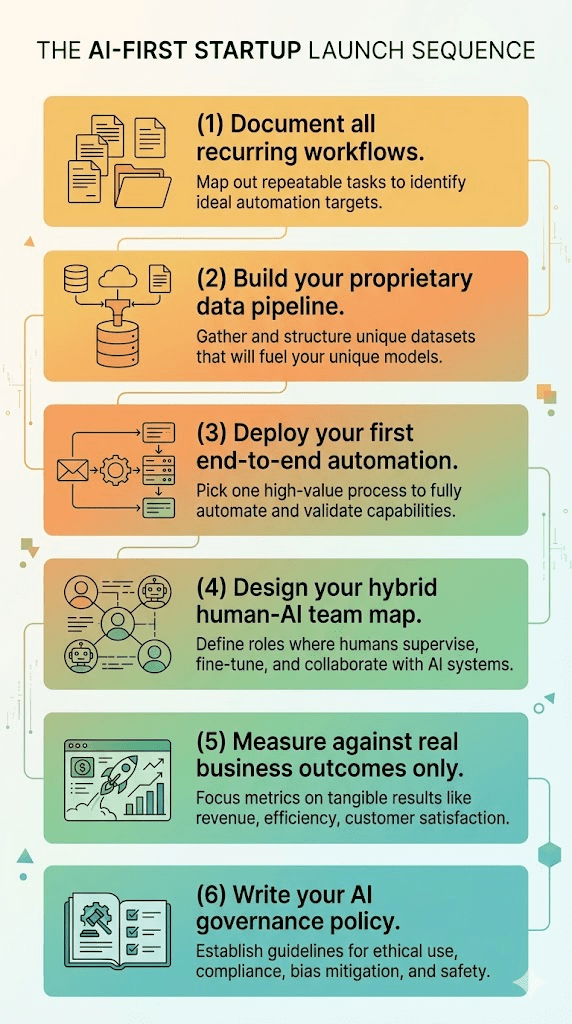
Have you documented your top 10 recurring workflows as structured, step-by-step processes? Do you know what proprietary data your product generates, and are you collecting it in a structured format? For every AI tool your team uses, can you name one business metric it is visibly improving? Have you run the automation test on your next planned hire? Does your team have a shared understanding of which tasks are human-only versus AI-executable? Do you have even a basic AI usage policy covering data access, decision logging, and human escalation?
If the answer to four or more of these is no, the 30-day sprint above is your immediate priority.