
The article reviews the top 10 AI tools for customer acquisition, highlighting their functionalities, target users, and how they can streamline the process of identifying and engaging prospects effectively, with a focus on adaptability to specific business needs by 2026.
- AI tools enhance customer acquisition by automating lead generation, data enrichment, and sales analysis.
- Companies should choose AI tools based on specific weaknesses in their acquisition processes.
- Top tools include HubSpot Breeze for CRM integration, Apollo for prospecting, and 6sense for identifying buyer intent.
The process of obtaining new customers is becoming more reliant on data. In the past, companies depended on sales agents to seek out leads, marketers to develop promotions, and customer support workers to field inquiries. However, now computer programs can help at every stage of the process, from identifying prospects and supplementing the information available on them to customising the outreach, filtering leads, and evaluating sales conversations.
This shift is important because it speaks to the new realities of the process of customer acquisition. It is not only about generating more leads. Companies must be able to select the right leads and learn about their challenges so that they can approach the customers promptly.
TechnologyAdvice’s analysis of the technologies expected to gain traction by 2026 shows, for instance, that Apollo is a leader when it comes to lead generation as it can combine data gathering and customer enrichment with the help of lead sequencing and outreach automation, and that Clay stands out for its good enrichment and research on AI workflows.
The following list includes 10 AI technologies that promise to be very beneficial for the process of customer acquisition in the year 2026.
1. HubSpot Breeze
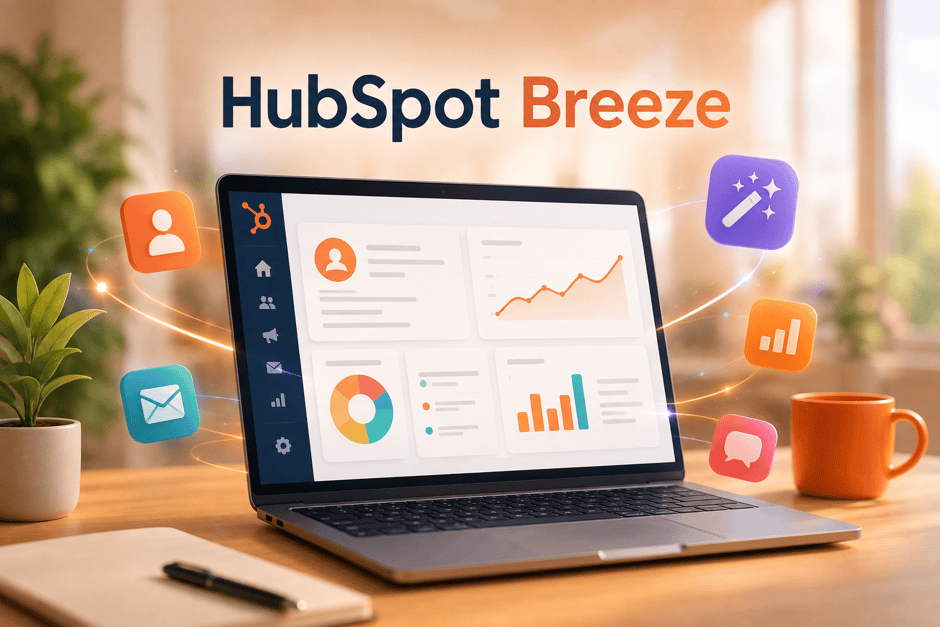
Ideal for a comprehensive approach to customer acquisition.
HubSpot Breeze is an integration of AI into CRM, marketing, sales, and customer service processes. Its prospecting features can be used to pin down potential customers, investigate businesses, enrich CRM data, and create unique outreach messages.
The main benefit here is context. Instead of AI processing a list of contacts, its capabilities will now be exercised within a broader CRM environment, with all interactions, prior communication, and sales data already available.
HubSpot has structured its 2026 prospecting comparison to show that Breeze is considered an in-house solution for lead generation, enrichment, and outreach.
For example, a B2B software company targeting the manufacturing sector could use this tool to find appropriate firms, get information about decision-makers, and send personalised emails, tracking the entire process through CRM.
Expert Opinion: HubSpot can be interesting for businesses not willing to use separate tools for CRM, prospecting, and marketing, in exchange for the absence of advanced AI functions that will be useful only for companies with a well-developed HubSpot ecosystem.
Who it’s for: SMEs, businesses in the middle market, and HubSpot users.
Link: https://www.hubspot.com/products/artificial-intelligence
2. Apollo.io
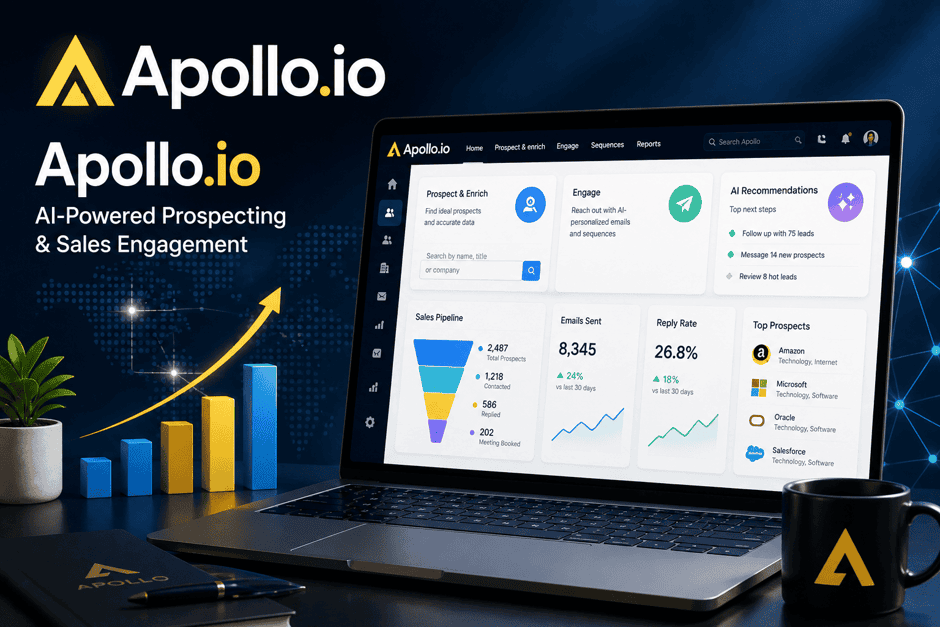
Best for AI-driven prospecting and outbound sales
Apollo is an excellent choice for companies looking to combine discovering prospects with reaching out to them.
Apollo combines a big database of business contacts, lead scoring, sequencing and sales automation in its platform. According to TechnologyAdvice’s August 2026 assessment, Apollo was rated the best in the list of AI lead creation tools with an overall score of 4.62 out of 5.
The key aspect is simplicity. A salesperson can just search for prospects, compile a list and plan the outreach campaign with the help of one application.
For example, a SaaS company may look for tech firms with 50-500 staff, find the marketing officers and start their automated email sequence.
Compared to its competitors, Apollo has been recently noted to be the fastest solution for teams needing a rapid transition from prospect search to cold emailing, while Clay seems to be more suitable for those requiring more extensive data enrichment.
Opinion: Apollo seems to be of special use for smaller and medium sales teams as it simplifies the process of creating an outbound system.
Best for: Startups, small and medium enterprises, sales development representatives and bulk B2B prospecting.
Link: https://bit.ly/4goC0Tt
3. Clay
Ideal for advanced research and data enrichment
Clay is unlike Apollo because it serves more than just a sales database; it is a flexible data and workflow platform.
Clay has the capability of combining data from various data vendors, and it can also apply AI agents for various purposes such as research, enrichment, and personalisation. This is important when regular databases do not contain sufficient information about prospects.
Clay has been identified as one of the most effective tools for custom enrichment and AI research workflows according to TechnologyAdvice.
Entailment: A marketing firm can detect businesses that have launched new websites, search for those businesses, discover the names of their C-suite executives, and create custom messages explaining how they can help them.
This is much more advanced than just sending the same email to a purchased list of leads.
Expert opinion: Clay is strong yet more challenging to master. A recent 2026 comparison showed that Apollo is much simpler for normal outbound activities, while Clay is extremely effective in situations that have a high barrier to data quality and require custom enrichment.
Suitable for: Growth teams, RevOps specialists, agencies, and tech-savvy sales staff.
Link: https://madewithclay.org/
4. 6sense
Ideal for recognising customers with buying intentions
One of the primary challenges faced in B2B sales is timing. A business can fulfil the perfect customer requirement yet be uninterested in purchasing at that time.
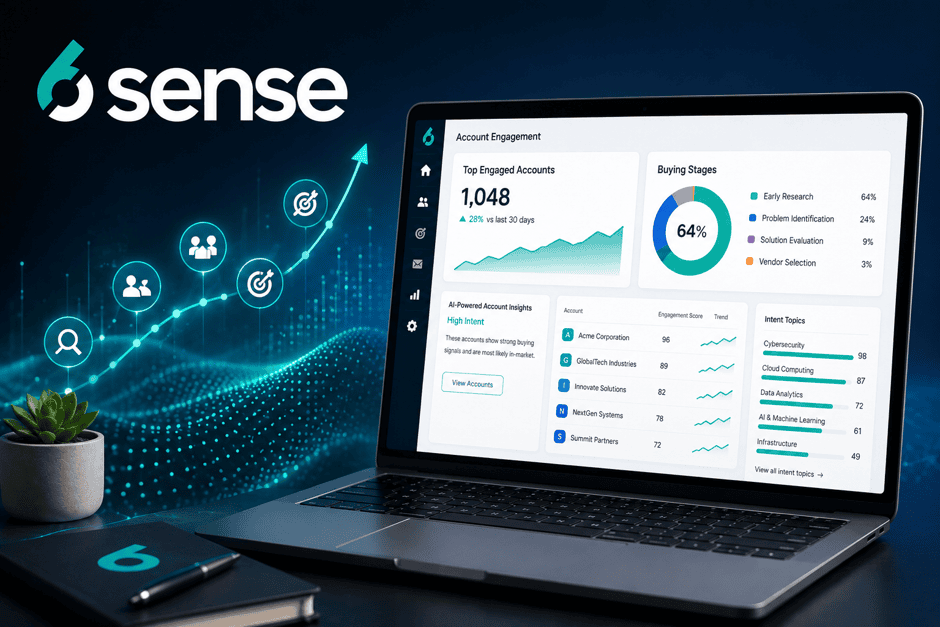
6sense seeks to identify firms that seem to be beginning the buying process using buying intentions and account-level indicators.
This is particularly useful for account-based marketing, where sales teams prefer to spend their efforts on a select few high-value firms.
For instance, a cybersecurity firm could use 6sense to find companies that indicated interest in cybersecurity-related matters and engage with them to make sales.
This approach exceeds the previous question, “Which organisations fit our ideal purchaser?”
Thus, the following question is, “Which firms fit our requirements and are planning to buy soon?”
A comparison of platforms for the GTM market in 2026 identifies 6sense as a leader in intent-oriented account targeting and ABM for businesses.
Professional opinion: 6sense works best for enterprises with many accounts, valuable deals, and lengthy sales processes.
Most suitable for: Enterprise B2B, ABM teams, and long sales processes.
Link: https://6sense.com/
5. Gong

Preferred for sales conversation analysis
Gong takes customer acquisition from a new perspective. Rather than concentrating on gaining prospects, it enables companies to learn what happens in sales conversations.
This technology can analyse the exchanges between customers and sales representatives and find out objections, threats, patterns of behaviour, and potential next steps.
This information can increase the effectiveness of marketing content and sales training, and assist companies with customer acquisition.
For instance, the software company believes customers are concerned mainly about the price; however, after analysing hundreds of sales calls, their team finds out that the concern is, in fact, the complexity of implementation. Afterwards, the company adjusts its product demonstrations, messages on the website, and other sales content accordingly. Gong remains among the top revenue-intelligence platforms in 2026, along with Apollo, ZoomInfo, HubSpot, and 6sense. Experts say that Gong becomes most useful once the organisation has a significant number of sales conversations to build patterns.
Link: https://www.gong.io/
6. Intercom Fin

Most suitable for inbound lead conversion
Customer acquisition often commences not with a salesperson but with a question being asked on a website.
Intercom Fin’s goal is to use AI to manage conversations with customers/parrots which is helpful for companies which get a significant number of questions on their websites.
Case in point: the customer asks if the given software works with Salesforce.
Instead of assisting the customer in going through the documentation, an AI can help them and consequently bring the conversation closer to sales.
Thus, it lessens the distance between interest and action.
The more significant trend is that AI customer service representatives become more and more part of the sales process rather than operating independently of it.
Expert opinion: Fin is particularly useful for companies where visitors to the websites are looking for instant answers before making the purchase decision.
Best suited for SaaS companies, online businesses, and organisations with higher inbound traffic.
Link: https://bit.ly/4ilwF1K
7. Jasper
Incredible service for content creation and marketing company
Writing is essential for any business.
Jasper provides various types of content created with the help of AI-based technology, which helps marketing teams create campaigns, relevant content, and marketing materials that comply with brand presence.
This service is especially helpful for those businesses that need many different variations of the same content for different target audiences.
For example, a company offering cybersecurity services could create many unique landing pages for healthcare, banks, and manufacturing companies instead of using one landing page.
Thanks to such artificial intelligence, the marketing team can produce those landing pages much faster.
It is important to make sure that the content produced by AI will not just increase the number of published materials, but ensure that content will be more relevant for the buyer.
Experts’ opinion: Jasper is more effective if used along with the marketing strategy rather than being used as a replacement for marketers.
Who is best for: Content marketing teams, agencies, and brands that are managing many campaigns.
Link: https://www.jasper.ai/
8. Lavender
Ideal for enhancing sales emails
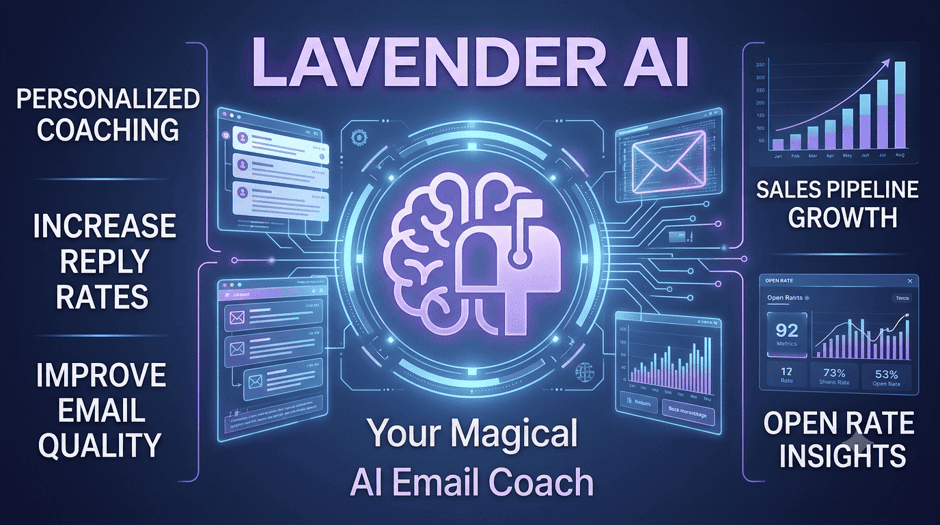
Email remains a key customer-acquisition channel, particularly in B2B markets. Lavender concentrates on assisting sales representatives with the creation of more efficient emails.
The system uses AI technology to provide feedback on sales communication and ensure greater personalisation, clarity, and relevance.
For example, instead of writing a general introduction for the chief marketing officer, the sales representative can apply AI technology to study the prospect’s business environment and write an introduction that relates to a certain business issue.
The aim is not to make emails longer. The aim is to make emails more relevant.
Lavender is well suited for businesses that involve a great number of outbound messages processed by SDRs and BDRs but still need some human supervision.
Expert opinion: Email AI solutions perform well if they enable salespeople to learn about the reasons for email inefficiency instead of just generating a lot of unnecessary messages. It is best suited for SDRs, BDRs, and those who work in the outbound sales departments.
Link: https://lavender.ai/
9. ZoomInfo
Ideal for collecting sales intelligence for enterprise companies
ZoomInfo is one of the popular B2B sales intelligence options.
The platform provides information on companies and contacts as well as insights about organisations, signals of intent and other data that sales teams can use to target potential clients.
According to TechnologyAdvice, ZoomInfo has been considered the best AI prospecting platform in its review from May 2026.
For example, an enterprise software vendor could use ZoomInfo to find companies with specific revenue, get access to contact information for necessary executives and prioritise companies with buying signals.
The strength of ZoomInfo lies in its scale. Enterprise sales companies need a lot more detailed information about the accounts than what the simple database provides.
Professional point of view: ZoomInfo is a better choice for companies that have an efficient sales process and high requirements for prospecting rather than for very small companies that start testing out outbound sales.
Link: https://www.zoominfo.com/
10. 1mind

Ideal for AI-enabled sales conversations on websites
AI website agents are becoming essential as buyers expect instant answers.
1mind specialises in providing conversational sales experiences whereby the AI can converse with visitors on the website and help to qualify or drive the discussion.
For example, an enterprise client visits a pricing page and asks about deployment, integrations and contract terms, among other questions. Rather than leaving the website for answers, the customer can use the AI sales agent to find answers.
This enables grabbing buying intent while the customer is still active in research mode.
According to a 2026 review of AI prospecting tools, 1mind is in a unique position due to its focus on going beyond just identifying prospects and making sales conversations happen.
Expert opinion: Conversational AI becomes more valuable when linked with CRM and sales processes rather than used as an independent online chat agent.
Suitable for: B2B companies that have high-value visitors on their websites and complex products.
Link: https://www.1mind.com/
Which AI Customer Acquisition Tool Should You Choose?
The answer depends on the biggest weakness in your current acquisition process.
|
Need |
Best choice |
|---|---|
|
All-in-one CRM and AI acquisition |
HubSpot Breeze |
|
Prospecting and outbound automation |
Apollo.io |
|
Advanced enrichment and research |
Clay |
|
Buyer intent and ABM |
6sense |
|
Sales-call intelligence |
Gong |
|
Inbound AI conversations |
Intercom Fin |
|
Marketing content |
Jasper |
|
Sales-email optimisation |
Lavender |
|
Enterprise sales intelligence |
ZoomInfo |
|
AI website sales conversations |
1mind |
A Bigger Trend: Connecting the Ideation
The key aspect is not that companies have introduced 10 AI tools.
The important development is that AI is now on its way to connecting various aspects of customer development.
A current B2B process can look like:
6sense identifies accounts showing interest; Clay studies and enriches the information; Apollo finds the contacts and initiates communication; Jasper assists with creating marketing materials; Lavender improves sales emails; 1mind or Intercom gets involved; Gong studies sales connections; HubSpot works with the customer.
The situation creates a more connected process of acquisition.
Nevertheless, businesses must avoid adopting AI just because it has such numerous characteristics. The newly formed analysis of GTM platforms of 2026 states that companies will have to choose between various specialisations.
The best option is identifying the actual problem first.
If a business fails to get enough customers, it should start with Apollo or ZoomInfo. If quality of data is the key issue, it’s better to use Clay. If salespeople cannot understand which accounts are ready to buy, 6sense will be the option. And if there are no conversions, Intercom Fin, 1mind or Gong tools will be more helpful.
Final Verdict
In conclusion, the way businesses acquire customers is now evolving with the help of artificial intelligence into an automated process.
The best tools are not designed merely to yield more leads; they assist organisations in differentiating between valuable and non-valuable leads, and they help draft strategies with regard to what prospective clients will need and when sales have to contact them.
For the majority of small- and medium-sized B2B companies, Apollo is one of the ideal options as it combines both prospecting and outreach. Clay is better for companies that want more advanced research and enrichment. HubSpot Breeze is perfect for businesses which need a powerful AI solution integrated into their CRM. For enterprise ABM, 6sense and ZoomInfo are the best products on the market, whereas Gong becomes useful where there are a lot of sales conversations within the organisation.
The key lesson is quite straightforward: the effectiveness of AI shouldn’t be measured by the amount of activity it is able to generate, but rather by the way in which it converts the right prospects into clients.
Frequently asked questions
What are the top AI tools for customer acquisition?
The top AI tools include HubSpot Breeze for CRM-wide integration, Apollo for prospecting and sales automation, Clay for advanced data enrichment, and 6sense for account-based marketing insights.
How can AI improve the customer acquisition process?
AI can streamline the customer acquisition process by automating lead identification, enhancing data with additional insights, and personalizing outreach efforts, ultimately leading to better engagement and conversion rates.
Which AI tool is best for small to medium-sized enterprises?
Apollo is highlighted as an ideal option for small to medium-sized B2B companies due to its combination of prospecting and outreach capabilities.
What is the significance of AI in marketing?
AI in marketing is significant as it enables companies to analyze customer data more effectively, tailor their messaging, and target the right prospects, enhancing overall marketing efficiency and ROI.
How does Gong contribute to customer acquisition?
Gong analyzes sales conversations to identify customer concerns and patterns, enabling companies to refine their marketing strategies and improve customer acquisition efforts based on real conversation data.