
Norwegian Air adopted an AI assistant from Kindly.ai to manage support calls, aiming to automate a significant portion of inquiries without replacing human agents. However, the claims of efficiency lack independent validation, emphasizing caution in interpreting success metrics.
- Norwegian Air's AI assistant helps manage airline support calls before human agents intervene.
- Efficiency claims should be independently verified, as vendor reports may not reflect reality.
- Setting up an AI platform can be more effective than building a proprietary model from scratch.
Norwegian Air’s support desk used to drown every winter storm season. Now an AI assistant built on a vendor platform most executives have never heard of catches a chunk of that traffic before a human ever picks up. Norwegian calls it a win. The record we could actually verify tells a narrower story.
The Problem
Norwegian Air runs on the same assumption every legacy and low-cost carrier runs on: a human answers the phone. That assumption gets expensive fast. Ground a hub in a storm, or pull a Boeing 737 MAX from rotation, and every affected passenger dials in at once.
Norwegian doesn’t publish exact wait-time or call-volume numbers for this story. But the shape of the problem is one every airline executive already knows cold. Air India describes the identical crunch during peak travel season. Finnair’s customers, by the airline’s own account, got fed up with an older chatbot that couldn’t process a rebooking request without making them repeat their itinerary from scratch. Virgin Atlantic’s version of the problem was quieter: complex travel questions were pushing people to abandon bookings altogether, no shouting match required.
What They Built
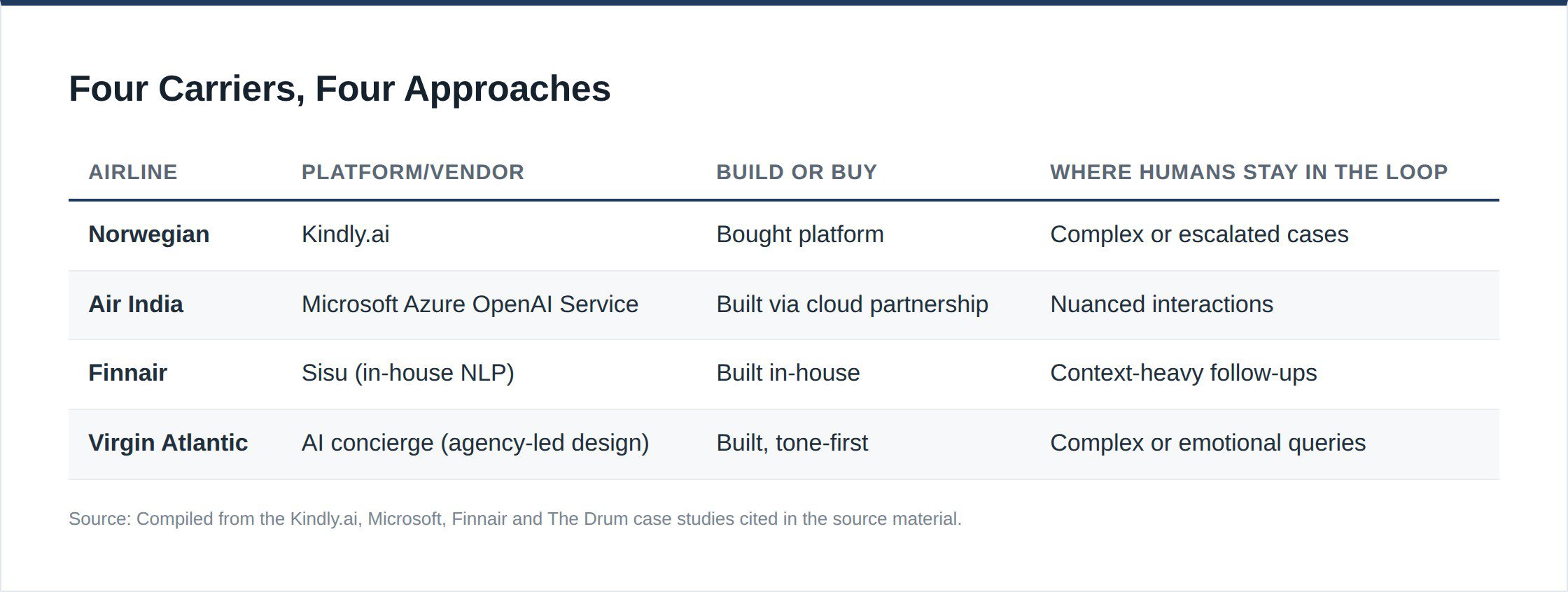
Norwegian didn’t train its own model. It licensed a platform from Kindly.ai, a Nordic conversational-AI vendor, and bolted it onto the existing support stack as an ‘AI Support Agent’ that sits in front of live agents rather than replacing them. When a passenger’s 737 MAX flight got disrupted, the bot pulled the flight-status feed and pushed rebooking and refund options before anyone reached a human — that’s the headline example in Kindly’s own case study.
The public record doesn’t say how many engineers Norwegian put on the integration or how long it took to ship. That’s worth flagging on its own — case studies love a hero number, and this one skips it entirely.
Other airlines took different roads. Air India built AI.g on Microsoft’s Azure OpenAI Service, a cloud partnership rather than an off-the-shelf bot. Finnair built Sisu in-house, using natural-language processing to handle context-carrying requests like date changes. Virgin Atlantic started with an agency defining tone of voice before anyone picked a model — a design-first sequence worth stealing no matter which vendor you end up with.
Based on your flight to Orlando, would you like assistance with hotel bookings as well?
— Virgin Atlantic’s AI concierge
The Results
There’s exactly one hard percentage in this whole record, and it belongs to Air India: an 80% first-call resolution rate for its AI-assisted call center, reported via Business Standard and not independently audited though
Norwegian’s own case study, published by Kindly.ai, describes the assistant easing a passenger’s 737 MAX disruption before an agent ever picked up, and claims reduced burnout among support staff. It does not break out a resolution rate or an automation percentage.
So where did the ‘65%’ now floating around in wider circulation on this case come from? Not from anything in the source material reviewed here. Treat it as marketing shorthand until someone produces the math behind it.
AI supports human agents by managing simpler inquiries, allowing them to focus on cases requiring their expertise.
— Air India, on its Azure-based assistant AI.g (via Microsoft customer story)
What Went Wrong Along the Way
Here’s the uncomfortable part: none of the four case studies behind this story mention a failure, a customer complaint, or a redesign. Kindly.ai’s write-up on Norwegian, Microsoft’s on Air India, Finnair’s own blog on Sisu, and The Drum’s piece on Virgin Atlantic all read like wins from page one.
That’s not evidence nothing went wrong. It’s evidence these are vendor- and airline-approved accounts, not incident reports.
Discount every efficiency claim here accordingly. If an airline cites this pattern to you, ask for the actual escalation and complaint logs — not the highlight reel.
Lessons for Your Team
-
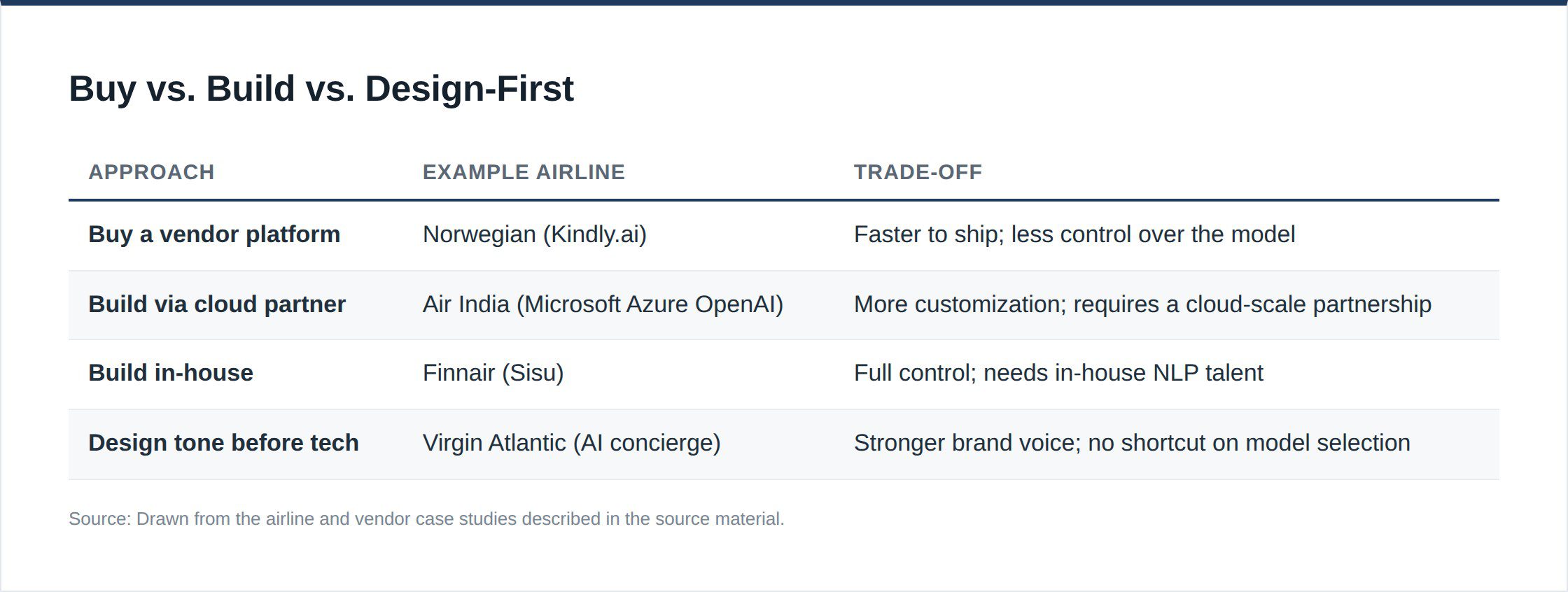
Buy the platform before you build the model. Norwegian licensed Kindly.ai instead of training something from scratch, and still shipped a working assistant.
-
Design the tone before you pick the vendor. Virgin Atlantic’s concierge started with brand voice, not model selection
-
Keep the human escalation path visible, not buried. Every case in this record routes complex or emotional queries to live agents instead of looping them through the bot forever.
-
Treat context retention as a baseline requirement, not a bonus feature. Finnair’s Sisu handles follow-up questions without forcing customers to repeat their booking details — the exact gap that killed the airline’s earlier chatbot.
By adjusting its responses based on context, Sisu dramatically reduces wait times and enhances user satisfaction.
— Finnair, on its AI assistant Sisu
Could You Do This?
Recreating Norwegian’s version — a licensed conversational-AI platform bolted onto an existing support queue — is realistic for a mid-size carrier with an integration team and a vendor contract. That’s the buy-side path, and it’s the cheapest door in.
Recreating Air India’s version means landing a cloud partnership at Microsoft’s scale, which most airlines can’t just casually assemble.
The Bottom Line
What this actually proves is narrower than the press releases suggest: airlines can route repetitive, well-defined queries to a bot and keep passengers calmer while they wait for a human.
What it doesn’t prove is any specific automation rate, cost saved, or satisfaction score that will help us quantify if this is actually true
Frequently asked questions
How did Norwegian Air implement AI in their support system?
Norwegian Air licensed a conversational AI platform from Kindly.ai to assist with support calls, managing inquiries before passengers reach human agents.
What percentage of automation does Norwegian Air claim?
The article mentions a 65% figure circulating but notes that no direct source or verification for this claim exists within the provided case studies.
What were the limitations of Norwegian Air's AI assistant according to the article?
The AI assistant does not handle complex queries, which are still routed to human agents, and the article stresses the lack of public evidence regarding successful outcomes.
What is the main comparison made between different airlines' AI strategies?
The article compares various airlines, highlighting Norwegian's use of a licensed AI platform versus others like Air India, which built its AI in-house on a cloud service.
What key lessons does the article provide for implementing AI in airline support?
The article suggests buying established platforms, designing user experience before vendor selection, and ensuring human escalation paths to improve customer service.