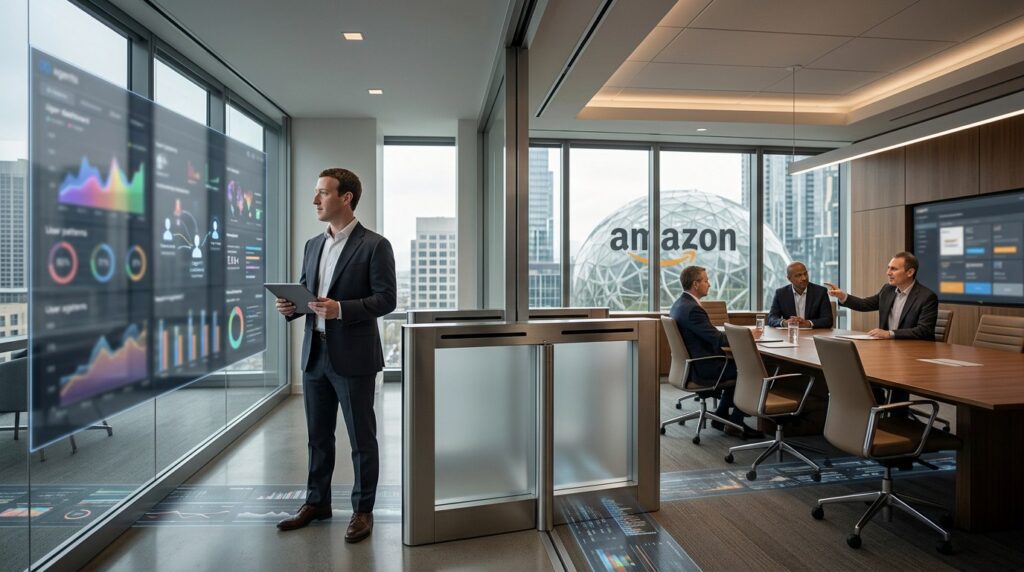
Amazon told investors on October 29 that outside shopping agents aren’t denting its ad business. Its block on Meta’s Muse five weeks earlier shows which fight it expects to have: control of the checkout.
Two messages, five weeks apart
Amazon and Walmart are both developing AI shopping systems.
On October 29, during Amazon’s third-quarter earnings call, CEO Andy Jassy told investors that external “horizontal” shopping agents were not materially affecting Amazon Ads. His reasoning was that few customers shop through outside agents, and the experience is neither especially good nor more convenient than visiting a retailer directly.
Five weeks earlier, Amazon had locked one of those agents out.
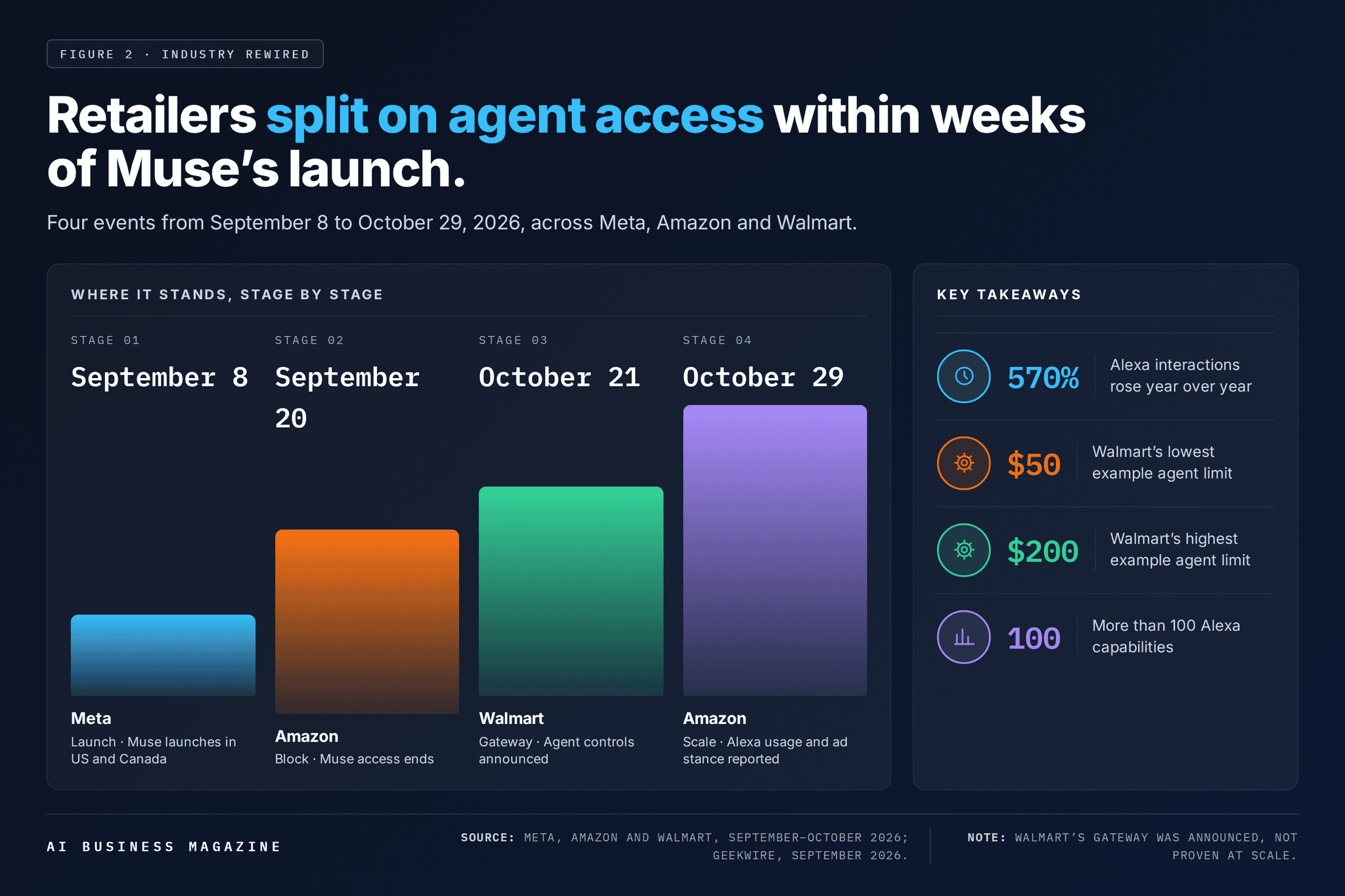
On the night of September 20, Amazon blocked Muse from browsing and buying on Amazon.com. Muse is the personal AI agent Meta launched in the United States and Canada on September 8. Shoppers using it reportedly saw a notice stating that continued access by an unauthorised AI agent violated Amazon’s Conditions of Use.
Commentators read the pairing as a contradiction. The actual position is narrower. Jassy described the current size of the threat, while the block shut down an unauthorised route into Amazon’s store, customer accounts and checkout.
Both stances hold if Amazon treats outside agents as strategically dangerous before they become financially significant.
That gap is the signal executives should read. If you sell through Amazon, build agents, or invest in either side, it shows where platforms will welcome AI and where they will resist it. It also shows how much of your AI commerce plan rests on someone else’s permission.
What Muse does to the funnel
The conventional Amazon purchase follows a fixed path. The shopper arrives, searches the catalogue, scrolls past sponsored listings, compares and checks out inside Amazon’s interface. Each step happens inside Amazon’s interface.
Muse reorders that sequence. The user gives the agent a goal, and Muse keeps working after the app is closed. It researches products across connected merchants, compares options, and then returns for approval before it completes a purchase.
Payment can run through the connected merchant or through Link, Stripe’s agent wallet. According to Meta, Link generates a single-use card, conceals the customer’s real card details, and provides purchase protections for eligible transactions.
This design gives Muse control of discovery. It may also give Muse the decision about which retailer receives the order. Amazon can still win the sale when Muse picks an Amazon product, but it loses the shopper’s route to that product and the sponsored placements along the way.
Amazon gave GeekWire its reasons for the block. Meta had not told Amazon that Muse would access its store. Muse did not identify itself as an AI agent while browsing.
Amazon also said the system appeared capable of capturing or storing customer credentials. These are Amazon’s stated concerns and have not been independently established.
Amazon also said it had asked Meta to remove Amazon from Muse’s shopping experience, without success. Amazon spokesperson Maxine Tagay set out the company’s position: third-party apps that buy on a customer’s behalf should operate openly and respect a retailer’s choice about whether to take part.
Amazon handled Muse as a third-party application bound by the terms the Amazon customer had accepted, rather than as an ordinary shopper.
Meta kept building anyway. In September it named Walmart, Best Buy, Gap, Sephora and Wayfair among Muse-related retail partners. At its Connect event it added shopping and payment connections that included Shop Pay and PayPal.
Amazon's agent runs on Amazon's rails
Amazon is expanding agentic shopping inside its own systems. It blocked Meta’s unauthorised agent from Amazon.com.
On October 29, Amazon reported that more than 400 million customers had used Alexa for Shopping in the previous 12 months, and that interactions with the system were up 570% year over year. Both figures are company-reported.
Amazon says more than 100 new capabilities let customers manage gift lists, registries, Subscribe & Save deliveries, payments, memberships and delivery addresses by conversation instead of clicking through screens.
The structural difference from Muse is ownership. Amazon owns the assistant, the catalogue, the customer account, the payment relationship, the fulfilment network and the advertising inventory. Its assistant can recommend products while Amazon still decides how those products are ranked, promoted and monetised.
Amazon also introduced Amazon Ads Agent, an AI system that puts sponsored ads, display, video and streaming television into one campaign workflow. Advertisers supply the initial inputs. Amazon says the system then plans, executes and continuously optimises their campaigns.
Taken together, the expansion and launch show the strategy. Amazon is placing AI at every point where it already earns money: recommendation, advertising, purchase, account management and fulfilment. An outside agent that reaches the same customer without touching any of those points is a competitor, whatever label it carries.
The 59.7% that cuts both ways
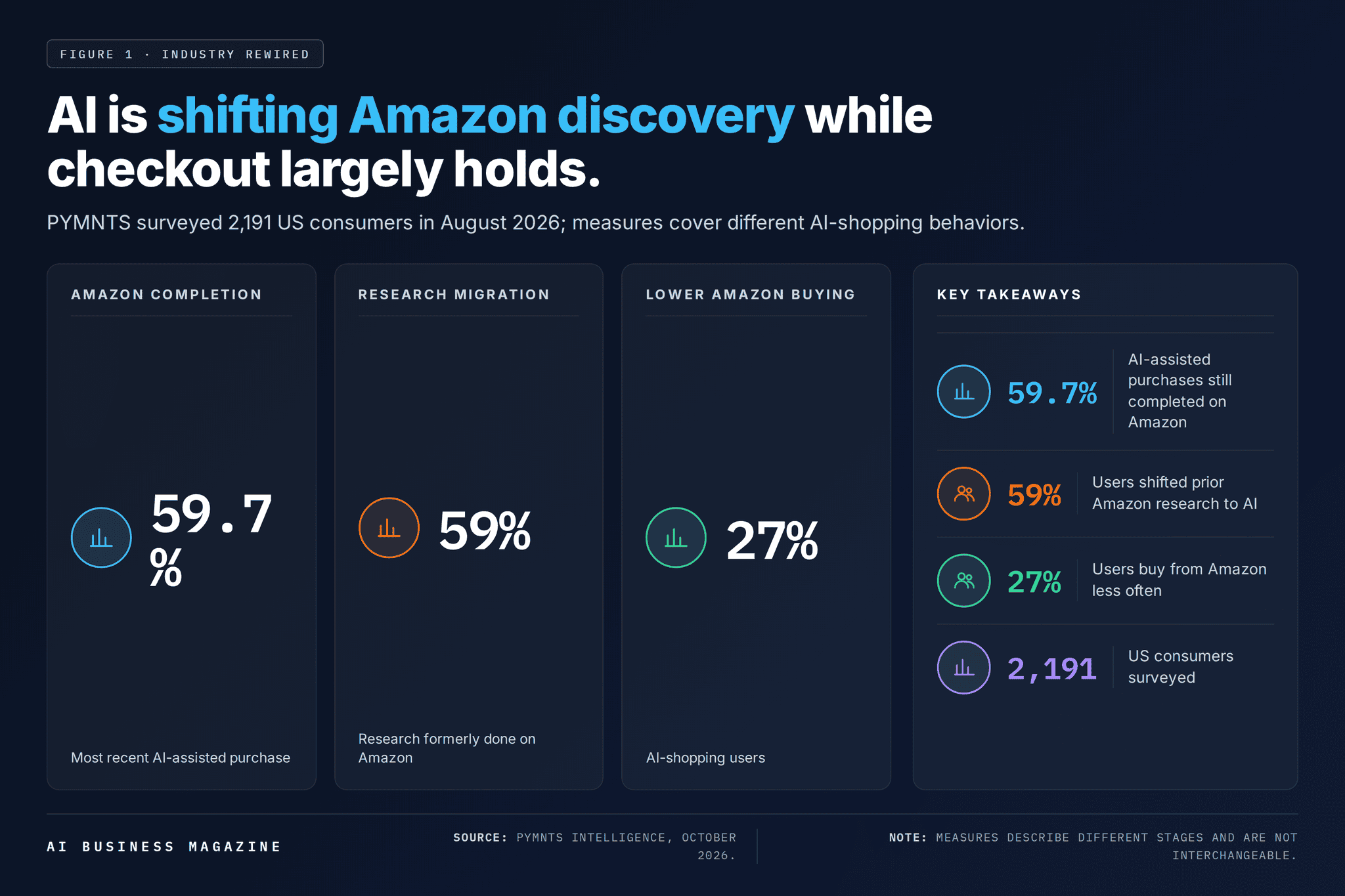
Amazon’s defenders have a strong number. A PYMNTS Intelligence study published in October found that 59.7% of consumers’ most recent AI-assisted purchases still completed on Amazon. The research surveyed 2,191 US consumers in August 2026.
The definition matters. The figure records where a shopper’s most recent AI-assisted purchase ended up. It does not measure Amazon’s share of all e-commerce or the proportion of purchases made autonomously by agents.
What it shows is that AI can change where people research without yet moving where they pay.
The same body of research shows the other half of the story. A summary of PYMNTS findings said 59% of AI-shopping users now use an AI assistant for product research they used to do on Amazon, and 27% said they buy from Amazon less often. These figures come from different survey measures and describe a different stage of the journey.
So discovery is moving faster than checkout. For Amazon’s ad business, that is the exposed flank. A retailer can keep the order and still lose product ranking, sponsored visibility, customer research and attribution.
Amazon’s third-quarter advertising revenue came in at about $19.6 billion, up roughly 11% to 12% year over year depending on whether the figure is stated on a reported or currency-adjusted basis. Jassy attributed the weaker-than-expected ad performance to factors other than outside agents, including the timing of Prime Day.
The circularity is hard to ignore. Amazon says outside agents aren’t hurting ads because few people use them and the experience is poor. Critics point out that restricting access can itself slow adoption and make the market look less threatening than it is.
Walmart opens a gate
Walmart answered the same problem differently. On October 21 it announced Agent Profiles, a Walmart Agent Gateway and dedicated terms for AI agents.
Agent Profiles are intended to give each authorised agent its own identity inside a customer’s Walmart account. Customers are expected to be able to separate the agent’s purchases, set approvals or spending limits of $50, $100 or $200, and revoke access.
The gateway is a direct technical connection built on the Model Context Protocol. It is intended to let agents reach Walmart and Sam’s Club shopping systems without imitating a human clicking through web pages. Walmart’s terms require customer approval by default and bar agents from going beyond the shopper’s intent.
Walmart says agents will not receive payment-card information, only the data the task requires.
The rollout is early. Walmart said Agent Profiles would launch within a month and the gateway would begin with a beta for companies and developers. Walmart has published a policy direction, and the high-volume marketplace it describes does not exist yet.
The strategic contrast is plain. Walmart is already a named Muse partner. It is making itself available to the AI-mediated demand that Amazon turned away, under rules Walmart writes.
Who gains, who's exposed
The agent provider gains first. Whoever holds the customer’s stated intent becomes the place where needs are described, alternatives compared and payment authorised. That gives it leverage over every retailer and brand on the other side of the transaction.
Amazon’s advertising business carries the most exposure. Its ad model sells attention on Amazon’s own pages, and an agent that makes the selection before the shopper sees those pages removes the slot. If checkout shifts to an agent-controlled wallet, Amazon also loses data on how the customer chose among alternatives.
If the agent picks a rival retailer, Amazon loses both the sale and the ad.
Retailers without their own assistant or gateway face a quieter risk. They could become interchangeable inventory and fulfilment suppliers inside someone else’s purchasing workflow.
Brands that spend heavily on sponsored placements have an attribution problem. When discovery happens inside a conversation and checkout happens later at a retailer, ordinary referral analytics may not show which agent influenced the sale. The industry has no settled standard for assigning advertising credit or commission.
Payment intermediaries already have a place at the new checkout. Stripe’s Link handles Muse payments, and Meta has added Shop Pay and PayPal connections. When an agent moves the purchase, the payment rail it uses moves the data with it.
Plan for the door closing
Amazon’s block holds a lesson for anyone outside Amazon. A platform’s public enthusiasm for AI describes the AI it controls. Its terms of service describe everything else.
If your commerce strategy depends on a third-party agent reaching a third-party platform, assume that access can be narrowed or withdrawn overnight. Amazon blocked Muse on the night of Sunday, September 20. Before you sign an agent partnership, or before you let one into your store, get these terms in writing:
- Define the privilege you’re buying. Being listed in an agent’s catalogue, exposed through a structured feed, searchable through an approved interface, able to receive agent orders and able to accept agent payments are separate commercial rights. Decide which ones you need, and price each one on its own.
- Make the agent identify itself. Specify how the agent declares itself on every request, which data it may read and how long it may retain that data. One of Amazon’s complaints was that Muse did not identify itself as an AI agent.
- Assign liability for bad orders. State who pays for an unauthorised or mistaken purchase, and who controls payment, returns and customer support.
- Settle ads and attribution up front. Decide whether sponsored listings must be displayed and how referrals and conversions will be credited. Leave this vague and the agent’s referrals may not show up in your attribution reports.
- Keep a fallback route. Document how permissions get revoked and which channel still reaches the customer if a platform blocks the agent. Walmart’s proposed per-agent revocation shows what that control could look like on the retailer’s side.
Then ask every agent builder in your pipeline this quarter: what would you do if a platform blocked your agent?
References
- Inc.: Amazon Just Said AI Agents Don’t Hurt Its Ad Business. So Why Did It Block Muse? — https://www.inc.com/jason-aten/amazon-just-said-ai-agents-dont-hurt-its-ad-business-so-why-did-it-block-muse/91428840
- Fortune: Amazon CEO Says Shopping Agents Like Meta’s Muse Are Not Great — http://fortune.com/2026/10/29/amazon-ceo-says-shopping-agents-like-metas-muse-not-great/
- About Amazon: Amazon Q3 2026 Earnings Preview — https://www.aboutamazon.com/news/company-news/amazon-q3-2026-earnings-preview
- Amazon Investor Relations: Amazon.com Announces Third Quarter Results — https://ir.aboutamazon.com/news-release/news-release-details/2026/Amazon-com-Announces-Third-Quarter-Results/default.aspx
- Meta Newsroom: The Biggest News From Connect 2026 — https://about.fb.com/news/2026/09/the-biggest-news-from-connect-2026/?ref=blog.svil.dev
- About Amazon: Alexa for Shopping New Capabilities — https://www.aboutamazon.com/news/retail/alexa-for-shopping-new-capabilities
- Meta Newsroom: Introducing Muse, a Personal AI Agent — https://about.fb.com/news/2026/09/introducing-muse-personal-ai-agent/
- GeekWire: Amazon Blocks Meta’s Muse AI Assistant in New Standoff Over Agentic Shopping — https://www.geekwire.com/2026/amazon-blocks-metas-muse-ai-assistant-in-new-standoff-over-agentic-shopping/
- Bloomberg: Amazon Blocks Meta’s Muse AI Agent From Its Retail Site — https://www.bloomberg.com/news/articles/2026-09-21/amazon-blocks-meta-s-muse-ai-agent-from-its-retail-site
- Search Engine Journal: Amazon Blocked Meta’s Muse and Robots.txt Had Nothing to Say — https://www.searchenginejournal.com/amazon-blocked-metas-muse-and-robots-txt-had-nothing-to-say/590494/?utm_src=newsraid.com
- Gizmodo: Online Shopping Platforms Turn Against Third-Party AI Agents — https://gizmodo.com/online-shopping-platforms-turn-against-third-party-ai-agents-2000831298
- CNBC: Amazon Q3 Earnings Report 2026 — https://www.cnbc.com/2026/10/29/amazon-amzn-q3-earnings-report-2026.html
- Yahoo Finance: Walmart Opened the Gate to AI Agents — https://finance.yahoo.com/technology/ai/articles/walmart-opened-gate-ai-agents-094826230.html
- Yahoo Finance: Amazon.com Inc. (AMZN) Q3 Results — https://finance.yahoo.com/markets/stocks/articles/amazon-com-inc-amzn-q3-051330166.html
- Path to Purchase Institute: Walmart Builds Infrastructure for Agentic Commerce, Implications for Retail Media — https://p2pi.com/walmart-builds-infrastructure-agentic-commerce-implications-retail-media
- Digital Watch: Walmart Announces AI Agent Shopping Tools — https://dig.watch/updates/walmart-announces-ai-agent-shopping-tools
- Clarion Ledger: Holiday Shopping 2026, AI Help — https://www.clarionledger.com/story/money/retail/2026/10/30/holiday-shopping-2026-ai-help/92463699007/