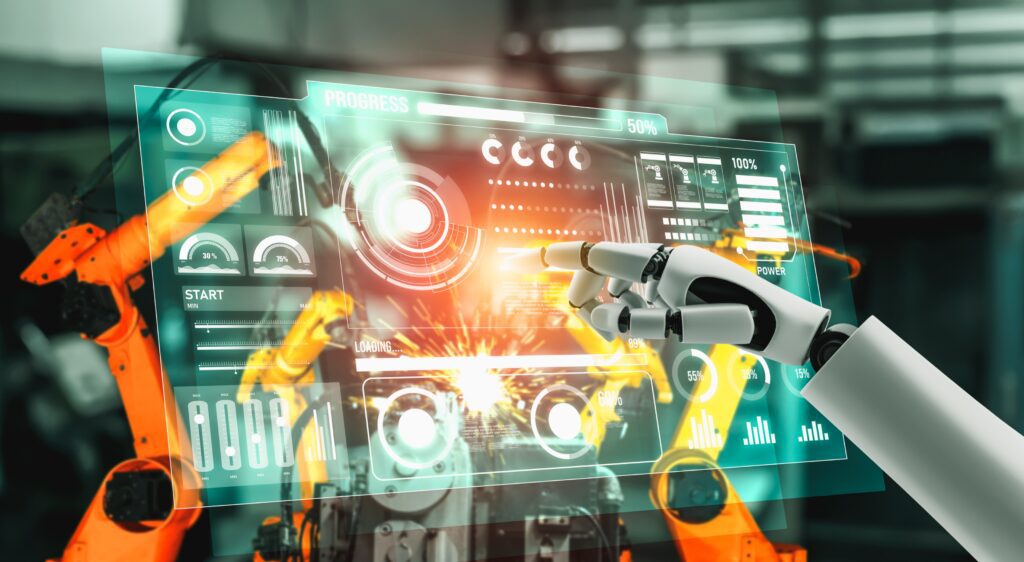
AI is revolutionizing manufacturing by enhancing efficiency, product quality, and operational flexibility. By 2025, AI adoption in manufacturing has become imperative, with significant investments and advancements in AI technologies.
- AI adoption in manufacturing has become imperative, with significant investments and advancements in AI technologies by 2025.
- AI is revolutionizing manufacturing by enhancing efficiency, product quality, and operational flexibility.
- By 2025, AI adoption in manufacturing has become imperative, with significant investments and advancements in AI technologies.
AI in Manufacturing: The Smart Factory Revolution and Industry 4.0
The manufacturing sector is undergoing a paradigm shift propelled by artificial intelligence in manufacturing. The integration of AI technologies in factory automation reshapes production capabilities, fostering unprecedented enhancements in efficiency, product quality, and operational flexibility. AI-driven manufacturing automation marks a revolution that will redefine competitive dynamics globally and establish new standards in industrial productivity.
AI’s relevance in manufacturing is no longer speculative—it is imperative. By 2024, an estimated 45% of manufacturing firms will have incorporated AI-powered manufacturing systems into their operations. The market for AI in manufacturing, valued at USD 5.32 billion in 2024, is forecasted to expand exponentially to USD 47.88 billion by 2030, registering a compound annual growth rate (CAGR) of 46.5%. This explosive growth underscores the critical role AI plays within Industry 4.0 smart factories, the comprehensive framework integrating digitization, automation, and data exchange. Industry 4.0 serves as the foundation upon which smart factories operate, blending AI with the Internet of Things (IoT), robotics, and cloud computing.
Global competitiveness and resilience challenges are driving this revolution. Manufacturing companies face economic uncertainties, supply chain disruptions, and rapidly evolving customer demands. Smart factories equipped with AI can respond to these challenges by enabling dynamic real-time decision making with AI, predictive maintenance powered by machine learning, and supply chain transparency. However, this transition is complex. Ethical concerns regarding data privacy and autonomous decision-making are emerging. The effectiveness of AI solutions hinges on data quality. The manufacturing sector faces a growing shortage of AI talent in manufacturing, complicating successful deployment.
Section 1: AI-Driven Automation Enhances Manufacturing Operations
Seamless integration of AI with IoT and cloud technologies is transforming traditional manufacturing workflows into highly efficient autonomic systems. AI automates critical processes such as order processing, smart inventory management with AI, real-time production monitoring, and customer service. Connected IoT sensors deliver continuous streams of operational data, feeding AI algorithms for near-instant analysis and decision-making. This enables predictive maintenance using AI—identifying machinery faults before failure—and continuous process optimization.
SourcePilot and FlowLens exemplify AI’s operational impact. SourcePilot deploys AI-powered workflow automation focused on scalable supply chain visibility. It tracks materials and components from sourcing through production, dynamically adjusting schedules and logistics to optimize throughput and reduce downtime. FlowLens leverages AI to optimize production planning and customer order management by analyzing historical and real-time data against demand forecasts, enabling agile responses to shifting market conditions.
Currently, 59% of manufacturers apply AI primarily for quality control, underscoring AI’s significant role in detecting defects and standardizing product outputs to minimize errors through AI-driven quality control systems.
Section 2: Generative AI and Autonomous Agents Transform Factory Systems
Generative AI and autonomous AI agents represent a step change in factory system capabilities. Generative AI—leveraging large language models and deep learning—creates new designs, simulations, and process adjustments through self-learning algorithms. Autonomous agents can independently perform inspection tasks, run experimentation cycles to optimize operations, and continuously refine manufacturing parameters.
Self-adaptive systems powered by generative AI for manufacturing enable machines to make real-time complex decisions without human input. For example, autonomous inspection robots can detect minute defects that manual quality checks might miss, then automatically adjust settings to correct process deviations. Generative AI accelerates innovation by suggesting new product designs or manufacturing methods based on data-driven insights. This level of autonomy fosters continuous improvement cycles that significantly reduce time-to-market.
Section 3: Industry 4.0—The Synergy of AI, IoT, and Robotics for Resilience
Industry 4.0 pillars—cyber-physical systems, IoT, cloud computing, and AI—form the architecture for next-generation manufacturing. There is a strategic shift from mass production toward AI-powered localized manufacturing, enabling flexible, customized, and small-batch production models. This transition better aligns with evolving consumer demands and market niches.
Smart factories reshape global supply chains by enhancing agility and transparency. AI-powered supply chain optimization unifies sourcing, production, and quality control data streams across distributed networks, enabling dynamic adjustments to supply risks and demand fluctuations. This integration bolsters business resilience by reducing dependencies on distant manufacturing hubs and minimizing disruption impacts.
AI-driven localized manufacturing disrupts traditional economies of scale by enabling profitability and competitive advantage in producing smaller, highly customized product volumes closer to consumers.
Section 4: Risks, Ethical Challenges, and Talent Shortages
Despite promising benefits, deploying autonomous AI systems entails ethical and safety concerns. Transparency in AI decision-making processes is vital for accountability. With machines executing decisions independently, establishing clear oversight mechanisms is mandatory to avoid unchecked errors or bias. Data privacy issues arise with extensive IoT sensor deployments, raising risks related to proprietary and personal information exposure.
AI in manufacturing is heavily dependent on data quality. Poor or biased data input can cause erroneous AI recommendations, resulting in costly production errors or safety incidents. Therefore, rigorous data governance in AI manufacturing and validation processes must accompany AI implementations.
The manufacturing AI talent shortage presents a critical barrier. Skilled AI professionals with expertise in manufacturing workflows, real-time monitoring, and industrial automation are in short supply. This gap threatens to slow down AI adoption, reducing competitiveness for lagging firms. Workforce development initiatives that include upskilling existing staff and recruiting AI specialists are essential to bridge the divide. Companies investing in training programs and industry partnerships stand poised to capture the full value AI offers.
Implications
The integration of AI into manufacturing delivers measurable improvements in efficiency, operational cost reduction, and product quality. Early adopters report productivity increases and supply chain responsiveness gains, translated into a 6%-10% average revenue uptick. AI enables predictive maintenance to reduce unplanned downtime and enhances asset utilization. AI-powered quality control reduces defect rates, ensuring better product consistency.
Competitively, firms deploying AI effectively acquire advantages in market agility and innovation speed. This transforms operational models, as AI augments human roles—shifting labor from routine monitoring to strategic oversight and exception management. Such workforce transformation requires concerted AI workforce upskilling efforts to equip personnel for collaborative work with AI technologies.
Ethical governance frameworks are prerequisites for trust and safety, assuring stakeholders that AI systems operate fairly and transparently with appropriate human supervision. Without these safeguards, risks of undesirable outcomes or regulatory sanctions increase.
AI-empowered supply chains and flexible factory configurations underpin business continuity. They mitigate vulnerabilities to global disruptions such as geopolitical instability or pandemics by enabling rapid production reconfiguration and localized manufacturing.
Future Outlook
The trajectory for AI in manufacturing is rapid and expansive. Smart factory deployments worldwide are poised to grow, underpinned by continuous advancements in generative AI and autonomous agents that will deepen factory intelligence and autonomy. AI ecosystems integrating end-to-end sourcing, production, and delivery processes will become standard operational architectures.
Industry focus is sharpening on ethical AI implementation and workforce skill development, both essential to maximizing AI’s transformative impact. The ongoing shift towards AI-powered localized manufacturing promises to disrupt global supply chain dynamics further, fostering innovation, lowering environmental footprints, and creating more resilient production networks.
This comprehensive outlook on AI in manufacturing elucidates the Smart Factory Revolution and Industry 4.0 as foundational shifts with profound implications. Stakeholders must advance technology adoption deliberately while managing ethical, data, and talent challenges to fully realize AI’s potential in shaping the future manufacturing landscape.
Glossary
- Industry 4.0: The current trend of automation and data exchange in manufacturing technologies, including cyber-physical systems, IoT, and AI-driven processes.
- Smart Factory: A digitally connected and automated manufacturing facility utilizing AI, robotics, and IoT to optimize operational efficiency and flexibility.
- Generative AI: AI technologies capable of producing new content, designs, or data patterns based on training from large datasets.
- Autonomous AI Agents: AI systems operating independently with minimal human input to execute complex industrial tasks such as inspection, decision-making, and optimization.
Frequently asked questions
What are the key benefits of AI in manufacturing?
AI enhances manufacturing by improving efficiency, product quality, and operational flexibility. It enables predictive maintenance, real-time production monitoring, and smart inventory management, leading to reduced downtime and optimized throughput.
How has AI adoption in manufacturing evolved by 2025?
By 2025, AI adoption in manufacturing has become imperative, with significant investments and advancements in AI technologies. Manufacturers are integrating AI into their operations to stay competitive and meet evolving market demands.
What challenges do manufacturers face when implementing AI?
Manufacturers face challenges such as data quality issues, siloed systems, and a lack of outcome-driven planning. Overcoming these requires building scalable, trustworthy IT infrastructure and fostering integrated, collaborative teams.
How does AI contribute to Industry 4.0?
AI is a cornerstone of Industry 4.0, integrating with IoT, robotics, and cloud computing to create smart factories. This synergy enables dynamic real-time decision-making, predictive maintenance, and supply chain transparency.