AI in Retail: Personalization, Inventory, and the Future of Commerce
A shopping experience so tailored and seamless, it feels as if the store knows you better than yourself—this is the power of artificial intelligence in retail transforming commerce today. Gone are the days when customers navigated generic product grids or waited in checkout lines without engagement. AI-powered retail solutions are revolutionizing how retailers connect with consumers, manage inventory, and prepare for a commerce landscape that blends human intuition with machine autonomy. This transformation is not incremental; it is foundational. Retailers who integrate advanced AI technologies strategically stand to reshape customer journeys, operational efficiency, and competitive positioning. This article examines AI’s impact in three critical retail domains—AI-driven personalization, inventory management automation, and the emerging agentic commerce—and outlines the talent adaptations fueling this next era of commerce.
The retail sector is amidst an unparalleled digital transformation, accelerated by pandemic-induced shifts in consumer behavior and supply chain fragility. Demand for seamless omnichannel experiences and real-time insights into customer preferences has never been greater. Retailers face mounting pressure to optimize every touchpoint, from digital storefronts to backend logistics. This imperative has driven AI integration in retail operations from experimental use cases into core business processes. Recent data shows that over 70% of retailers have adopted AI-driven personalization, inventory optimization AI tools, or automated commerce functions. The economic stakes amplify this urgency: global retail AI market size is projected to exceed $30 billion by 2027. For businesses navigating razor-thin margins and intense competition, machine learning in retail delivers quantifiable value through operational cost reductions, increased conversion rates, and better inventory utilization.
The road ahead is clear—retail’s digital future will be defined by AI’s ability to synthesize vast data and automate complex decisions. However, these advances come with challenges spanning data privacy concerns, evolving workforce demands, and emergent governance of autonomous AI agents. Below, we deconstruct the key domains where AI’s impact is already reshaping retail commerce.
Personalization Drives Customer Engagement
Artificial intelligence-driven personalization is the most visible and immediate way retailers engage customers. AI-powered recommendation engines analyze browsing behavior, purchase history, and social signals to deliver product suggestions with uncanny precision. This capability accounts for as much as 31% of ecommerce revenues during engaged sessions, a figure that underscores the direct revenue impact of AI personalization strategies in ecommerce. Brands that employ AI recommendations report significantly higher conversion rates and average order values compared to those relying on traditional, rule-based merchandising.
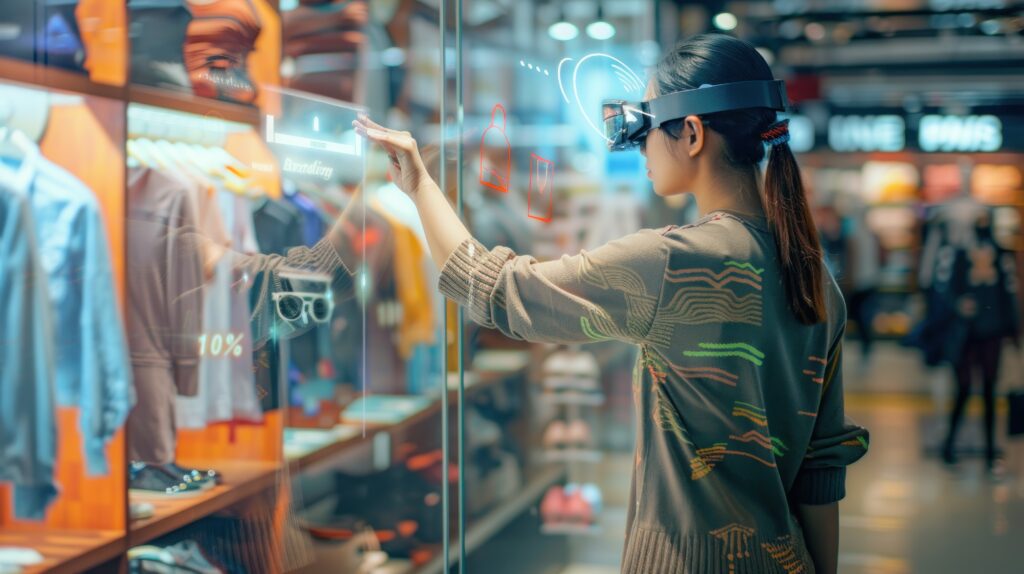
Beyond recommendations, AI enables immersive customer experiences through virtual try-ons powered by augmented reality (AR) and AI-generated digital twins. AR virtual try-ons allow customers to “wear” eyewear, apparel, or cosmetics virtually before buying, significantly reducing return rates. According to industry research, more than 70% of shoppers say AR try-ons increase their likelihood to buy a product, while 40% indicate a willingness to pay premium prices for these experiences. Leading platforms integrate computer vision technology and deep learning models to replicate size, fit, and aesthetics accurately in real-time on mobile devices.
AI chatbots for retail also extend personalization through conversational interfaces capable of handling complex queries, personalized product suggestions, and customized promotions. The interplay between these technologies creates a hyper-personalized shopping journey that adapts dynamically as consumer preferences evolve.
Yet, personalization is not without challenges. Data privacy compliance in AI remains a critical concern as retailers collect and process sensitive customer information. Regulations like GDPR and CCPA demand transparency and responsible data handling. Additionally, maintaining real-time personalization accuracy requires sophisticated big data infrastructure for retail capable of processing high-velocity data streams and integrating cross-channel customer data without latency or error.
Notable technology platforms enabling these capabilities include Amazon Personalize, Google’s Recommendations AI, and Shopify’s AI apps, which offer scalable solutions for businesses ranging from startups to global enterprises.
AI Optimizes Inventory Management
Inventory management has historically been a pain point for retailers, plagued by inaccurate forecasts, stock imbalances, and inefficient replenishment cycles. AI’s application in this domain is revolutionizing supply chain dynamics by enabling precise demand forecasting with machine learning, real-time inventory tracking, and automated sell-through analysis.
Machine learning algorithms process historical sales data alongside external factors such as seasonality, market trends, promotions, and even economic indicators to predict inventory needs with unprecedented accuracy. According to case studies, AI-driven demand forecasting reduces errors significantly, leading to a 10–20% reduction in inventory holding costs and a substantial decrease in stockouts—situations where high demand is unmet due to lack of product availability.
Integration of AI-powered inventory optimization tools with platforms like Shopify and ERP systems allows automated purchase order generation and dynamic stock allocation across store locations. This automation both minimizes human error and frees operational staff to focus on exceptions requiring critical thinking.
Real-time inventory tracking enhanced by AI-powered IoT sensors and IoT devices provides transparency across the supply chain. Retailers gain early warning signals of potential disruptions allowing proactive adjustments. Furthermore, analytics derived from AI enable smarter promotions to accelerate slow-moving stock and reduce waste. This is especially valuable for perishable goods or fashion apparel subject to trends.
However, vendor cooperation remains an obstacle. Retail ecosystems involving multiple suppliers and distributors often lack data sharing standards or sufficient incentives for real-time transparency, limiting the potential of end-to-end AI supply chain optimization. Policymakers and industry groups face the task of addressing these gaps through data governance frameworks for retail.
The financial impact is clear. Retailers employing AI for inventory management report a 15–30% reduction in operational costs related to inventory and logistics. These savings translate to improved profitability and a competitive edge in fulfillment speed.
Agentic Commerce Will Transform Retail
Looking beyond current AI applications, agentic commerce in retail represents a radical evolution where autonomous AI agents act as digital shopping assistants or buyers on behalf of consumers. These agents leverage natural language processing, identity verification, and complex negotiation algorithms to fulfill shopping tasks with minimal human supervision. The concept elevates AI from a support tool to an independent commerce actor.
Economic projections place agentic commerce as a $1 trillion industry in US retail revenue by 2030, potentially commanding 25% of the total ecommerce market. Such agents will execute activities ranging from sourcing deals and managing subscriptions to personalized reordering, all while negotiating vendor terms.
The emergence of autonomous AI agents for commerce requires robust frameworks for trust and security. Protocols verifying agent identity, ensuring transparent interactions, and preventing monopolistic behaviors are essential to avoid market distortions or fraud. Industry leaders like OpenAI and Stripe are pioneering standards and APIs designed to maintain an ecosystem where multiple agents compete fairly and securely.
This technology raises critical concerns. Loss of human oversight risks errors or decisions misaligned with consumer intent. There is potential for agents to consolidate power, disadvantaging smaller retailers or consumers dependent on a few dominant AI intermediaries. Addressing these risks demands proactive regulatory and technological governance.
Nevertheless, AI agent-based shopping assistants promise to redefine retail’s value chain by automating routine buying tasks, reducing friction, and creating new personalization layers beyond current capabilities. Early deployments include concierge-style agents for luxury goods and automated replenishment services for everyday household items.
Growing Demand for AI Talent in Retail
The expansion of AI across retail functions is shifting workforce requirements dramatically. Specialists in AI and machine learning, particularly those skilled in personalization algorithms, AI chatbot development for ecommerce, and supply chain machine learning optimization, are in increasing demand. Retailers prioritize expertise with platforms that blend AI and operations, such as Shopify for ecommerce storefronts, Zapier for process automation, and OpenAI’s APIs for natural language and agentic capabilities.
Adapting workforce strategies to blend human and digital workers becomes a competitive imperative. Retail organizations are experimenting with hybrid models where AI handles data-intensive or transactional tasks while humans oversee strategy, customer relationships, and ethical considerations.
Training and upskilling programs must evolve rapidly to close skill gaps. Upskilling frontline retail staff on AI tool utilization and recruiting data scientists with domain expertise in retail analytics and machine learning are parallel priorities. Internal collaboration between IT and business units ensures solutions respond to operational realities, not just technological possibility.
Talent shortages remain a significant bottleneck. Retailers that fail to invest in developing or acquiring AI proficiency in retail risk falling behind in delivering personalized experiences and operational efficiency at scale.
Implications
The real-world business impact of AI in retail is evident. Personalized product recommendations and immersive AR try-ons drive higher conversion rates and order values, translating directly into increased sales and customer retention. AI-powered inventory management systems strengthen supply chains, reduce waste, and enable retailers to fulfill orders more reliably and cost-effectively. Together, these capabilities contribute to better margins and scalability.
From the consumer perspective, AI is reshaping expectations. Shoppers increasingly demand that brands know their preferences, respect their time, and offer interactive experiences that emulate in-person shopping advantages online. AI delivers these benefits by offering convenience, confidence in purchasing decisions, and ongoing relevance.
Operationally, the benefits hinge on data quality, vendor collaboration, and technology integration. Vendors unwilling or unable to share data limits AI inventory optimization effectiveness. Data privacy and security in AI retail applications pose legal and reputational risks, requiring rigorous governance. The rise of agentic agents introduces new challenges around trust and control—how consumers and retailers ensure AI acts in alignment with their interests.
Early AI adopters in retail gain a competitive advantage by operating with greater agility, customer understanding, and lower operating costs. Yet these benefits require sustained investment in technology, workforce, and governance.
Future Outlook
Looking forward, retail will further converge AI-powered digital twins, augmented reality shopping experiences, and agentic AI technologies to push the boundaries of personalization and automation. Industry standards defining identity verification, interoperability, and ethical practices for AI agents will solidify, ensuring agentic commerce scales sustainably and securely. Workforce demands for AI skills will continue rising, prompting retailers to deepen hybrid human-AI operational models and invest heavily in training.
By 2030, we expect retail ecosystems transformed—where AI is not merely an enhancement but the foundation. Autonomous agents will transact on behalf of consumers regularly, supply chains will react in real-time to global trends, and personalized experiences will be the baseline customer expectation. Those who fail to integrate AI intelligently risk irrelevance in a market that rewards precision, speed, and trustworthiness.
This analysis establishes that AI is no longer optional for retailers aspiring to leadership. The shift to AI-powered personalization, inventory optimization, and agentic commerce demands decisive action to build capabilities, mitigate risks, and capitalize on emerging market potential. The winners will be those that align technology investments with clear business objectives and governance frameworks—ushering in a new retail era optimized for the digital age.