
Microsoft announced a voluntary exit program for about 60,000 employees amid its restructuring and increased AI adoption. The decision highlights which roles are seen as replaceable by AI and which are essential to the company's operations, though the program is not presented as a direct replacement of jobs by AI.
- Eligible employees are from specific teams, such as finance and HR, which involve routine tasks suitable for AI.
- Roles in marketing, security, and data centers are excluded, indicating Microsoft sees different staffing needs there.
- Microsoft anticipates a low uptake of the voluntary offer and is managing workforce changes cautiously.
Microsoft offered voluntary exits to about 60,000 employees on October 26. The teams it included, and the teams it left out, show where it thinks smaller teams and AI can carry more of the work.
The number that travelled
When a company wants fewer people, it usually chooses them. Managers rank teams, HR drafts the notices, and the cuts arrive on a single morning.
Microsoft tried the opposite order this autumn.
On October 26, 2026, Chief People Officer Amy Coleman announced a Voluntary Exit Offer for about 60,000 eligible employees. The offer covers participating teams in the United States, Canada, India and the United Kingdom, at internal level 70 or below. Microsoft employed approximately 223,000 full-time people as of June 30, 2026.
The 60,000 figure spread quickly, usually beside the word AI. It counts eligibility. Microsoft has not said 60,000 jobs will disappear, and it has not presented the program as AI replacing staff.
If you plan workforce changes around AI adoption, the design of the offer is the useful part. It shows which functions a large AI vendor is willing to thin out first and which it is guarding. It also shows how much a voluntary program can tell you before any jobs are actually gone.
Who got the offer and who didn’t
Participation is decided team by team. Coleman’s announcement said it varies by organization according to business priorities, customer commitments and workforce needs. Two employees at the same level can be treated differently depending on where they sit on the org chart.
Reuters reported the participating areas as AI Experiences, Copilot, finance, human resources, Xbox, and Windows + Devices. Marketing, the commercial business and security were reported as excluded. Other reports said some data-center, sales and engineering groups were not participating.
Finance and HR are the clearest signal. Both functions carry a lot of repeatable information handling, such as preparing reports, answering routine employee questions, processing transactions, drafting documents, routing cases and maintaining records. Those are the workflows where AI tools and process redesign can most plausibly reduce the hours a team needs.
Copilot and AI Experiences point somewhere else. Microsoft is reorganizing the teams that build and commercialize its AI products, which suggests reshaping around those products rather than replacement by them. Xbox and Windows + Devices look like product and portfolio restructuring, with no direct AI substitution established.
The exclusions tell you as much as the inclusions.
Marketing, commercial and security sit close to revenue, customers and risk. Data-center teams sit close to the infrastructure Microsoft is racing to build. Leaving them out says Microsoft sees different staffing needs there today.
It doesn’t make those roles safe from automation later.
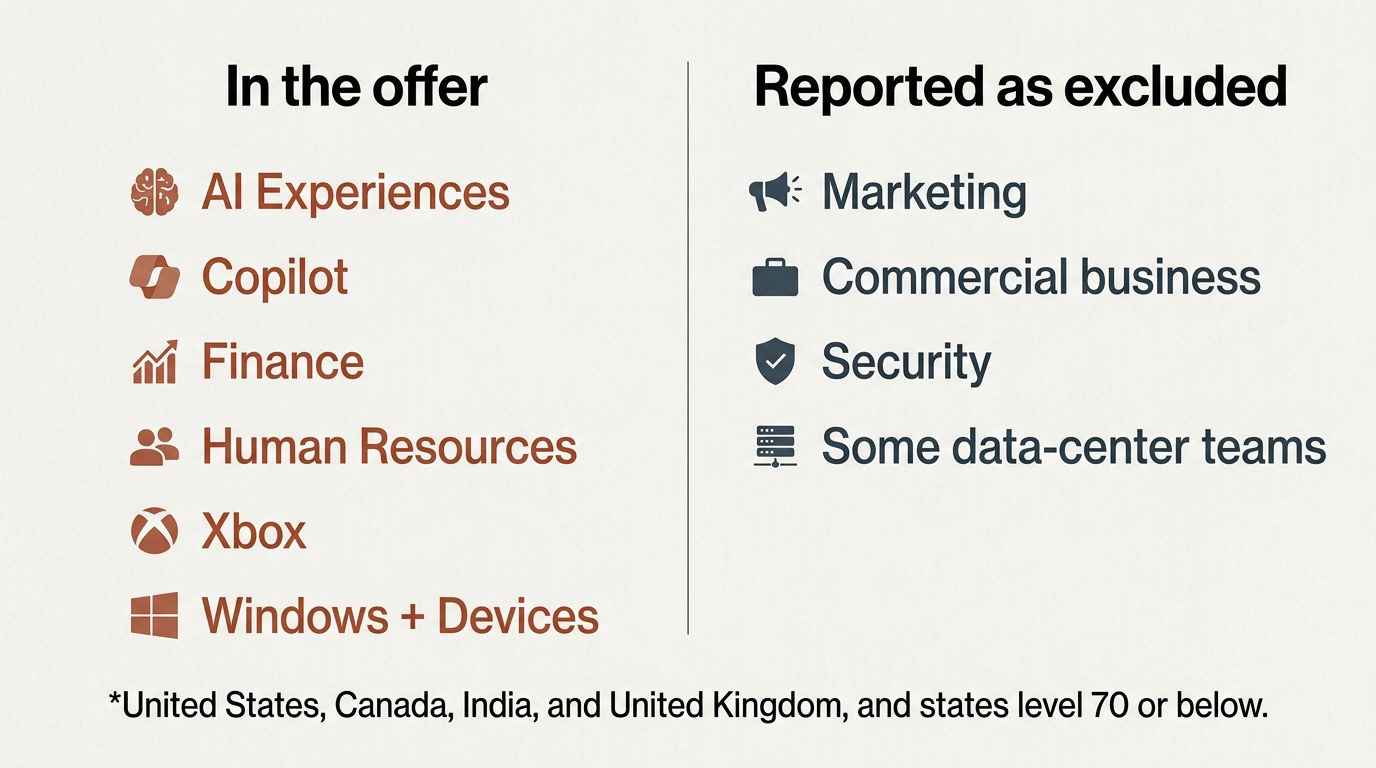
Microsoft opened the offer to selected functions while leaving revenue-, risk- and infrastructure-adjacent teams outside it.
A standard package with modest expectations
Microsoft’s public memo kept the terms general. Eligible employees were promised individual offer details by email, covering financial support and career-planning resources.
Reports citing Microsoft and people familiar with the offer filled in more. Reports said employees had until early December 2026 to decide and that those who accepted were due to leave on December 31, 2026. The package was described as similar to Microsoft’s standard severance.
At least one report cited a minimum of eight weeks of base pay for U.S. employees, varying with tenure and level.
That is hardly a lavish lure. Microsoft reportedly expects limited participation and points to a 3–5% uptake range in comparable voluntary programs. No verified acceptance figure was available by November 1.
Microsoft has also not disclosed the program’s expected cost, its savings target or a final headcount reduction.
So what is the offer for, if few people are expected to take it?
Part of the answer is sorting. Employees declare who wants to go, and the business learns which people and capabilities it is about to lose before it picks anyone for involuntary redundancy. That spares the company the legal and morale cost of a layoff, at least for this round.
The sorting has a catch. The people most willing to leave may be specialists with good outside options, while people in less portable roles stay. For an employee whose team has just been listed as participating, the offer can also read as a verdict on the team’s future, formal notice or not.
July set the terms
The voluntary offer followed a compulsory round. On July 6, 2026, Microsoft eliminated about 4,800 roles, approximately 2.1% of its global workforce, while restructuring commercial and Xbox operations. The Xbox changes included about 3,200 cuts and the closure or divestment of several studios, according to Reuters.
Coleman took on the AI question directly at the time. In Microsoft’s July communication, she said the eliminated roles were not being replaced by AI. She also acknowledged that AI was changing how work was done and automating some routine tasks.
Her October announcement was more cautious still. It leaned on flexibility, financial support, career planning and organizational adaptation, and it does not say Copilot or any other system will do the work of people who leave.
Read together, the two rounds describe an indirect effect. AI can lower the number of people a process needs without a one-for-one software swap, through fewer coordination layers, smaller project teams, faster document production and more automated support. That pattern is harder to point at than a robot taking a desk, and it can matter just as much to headcount.
The capital bill on the other side
The pressure on headcount comes from the spending column. Microsoft spent $115.9 billion on property and equipment in fiscal 2026, with much of the increase reflecting data centers, servers and related infrastructure.
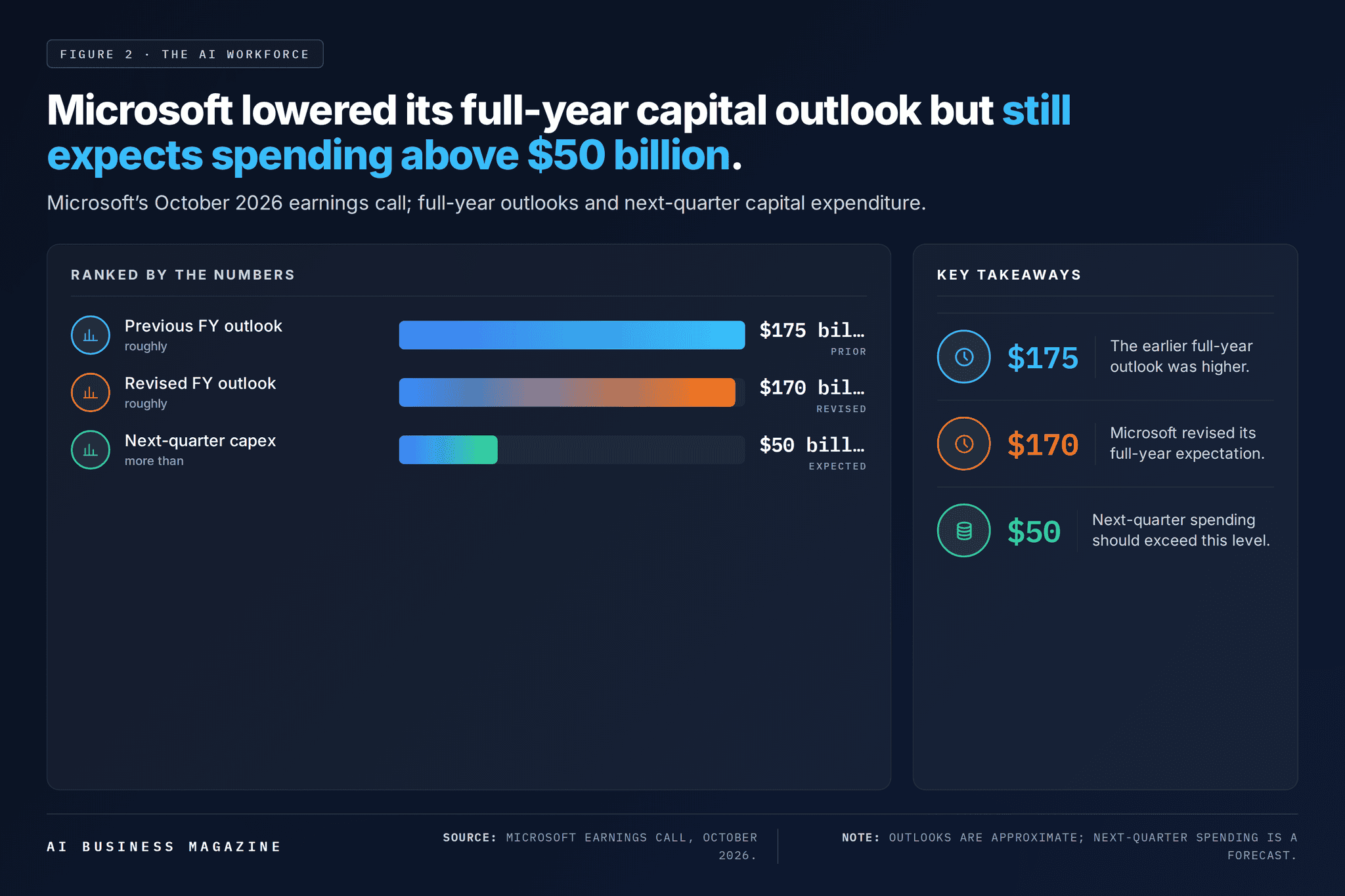
On its October 2026 earnings call, Microsoft reported quarterly capital expenditure of $37.5 billion, with roughly two-thirds going to short-lived assets, principally GPUs and CPUs. It said it expected more than $50 billion in the following quarter. It also cut its full-year capital-spending expectation from roughly $175 billion to roughly $170 billion, partly because of delayed third-party GPU capacity.
Headcount programs can lower recurring compensation costs or move people toward faster-growing products. Spending at that scale while protecting margins gives any finance team a reason to look at payroll.
How Microsoft says it rebuilds work
Kathleen Hogan, Microsoft’s chief strategy and transformation officer, has given the company’s own account of the end state. In September she wrote that Microsoft aims to become a “Frontier Firm,” in which people remain responsible for judgment and accountability while AI expands what teams can accomplish.
Her central lesson was blunt. Licensing an AI tool does not transform work. Teams have to redesign complete workflows, define permissions and keep human review where it is required.
Of the patterns Hogan described, process redesign matters most for the teams in this offer. In that pattern a workflow is rebuilt around people, agents, data and approval points.
The examples come from inside Microsoft. A supply-chain team deployed more than 100 purpose-built agents across planning, sourcing, fulfillment and logistics, and selected workflows became faster, based on Microsoft’s own analysis. A nine-person engineering team delivered an initial product release in 35 days using AI throughout.
Microsoft’s footnote cautions that it was one dedicated project and should not be read as a company-wide benchmark.
Those cases show the mechanism the exit offer depends on. A departure saves money only if the work stops, is absorbed by remaining staff, moves to another team, is outsourced or is handled by software. If managers end up rehiring, paying overtime or keeping contractors, the headcount saving never reaches the operating line.

AI changes headcount only when the workflow itself is rebuilt—and when responsibility for the final decision remains clear.
Redeployment without a roster
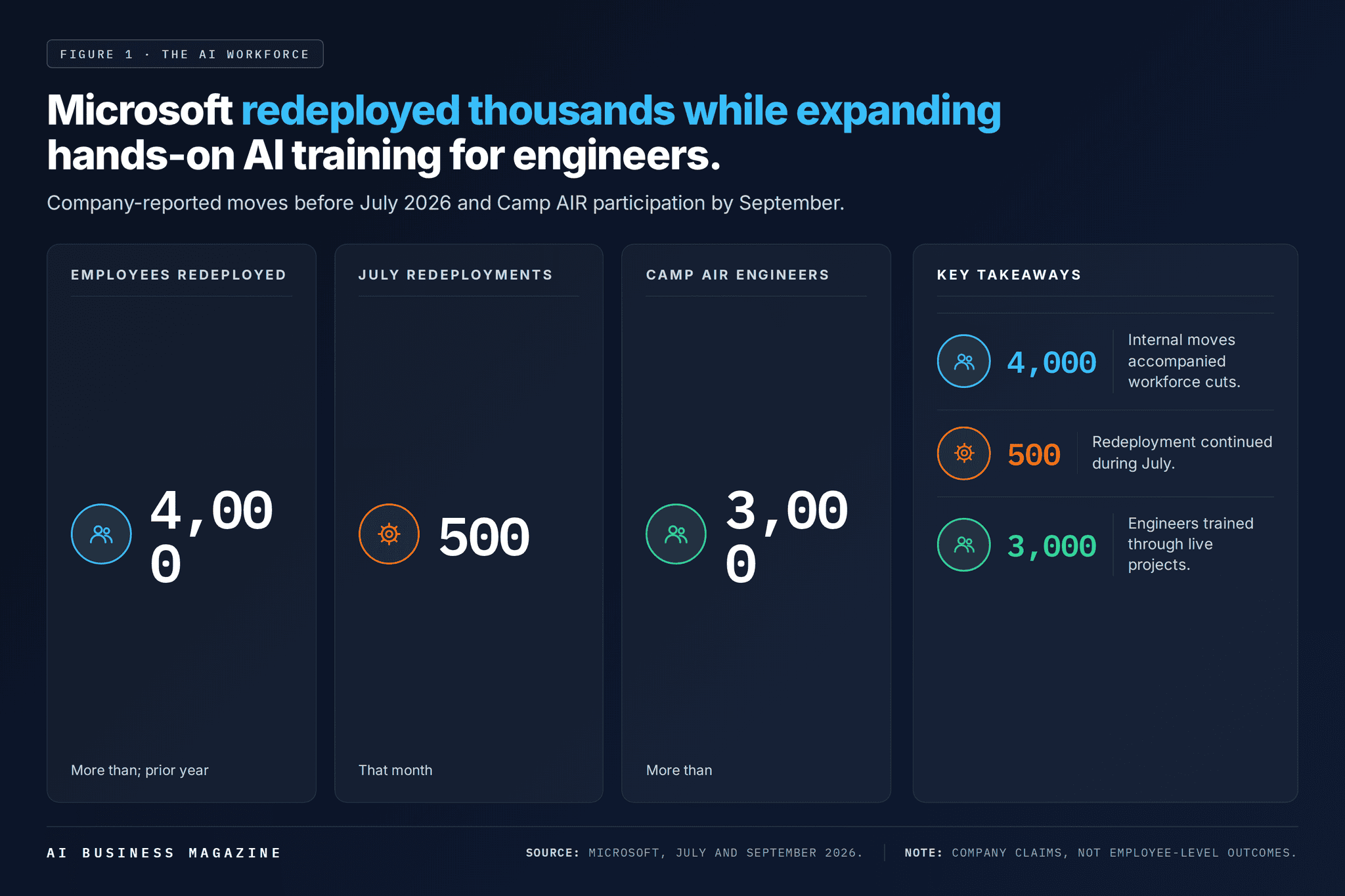
Microsoft points to internal moves as its counterweight to cuts. It said that in the year before July 2026 it redeployed more than 4,000 employees into new roles, including 500 that month. Coleman presented redeployment as preferable to eliminating roles where possible.
Brad Smith, Microsoft’s president, separately told the Seattle Times the company had redeployed about 4,000 people affected by earlier reductions. Reporting based on Microsoft’s statements said the company was reskilling and relocating workers while still hiring for new teams.
Training runs alongside. Hogan said the Camp AIR accelerator, which puts cross-functional teams on a live business problem while they learn AI tools, had expanded to more than 3,000 engineers. Microsoft’s conclusion was that individual training fell short, and that adoption lasted when teams experimented together, discussed role changes and built confidence.
The annual report describes continuous learning through internal and external content, grants and LinkedIn learning pathways. It sets no timetable linking those programs to the employees eligible for the October offer.
That link is what an employee in a participating finance team actually needs. A named destination role, with a start date and protected pay, weighs more against eight weeks of base pay than a learning catalog does.
What December 31 will show
Reports said accepted departures were due to take effect on December 31, 2026. Watch finance, HR and the Copilot teams first. If acceptance runs high there, the next test is whether Microsoft can hold customer service, security, product quality and employee workload steady with fewer people doing the work.
References
-
Microsoft voluntary buyouts (CNBC) — https://cnbc.com/2026/10/26/microsoft-msft-voluntary-buyouts.html
-
Microsoft buyout offer (AP News) — https://apnews.com/article/c5a639f53615be198db1799adf6837e1
-
Microsoft buyout, AI, layoffs and Xbox (AP News) — https://apnews.com/article/microsoft-buyout-ai-layoff-xbox-c5a639f53615be198db1799adf6837e1
-
Microsoft offers buyouts to 60,000 staff as AI costs mount (HCAMag) — https://www.hcamag.com/us/specialization/change-management/microsoft-offers-buyouts-to-60000-staff-as-ai-costs-mount/594977
-
Microsoft offers 60,000 employees voluntary buyouts as AI spending accelerates (13abc) — https://www.13abc.com/2026/10/26/microsoft-offers-60000-employees-voluntary-buyouts-ai-spending-accelerates/
-
Microsoft 60,000 employee buyouts amid AI spending (USA Today) — https://www.usatoday.com/story/money/business/2026/10/27/microsoft-60000-employee-buyouts-ai-spending/92457423007/
-
Microsoft offers voluntary exit packages to 60,000 staff (AFP) — https://www.afp.com/en/microsoft-offers-voluntary-exit-packages-60000-staff-0
-
Microsoft voluntary buyout (CBC News) — https://www.cbc.ca/news/business/microsoft-voluntary-buyout-9.7396520
-
Microsoft buyouts for 60,000 workers amid artificial intelligence layoffs (CBS News) — https://www.cbsnews.com/news/microsoft-buyouts-60000-workers-artificial-intelligence-layoffs/
-
Microsoft offers voluntary exit packages to 60,000 staff (AFP) — https://www.afp.com/en/microsoft-offers-voluntary-exit-packages-60000-staff
-
Microsoft offers buyouts to around 60,000 employees, reports say (TechCrunch) — https://techcrunch.com/2026/10/26/microsoft-offers-buyouts-to-around-60000-employees-reports-say/
-
Microsoft voluntary exit offer buyout for 60,000 employees (Fortune) — https://fortune.com/2026/10/30/microsoft-voluntary-exit-offer-buyout-60000-employees/
Frequently asked questions
What was the purpose of Microsoft's voluntary exit program?
The program aimed to reduce headcount while allowing employees to voluntarily leave, reflecting Microsoft's strategy to adapt to AI integration in certain roles without involuntarily laying off staff.
Which teams were included in Microsoft's voluntary exit offer?
Teams included in the offer are AI Experiences, Copilot, finance, human resources, Xbox, and Windows + Devices, while marketing, commercial business, and security teams were excluded.
How many employees are eligible for the voluntary exit offer?
Approximately 60,000 employees at internal level 70 or below in select teams across the United States, Canada, India, and the United Kingdom are eligible for the voluntary exit offer.
What kind of financial support is offered to employees who accept the buyout?
Eligible employees were promised general details about financial support and career-planning resources, which reportedly include a minimum of eight weeks of base pay for U.S. employees, varying by tenure.
What has been Microsoft's recent approach to staffing amid AI changes?
Microsoft has been reducing its workforce through voluntary offers and restructuring while emphasizing the importance of AI in redesigning workflows rather than simply replacing personnel.