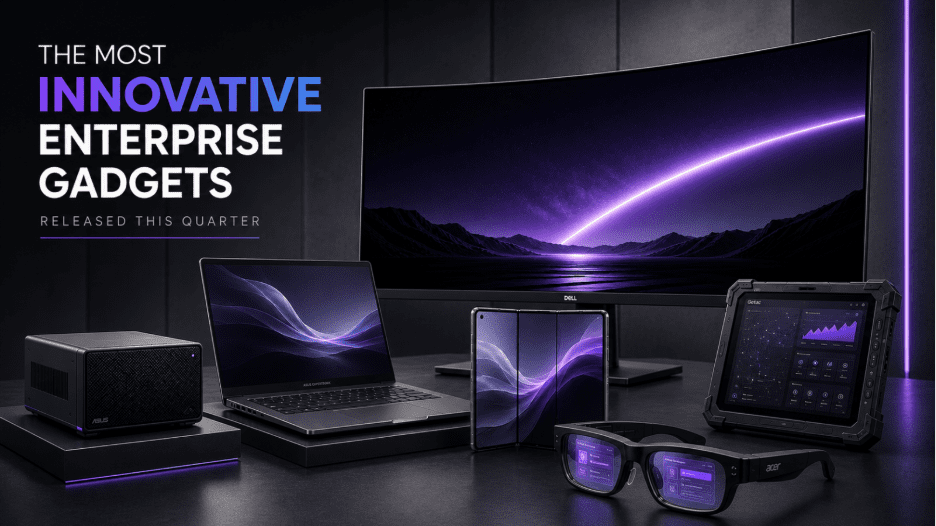
Six physical devices spanning compute, displays, mobiles, outdoor civil work, and augmented reality. Every gadget on the list is verified, in-market, and built with the newest 2026 technology that definitely did not exist for deployment less than two years ago.
In Q2 2026, three key technological developments all came together to create an exceptional array of high-quality professional tools. First, on-device Artificial Intelligence (AI) Inference has reached mainstream performance. NPUs (neural processing units) have achieved approximately 50 trillion operations per second in ultralight laptops and over 1,000 trillion operations per second for desktop-class systems. Second, companies have started to migrate from traditional Windows OS-based environments to ARM OS-based environments. This has enabled true edge usage of AIs with multiple days’ battery life in MIL-STD-810H compliant rugged devices. Third, micro OLED optics have progressed sufficiently that dual 1080p displays fit within a wearable device weighing less than 70 grams. Therefore, users can work within the same conditions as if they were using an actual computer screen.
As a result of these advancements, devices developed for use in the field no longer require physical infrastructures protected from climate change and other forms of damage. Devices using NPUs process all sensitive information in a distributed manner (no outside connection) and as close to real-time as possible. By utilizing ARM OS-based rugged tablets in the field, users are also able to utilize the full features offered by their Windows desktop configuration without needing to return to a traditional configuration. Finally, by using micro OLED display glasses instead of standard monitors, users can employ their full-sized device without using an external monitor. In conclusion, each professional device presented in this quarter’s overview will help professional users significantly reduce their usage of resources.
These six devices go from a $499.99 AR-based wearable to a $2,999 petaflop compute node and have their own applications, budgets, and deployment scenarios. They all share one consistent purpose for their build: to deliver consumers the best enterprise hardware of 2026 with more capability and fewer dependencies.
|
Device |
Category |
Price |
Defining Hardware Spec |
Primary Deployment Use |
Portability |
|
ASUS Ascent GX10 |
AI Supercomputer |
$2,999 |
NVIDIA GB10, 1 petaFLOP, 128GB unified memory |
On-prem AI dev, model fine-tuning |
Desk-bound |
|
ASUS ExpertBook Ultra |
Business Ultrabook |
~$2,870 |
Core Ultra X9, 50 TOPS NPU, 0.99kg, vPro |
Mobile execs, IT-managed fleets |
Full mobility |
|
Dell UltraSharp 52 |
Professional Monitor |
$2,899 |
52-inch 6K IPS Black, 120Hz, TB4 KVM, 2.5GbE |
Analysts, traders, engineers |
Fixed workspace |
|
Samsung Z TriFold |
Foldable Phone |
$2,899 |
10-inch AMOLED, Snapdragon 8 Elite, 16GB RAM |
Traveling execs, field roles |
Full mobility |
|
Getac ZX80W-EX |
Rugged AI Tablet |
~$2,199 |
Qualcomm QCS6490 ARM, Hexagon NPU, IP67, 1000-nit display |
Field operations, utilities, first responders |
Full mobility (Extreme) |
|
Acer AR Vision GR0 |
AR Display Glasses |
$499.99 |
Dual 1080p micro-OLED, 172-inch virtual, 69g |
Private viewing, travel work |
Full mobility |
*Six devices listed are physical hardware which have been verified against Manufacturer specification and existing reviews, correct as of June 2026.
Petaflop-Class Desktop AI Supercomputer for On-Premises Inference and Model Fine-Tuning

The ASUS Ascent GX10 is designed to deliver one petaflop of AI inference performance from a compact 150 × 150 × 51mm chassis. This impressive amount of power is derived from the NVIDIA GB10 Grace Blackwell Superchip, which houses an Arm-based 20-core Grace CPU paired with a next-generation Blackwell GPU that features 5th-generation Tensor Cores and FP4 precision support. The GX10 is capable of providing 1,000 TOPS of AI processing performance. At a price point of $2,999, it is $1,000 less expensive than the NVIDIA DGX Spark (which utilizes the same CPU/GPU architecture), making it the most affordable low-cost entry to petaflop-class desktop compute available today.
Empowering enterprise teams is the 128GB of unified LPDDR5x memory included with the GX10; this is what allows this machine to run models up to 200 billion parameters locally without transmitting any sensitive organizational data through external cloud endpoints. The dual-unit stacking capability of NVIDIA’s ConnectX-7 networking allows for the possibility of scaling this machine to 2 petaflops of performance, as well as having up to 256GB total memory combined from the stacked duo. The NVIDIA DGX OS comes pre-installed with an entire AI software stack, ready to utilize agentic frameworks like OpenClaw and NemoClaw. The GX10 was one of the winners of a Computex 2026 Best Choice Award in the AI Computing category, and it has been demonstrated by TechRadar Pro to be as powerful as claimed.
Sub-Kilogram Enterprise Laptop with Post-Quantum Firmware Security and a Tandem OLED Display
The ASUS ExpertBook Ultra is an extremely lightweight laptop weighing only 0.99 kg, which is a very important consideration when it comes time to purchase an ultra-lightweight laptop. For the last ten years, there have always been issues with ultra-lightweight enterprise laptops, either via a failure of their specifications related to security or an inability of manufacturers to satisfy their clients with regard to security. The ExpertBook Ultra has none of these issues, being powered by the Intel Core Ultra X9 Series 3 processor on the Intel vPro platform with a total NPU rating of 50 TOPS and meeting NIST SP 800-193 guidelines in terms of firmware resilience via ASUS ExpertGuardian, which operates at the BIOS level and offers self-healing firmware recovery and post-quantum cryptography support capabilities. The vPro platform provides IT administrators the ability to manage and control their fleet of laptops with remote provisioning, out-of-band management, and compliance verification without having to have physical access to each device, making it simple for IT administrators to deploy and manage their fleets.
The ExpertBook Ultra features a 3K Tandem OLED touchscreen that has a maximum peak HDR brightness of 1400 nits; the maximum brightness specification is the same as that of the premium consumer ultrabook with additional enterprise-compliant security architecture. The ExpertBook Ultra has a battery life of approximately 16 hours when using “usual workloads”; in addition, the chassis of the ExpertBook Ultra is made from aerospace-grade AZ31B magnesium-aluminum alloy with a PEO nano-ceramic coating, which gives the laptop a thickness of 10.9mm. Lastly, the ExpertBook Ultra received a Computex 2026 Best Choice Award in the Sustainable Tech category, and it was recognized for its Digital Product Passport compliance and its overall sustainability.
The World’s First 52-Inch 6K Curved Monitor, One IPS Black Panel Replacing a Three-Screen Setup
At CES 2026, Dell introduced the UltraSharp U5226KW Thunderbolt Hub Monitor to make a strong case that there should be no need for a 3rd monitor to support the needs of professional users with multiple computing platforms needing support for multi-tasking workloads in architecture and other fields. The UltraSharp U5226KW has a 52″ diagonal (138.3 cm) measured active display area; native resolution of 6,144 x 2,560 (6K); equivalent to (1) 4K display and (2) 1440p displays all combined onto a single uninterrupted panel with a curved surface and pixel density of approximately 129 PPI. The U5226KW uses IPS Black panel technology to provide a contrast ratio of 2000:1, color gamut of 98% of DCI-P3 colors, and refresh rate of 120 Hz. PCWorld believed it could be a direct replacement for their three-monitor desk configurations, while PCMag rated it as Excellent; their top choice for multitaskers who have many sources of high-density information across multiple workflows.
The U5226KW connects to the workstation with an enterprise-quality connectivity architecture. It has Thunderbolt 4 upstream with a maximum bandwidth of 40 Gbps, as well as Extended Power Range (140W) power delivery, which will provide power to one or more mobile workstations that consume more than 100W during continuous load conditions. It includes an integrated 2.5 Gb/s Ethernet port that supports traditional PXE booting, MAC address pass-through, and Wake-on-LAN capabilities, making the U5226KW a fully managed IT device when connected to existing managed networks without requiring additional infrastructure for the desktop.
Dual Titanium Hinge, 10-Inch AMOLED, Snapdragon 8 Elite and It Fits in a Jacket Pocket
Shipping out to consumers in the U.S. on January 30, 2026, the Galaxy Z TriFold from Samsung was the first Galaxy product sold at a price point of $2,899. Built with Galaxy AI to boost work productivity through functionality such as sophisticated hinge technology and multitasking functionality for both fun and work, the Galaxy Z TriFold folds a 10-inch Dynamic AMOLED display down to a footprint of 159.2×75 mm using a tri-titanium Armor-FlexHinge system, with the interior panel being 3.9 mm thick at its thinnest unfolded position — a mechanical feat that TechRadar deemed a ‘marvel’ in reference to the overall engineering of the product in their first-look review and that Sam Rutherford of Engadget stated he was totally sold on the product from his initial handling at CES 2026. The inward-folding hinge geometry provides a completely enclosed main display once folded, with no exposed panel surface.
The Samsung One UI 8.5 operating system was designed specifically for the three-panel setup of the Z TriFold and detects the current angle of the device and will automatically switch modes between Phone Mode, Compact Tablet Mode, and Full Work Space Mode. The Tri-App Split feature allows users to use three different full-width mobile applications simultaneously on the open display, which is a strong justification for executives and field consultants who currently carry both a laptop and a smartphone for any travel engagement. The Snapdragon 8 Elite processor powers the machine along with 16GB of RAM.
ARM-Based Windows 11 Efficiency Meets MIL-STD-810H Durability for Edge AI in the Field
The Getac ZX80W-EX tablet is an 8-inch rugged Tablet with the Windows 11 Operating System that operates on the Qualcomm ARM Architecture. Its development also reflects the industry’s need to develop a rugged Android Tablet with the best Edge AI / Machine Learning capabilities to be used in very harsh and demanding environments. Field employees have had a very difficult decision to make in the past few decades. Should they use a light consumer-grade tablet with superior AI Capabilities and run the risk of breaking it from drops, spills, or theft? Or should they carry a heavy, slow, battery-consuming Ruggedized Tablet that doesn’t offer effective solutions for using sophisticated Machine Learning Algorithms at the edge? Getac ZX80W-EX is compliant with MIL-STD-810H and IP67 Standards, and can withstand a 6-foot (1.8m) drop on any surface and can be used in total Dust and Water immersion. Despite all of this, the Getac ZX80W-Ex is also capable of being updated and maintained over the Air using a standard mass-hosted web service.
With the Qualcomm QCS6490 Octa-Core ARM CPU, the ZX80W is able to operate the full Windows 11 IoT Enterprise LTSC Operating System without exceeding the thermal or power limits for extreme environmental applications. The key hardware feature of this device is the Integrated Qualcomm 6th Generation AI Engine with dedicated Hexagon NPU, which allows users to execute intelligence at the Edge. This also allows Utility Workers, First Responders, and Managers of Manufacturing Floors to execute Computer Vision Models and Predictive Maintenance Analytics, and create Real-Time Documentation with a local device, without relying upon unstable cellular connections or moving sensitive operational data to the cloud. It offers a dazzling 1,000-nit display readable in bright, direct sunlight. The tablet also comes loaded with 12 GB RAM, 256 GB storage, a 5G Sub-6 antenna, and dedicated GPS for tracking assets in remote areas. Optionally available is an addition to the rugged tablet to make it ATEX and IECEx Zone 2/22 certified for hazardous location usage.
Dual 1080p Micro-OLED Display Glasses — 172-Inch Virtual Screen, 69 Grams, Announced at Computex 2026
On May 29, Acer revealed the AR Vision GR0 at Computex 2026. The device is Acer’s first augmented reality hardware in seven years, and their most meticulously designed wearable release ever. The GR0 (GR100F) links into Android, iOS, and Windows via video tether and runs dual 1920 x 1080 micro OLED displays through birdbath optics at 200 nits on a simulated 172″ display at six meters. The device weighs 69 grams. Acer sees its primary business case for the device as being able to privately view sensitive work documents on the plane, at a client site, or at an open-plan desk, which the tethered, low-weight device fits directly into. The micro OLED displays operate at 60Hz with DCI-P3 coverage, sufficient for reviewing documents, spreadsheets, video conferencing and presentations.
Acer has made a few smart hardware choices which contribute to the AR Vision GR0 being a much more practical device for the price. Magnetic prescription lens inserts can clip in and remove so you don’t have to buy one frame type for users that wear glasses, and the user can remove them when not needed. The detachable light shield can block ambient light for use in brightly lit environments, and touch-sensitive controls on the frame can change brightness or volume without having to interact with the phone you have the device tethered to. At $499.99, the price is below nearly all enterprise XR devices, but they are not competing for refresh rate, which in the display glasses space goes as high as 240Hz on a $849 ROG Xreal R1. When organizations are assessing private screen mobility applications instead of VR/AR displays, it’s easy to get specs mixed up, but that’s where the GR0 lies, the right column. It will be released in North America in 2026, and in EMEA and Australia in Q4 and Q3 2026, respectively.