
The article discusses how Cisco significantly accelerated its software engineering processes by integrating AI tools like OpenAI's Codex, enabling the company to save over 1,500 engineering hours monthly and reduce critical engineering tasks from months to weeks, transforming the role of software engineers in the process.
- Cisco saves over 1,500 engineering hours monthly by using AI tools.
- AI can perform complex engineering tasks autonomously, increasing productivity.
- The role of engineers is shifting from coding to overseeing AI-generated work.
For a long time, the process of developing software for businesses had a similar pattern: the wants were gathered, engineers explored what was already out there, teams created code, changes were reviewed, security checks were performed, and releases were prepared. Even a small project could take weeks or months because it was not only about creating code but also about finding a way through complicated program code, dependencies, manuals, tests, safety regulations, and processes of the organisation.
However, now things are starting to change thanks to generative AI.
The most vivid example being noted is Cisco’s decision to introduce coding AI tools into the business processes of software companies. Cisco claims that the use of Codex by OpenAI allowed the company to save more than 1,500 hours a month in engineering, increased the speed of corrections made by 10 to 15 times, and let Codex develop 95% of AI functions in the process.
This moves beyond just requesting a function from an AI chatbot.
It indicates a move from AI being an assistant to an AI becoming a technical or engineering agent capable of executing complex steps.
AI Copilot to AI Engineering Agent
Traditional AI coding tools acted as intelligent auto-complete tools. Developers would write their code and get suggestions. While they could seek a specific function, explain their requirements or request debugging services, humans had to manage every single action.
Agentic AI transforms this process.
With engineering agents, the developer is given a broader target rather than a specific requirement. The agent may analyse the repository, comprehend the dependencies, make changes in different files, perform testing, look at reasons for failures, and conduct iterations.
According to OpenAI’s study on the use of office agents, the new methodology grows quickly. By May 2026, more than 70% of Codex users started asking it to perform tasks that could be completed with more than an hour of human work. There was also a significant increase in the number of requests for tasks that typically take more than eight hours of effort from a person.
One may conclude that the change appears to be helpful not only because AI performs programmers’ duties more quickly.
AI is able to perform a complicated chain of engineering tasks.
Cisco’s AI Engineering Experiment:
Cisco is a leading example due to the complexity of its engineering environment, which cannot be compared to an ordinary software project. It uses massive mission-critical systems and complex systems of C and C++ programming languages, which include a huge number of repositories. Such a system consists of the knowledge accumulated throughout the years of architectural decisions, requirements in the area of safety and security, and much more. In the case of Cisco, Codex was implemented without being limited to isolated tests but was used in real life within working processes. The outcome was successful.
1,500 engineering hours saved every month
According to Cisco, the company saves over 1,500 engineering hours each month thanks to AI-powered workflow.
This statistic is important because enterprise productivity is not only determined by the speed at which an employee writes code.
Hours are also consumed by activities such as
-
Understanding unknown source code
-
Searching through databases
-
Looking into bugs
-
Writing tests
-
Updating documentation
-
Reviewing changes
-
Debugging failures
-
Completing repetitive maintenance
-
Converting requirements into actions
Due to AI, it is possible to perform a considerable number of the aforementioned activities at the same time.
10–15 times better defect resolution metrics
In addition to reporting a 10–15 per cent gain in defect resolution metrics through Codex CLI, Cisco also notes that this example illustrates one of the more compelling uses of AI agents.
The required steps for a developer trying to solve a problem manually involve reconstructing the issue, studying the logs, finding which piece of code generated it, identifying dependencies, finding a solution, applying it, and testing it.
On the contrary, an agent can perform many of these activities in a fully automated way.
This means that the engineer can focus on deciding whether the proposed solution is appropriate rather than completing all the steps manually.
Reducing quarters to weeks
The most exceptional assertion of Cisco is that Codex has also shortened the time for crucial engineering in the field of AI defence from months to weeks.
This is the true power of agent engineering.
Rather than considering how long a single engineer will take to accomplish a task.
How much work can be performed by multiple AI agents under the watchful eyes of engineers at the same time?
The Lengthy Process of Enterprise Engineering

To appreciate the impact of AI-induced acceleration, it’s useful to learn about the uses of engineering time.
Coding is but one aspect of the software development life cycle.
Learning about systems and practices
Bigger corporations don’t usually begin from scratch.
A new functionality can require many APIs, services, databases, or internal libraries. An engineer may need to take days figuring out which points need an upgrade.
AI agents with repository-level context can simplify this process.
Standard implementation
Numerous enterprise processes can be described in terms of the same model.
These include:
-
Creation of API endpoints
-
Update of configuration files
-
Unit testing
-
Interface migrations
-
Documentation creation
-
Code refactoring
-
Logging
-
Dependency updating.
These actions require expertise but do not imply the necessity for human engineers to reproduce all the lines.
Debugging
Debugging constitutes a critical part of the engineering process.
An engineer usually needs to go through source code, logs, tickets, and technical documentation before discovering the main problem.
An agent can collect some of that information and provide the reason and a way to fix the issue.
Code review and testing
Moreover, AI can be used to prepare the code for testing.
One case study claimed that with the assistance of AI code reviewers, the time spent on code review was reduced by 33%, and incident triaging time shortened by 45%. However, given that these data came from the case study conducted by Thoughtwave specialists, it is best to be cautious about the reliability of this information.
The Changing Role of Software Engineers
What happens to engineers if AI agents take over more implementation tasks?
The response is not simply “engineers are gone”.
Rather, the centre of gravity changes.
According to Kiran Katreddi, engineering head at Meesho, AI changes what senior engineers do. Making architectural decisions, mentoring, and complex problem-solving become more critical as more coding is done by AI.
This implies the shift is already happening.
An engineer of the traditional type used to spend hours implementing a feature.
An AI-augmented engineer uses some of the same hours for specifying the architecture, assigning the task to an AI agent, inspecting the program created, and performing testing of the result.
Thus, an engineer stops being a code executor and becomes a technical musician, conducting the process.
Goldman Sachs Demonstrates Enterprise-Level Changes
This revolution is being seen in the financial sector.
Goldman Sachs is implementing domain-specific AI into its engineering department, with around 12,000 developers reportedly making use of advanced AI technologies like Claude and Devin. CIO Marco Argenti pointed out the challenges connected to transferring the company’s internal “tribal know-how” – methods, security measures, and practices – into AI systems.
This idea is important.
A universal AI model may be capable of programming in Python and Java.
However, it won’t necessarily know how Goldman Sachs wants these programming languages to be employed.
Enterprise AI thus gains much more significance when companies educate AI on their own:
-
Coding practices
-
Architectural patterns
-
Security regulations
-
Deployment practices
-
Documentation requirements
-
Internal instruments
-
Business regulations
-
Compliance restrictions
Argenti’s approach presumes using institutional knowledge as something which may be typed into reusable AI “skills”.
The Productivity Gains Are Real—but They Are Not Automatic
The real productivity increases are indisputable, but they do not happen automatically.
There is great excitement around AI engineering; however, it is crucial to remember that not all AI projects turn out to be successful.
Meta provides an excellent case in point. The company has made an effort to carry out a large-scale AI-based restructuring of its workforce while forming smaller teams with the help of AI workers and facing internal resistance, productivity problems, and issues with reliability.
The main conclusion drawn from this case is as follows:
Acquiring AI technologies does not guarantee turning a company into an AI business.
People have to change their procedures regarding these tools.
If an engineer uses AI technologies but has to stick to the procedures utilised in conventional processes, one should not expect much of an increase in productivity.
What Does It Mean to Have Effective AI Engineering Practices
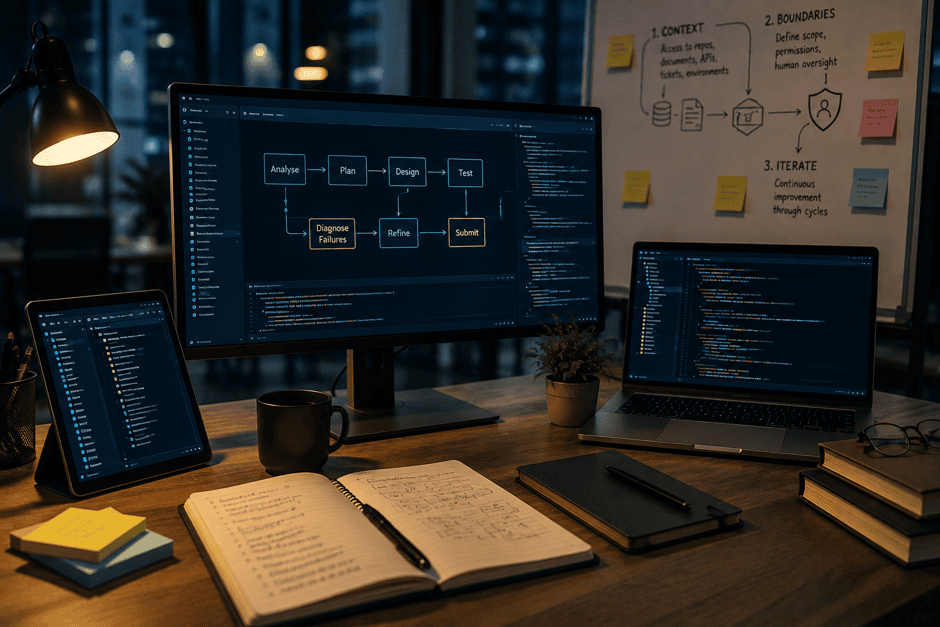
Successful companies are taking the approach of introducing AI systems as an element of the engineering workspace rather than just a mere substitutive tool that can do the work of an engineer.
Step 1: Introduce the concept of context.
The agent will not only need an instruction.
It should have access to the necessary repositories, documentation, ticketing systems, APIs, and development environments.
Otherwise, the AI can provide a technically accurate but completely irrelevant solution.
Step 2: Specify the limits of authority.
The agents must be given limited powers.
If it is a simple task, the agent may implement its own changes, conduct tests, and submit requests for code changes.
For complicated tasks, a human should always be the one in charge.
This is particularly important in banking, healthcare, cybersecurity, and other essential domains.
Step 3: Allow for iterations.
The real benefit comes when the agent is not limited to providing a first draft only.
An effective process would look like this:
Analyse → Plan → Design → Test → Diagnose failures → Refine → Submit a project
Step 4: Evaluation of Results
Organisations need to go beyond counting lines of code produced by AI to evaluate their performance.
There are better metrics to look into:
-
Time taken to resolve bugs
-
Yield time of pull requests
-
Frequency of deployments
-
Coverage rate of tests
-
Rate of unsuccessfully applied changes
-
Level of satisfaction among developers
-
Amount of time doing repetitive work
-
Time between the moment of gathering requirements and actual use of the product
The report by Accenture about a study conducted in partnership with GitHub throws light on the relevance of measurement. The experiment involved 450 developers who worked with Copilot and 200 in the control group and revealed improvement in build successes and pull request activities, as well as a high satisfaction rate among developers.
AI Can Compress Work—but It Can Also Compress Mistakes
AI has the capacity to speed up job processes, but it also has the capacity to speed up errors.
The problem of speed becomes more complex with the advent of AI.
While AI makes developers ten times more efficient in creating fixes, it also makes them ten times more efficient in delivering incorrect fixes.
This is also the reason why security and quality control become a lot more important than less important.
According to a recent AI code implementation study, security must be incorporated into the workflow of developers instead of being treated simply as the final stage of inspecting the output.
Similarly, academic research is quite concerned about the same topic. According to an empirical study on AI-generated pull requests done in 2026, coding machines have an influence on software quality that must be measured differently in the different stages of the software development cycle.
In other words, just because you have more code, it does not mean you have better software.
The Advantage that Remains Hidden: Parallel Engineering
The factor that contributes to most of the productivity experienced in an AI system is the fact that parallelism is utilised.
An engineer usually tackles one problem at any given point.
In this case, organisations can employ numerous agents to assist in resolving different problems simultaneously.
Consider this example:
-
Agent 1 – Analyse the old authorisation system
-
Agent 2 – Build unit tests
-
Agent 3 – Study existing vulnerabilities
-
Agent 4 – Write documentation
-
Agent 5 – Build a prototype for an API
Humans are the ones who analyse the information afterwards.
It has been reported by OpenAI that the most engaged users of Codex will have been generating above 60 hours of agent operation per day by the year 2026 at the 99th percentile.
This is where the phrase “months into days” starts making sense.
The AI is not really processing data 100 times quicker than a person.
It turns out there is one more distinct benefit: agents can perform a number of tasks simultaneously.
Enterprise AI is Transforming into an Organisational Capability
The significant lesson learned from Cisco, Goldman Sachs, and other early adopters is that AI engineering is becoming more focused on overall organisational structure rather than on individual productivity.
Organisations that give their employees AI tools may only now expect moderate benefits.
In contrast, companies that connect their AI agents with repositories, development environments, internal documentation, testing machinery, and business processes can expect to achieve more significant effects.
Gartner’s 2026 study of Revvity also provides insight into the significance of agent-based coding, which permits the acceleration of software delivery while enabling engineers to pay more attention to end-client needs. Gartner mentions the importance of writing down architectural principles and domain context to help AI operate in their environment.
This is an important distinction.
Competitive advantage does not come from having the most sophisticated models.
It comes from having an AI-friendly environment.
Conclusion: From Faster Coding to Faster Engineering
The most significant change in the use of AI within the enterprise setting is not the ability for machines to now create software programmes.
They have been capable of that for several years now.
Instead, it is the increasing capability of AI agents to take part in the entire engineering cycle, from requirements analysis and repository management through coding, testing, fault finding, and change preparation.
As seen in Cisco’s experience, tasks that may have taken several quarters can now be completed in just weeks, and many engineering hours could be reallocated to more important tasks.
The examples from Meta and others show the other half of the coin. Poorly implemented processes, lack of governance, insufficient context, and unreasonable expectations can render the whole idea meaningless.
This new paradigm, then, is not about AI replacing engineers.
It is more like engineers controlling swarms of AI tools.
That difference may set the stage for the next generation of enterprise software development.
Those who learn to do it may realise that the challenge is no longer
“How many engineers do we need to make this?”
But rather,
“What can our engineering organisation achieve if each engineer had their own swarm of AI helpers working with them?”
Frequently asked questions
How is AI changing software engineering practices?
AI is changing software engineering by allowing AI tools to handle complex coding tasks, which results in significant time savings and enables engineers to focus on higher-level responsibilities.
What results have companies seen from implementing AI in engineering?
Companies like Cisco have reported a reduction in engineering time for critical tasks from months to weeks and a 10-15% improvement in defect resolution metrics thanks to AI.
What challenges do organizations face when integrating AI into their workflows?
Organizations often face challenges such as internal resistance, the need for updated procedures, and ensuring that AI tools have the necessary context to operate effectively.
How does AI impact the role of software engineers?
AI shifts the role of software engineers from coding to more strategic tasks, such as overseeing AI processes, making architectural decisions, and mentoring junior engineers.
What is the significance of context for effective AI engineering?
Context is crucial for AI systems to provide relevant solutions; they need access to repositories, documentation, and business processes to operate effectively in an engineering environment.