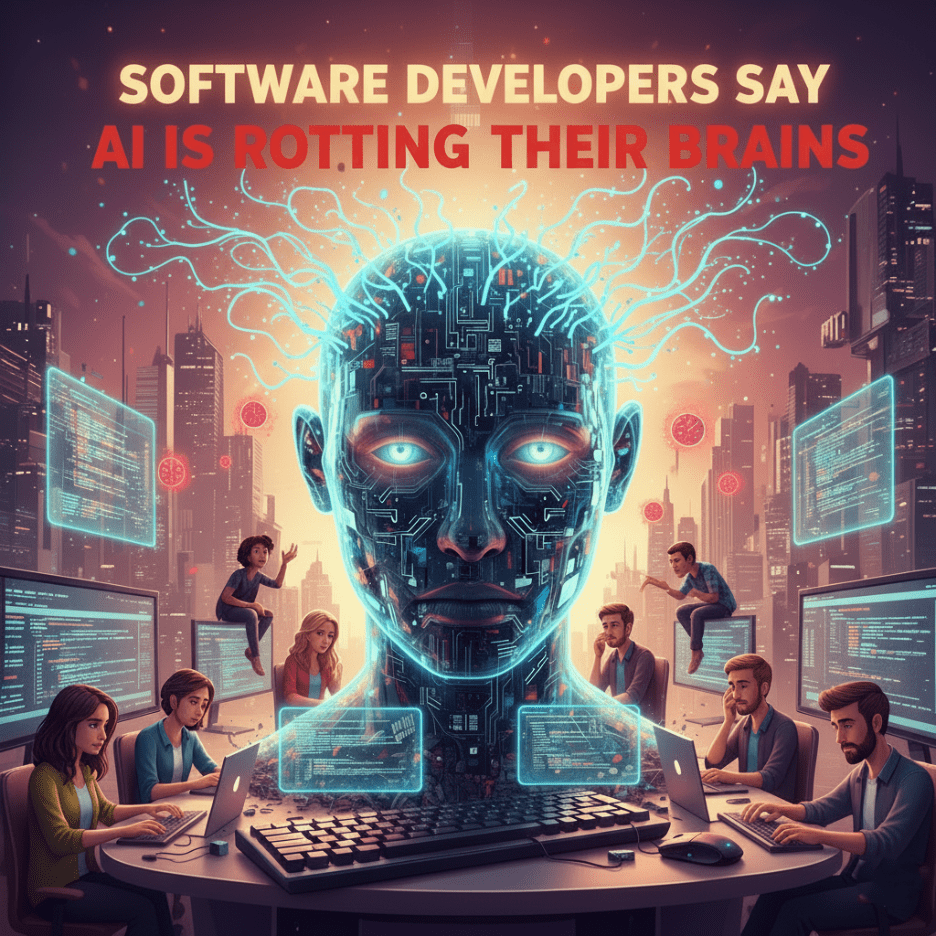
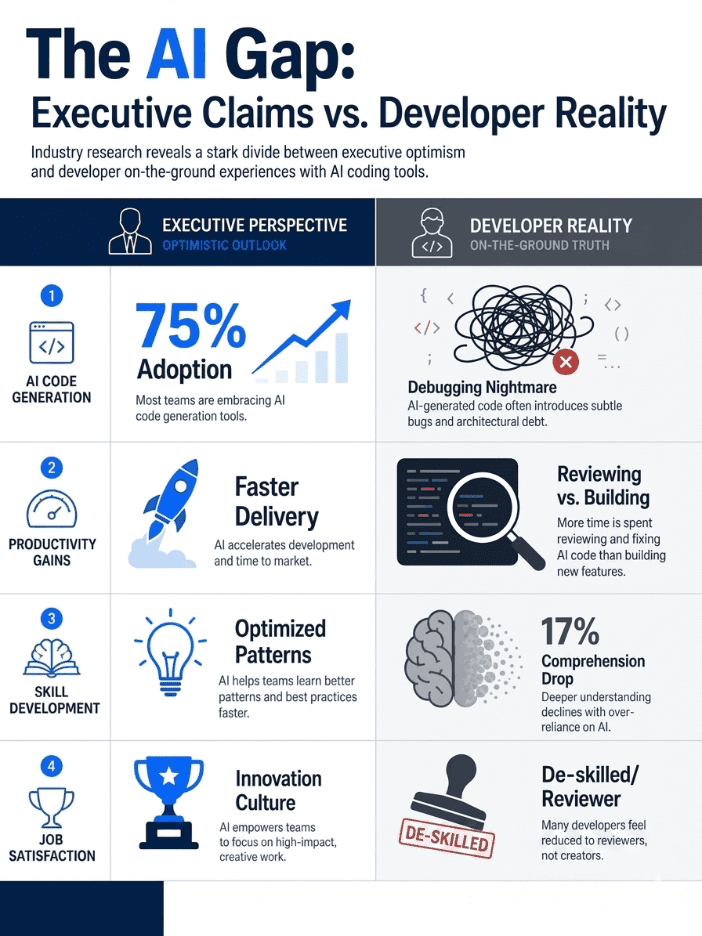
Tech executives celebrate AI generating 75 percent of new code while developers watch their fundamental programming skills slowly becoming dormant. This troubling disconnect between corporate AI adoption narratives and on-the-ground developer experience has sparked a growing movement of disgruntled engineers who feel their cognitive abilities deteriorating under mandatory AI tool usage.
The Alarm Bells Ringing Across Silicon Valley
A recent investigative report from 404 Media revealed what many developers have been whispering about in private channels. Anonymous engineers at major tech companies describe AI usage as increasingly time-consuming and frustrating because they must fix flawed output rather than write clean code from scratch. One developer confessed bluntly, “It’s making me dumber for sure”.
The problem extends beyond occasional bugs. Developers report feeling like they are de-skilling themselves and losing their ability to perform jobs effectively without AI crutches. They describe watching their teams shrink while AI adoption percentages become vanity metrics in executive dashboards. The phenomenon creates what experts call “ghost decisions” where developers ship code they cannot fully understand or explain.
Especially with LLMs operating on statistical probabilities rather than definitive logic, the software they generate can look flawless on the surface while containing deep structural inefficiencies. When massive corporate codebases are flooded with hundreds of thousands of AI-generated lines every week, tracking vulnerabilities becomes a logistical nightmare.
Tech Own Research Says
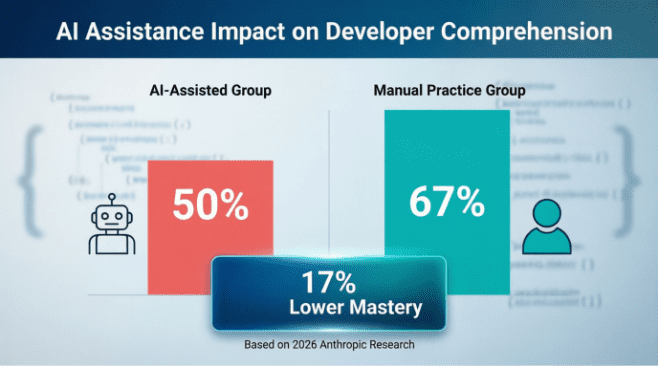
Anthropic’s research confirms AI assistance led to a statistically significant decrease in coding mastery among programmers. The study tracked 52 junior software engineers using AI coding assistance versus manual coding when building a Python Trio library. Developers using AI scored 50 percent on comprehension quizzes compared to 67 percent for the manual group, representing a 17 percent lower comprehension score.
The root cause is a dramatic shift in cognitive loads. Instead of writing code, developers now spend their days reviewing, testing, and troubleshooting massive torrents of probabilistic AI output. Evaluating code generated by an algorithm uses significant mental energy because the human engineer must constantly scan for subtle errors, hallucinations, and structural vulnerabilities. This shift from creative builder to tedious code babysitter is driving tech fatigue to an all-time high.
Developers are forgetting basic APIs, losing mental models of their codebases, and struggling to navigate complex systems without AI assistance. This skill atrophy occurs even as Google boasts that three-quarters of its new code comes from the AI generation. Microsoft CEO Satya Nadella stated that 20-30 percent of the company’s code was written by AI in April 2025. Microsoft CTO Kevin Scott projected that 95 percent of AI-generated code would be by 2030. Yet these impressive statistics mask the human cost of rapid automation. At Google, Sundar Pichai announced at Cloud Next 2026 in April 2026 that 75 percent of new code is now AI-generated, up from 50 percent just six months earlier.
The Technical Debt Looming Warnings
There has been a warning signaling widespread usage of agentic AI can create a shadow web of technical debt, with human negligence to recheck AI-generated codes that will become impossible to untangle as models become bigger and more popular. In the long term, actual quality of output matters more than organizations’ willingness to participate in AI-driven development in the short term without proper oversight, especially when dealing with broader industries where security and compliance have paramount importance. A holistic approach with developers and support knowledge base is the way forward in domain-level technological advancements, with inter-departmental teams supporting each other with balanced workflows.
The current reality also has harsh truth as Meta cut 10 percent of its workforce (around 8,000 people) in April 2026, Microsoft offered voluntary retirement to about 7 percent of its US workers (8,750 employees eligible out of approximately 125,000 US workers), Snap laid off 16 percent of full-time staffers (about 1,000 people) citing AI efficiency gains, and as of today further employee cutoff threats looms in the industry.
Why Developers Feel Their Brains Rotting
The sensation of cognitive decline stems from several interconnected factors.
First, AI output often contains subtle errors requiring deep debugging expertise that developers aren’t practicing because they’re busy fixing mistakes instead of creating original solutions.
Second, when AI generates code across hundreds of files simultaneously, no single developer can evaluate whether it’s secure or well-architected.
Third, developers need to understand the ins and outs of the system, model architecture, and embedded layers to conduct production AI maintenance and enforce required guardrails.
Fourth, mandatory AI adoption for performance reviews creates pressure to use tools that engineers distrust. Companies push AI usage despite operational nightmares, forcing developers into workflows that feel counterproductive. The structure underneath AI adoption represents real failure rather than technology itself.
Business Solutions That Actually Work
Forward-thinking organizations are pivoting from forced AI adoption to strategic augmentation that preserves developer expertise while leveraging AI benefits. The key lies in treating AI as a tool rather than a replacement for human judgment.
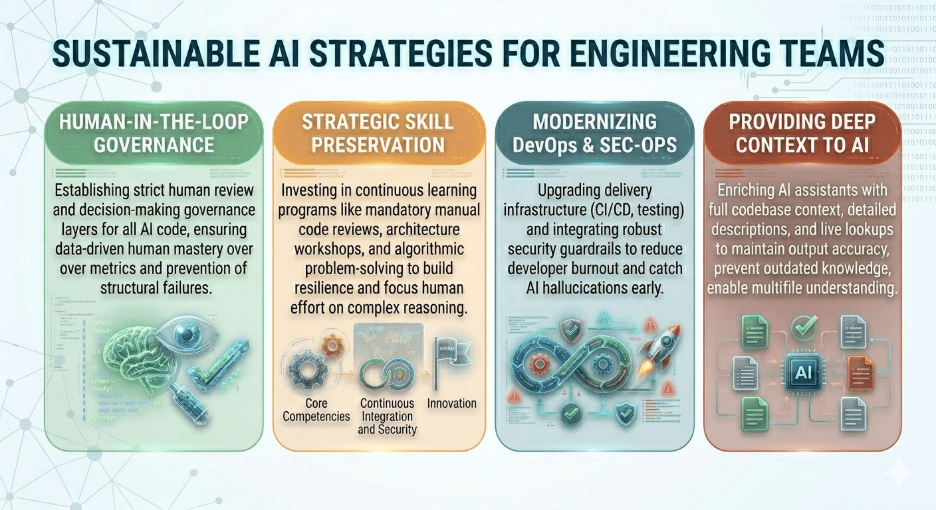
- Human-in-the-Loop Governance Framework
Companies achieving sustainable AI integration implement strict governance requiring human review of all AI-generated code before production deployment. This approach maintains coding mastery while capturing efficiency gains. Leaders build operational structures that make AI governable rather than letting metrics override evidence.
Organizations should establish clear decision layers where humans remain in the path of every critical choice. When metrics and experience point in opposite directions, the experience serves as evidence while metrics function as dashboards. This prevents structural failures that demoralize engineering teams.
- Strategic Skill Preservation Programs
Businesses protecting their technical talent invest in continuous learning programs that ensure developers maintain core competencies. These include mandatory code review sessions without AI assistance, architecture design workshops, and algorithmic problem-solving exercises that build cognitive resilience against skill atrophy.
Companies implementing balanced AI strategies report higher retention rates and more sustainable innovation. The goal involves augmentation rather than replacement, where AI handles repetitive tasks while humans focus on complex reasoning and creative problem-solving.
- Modernizing DevOps Delivery Infrastructure
The speed gains achieved by using AI code assistants mean very little if the rest of the software pipeline remains bogged down by legacy systems. To alleviate developer burnout, organizations must modernize their automated testing, continuous integration, and continuous deployment environments and look for frameworks to build modular AI with defined business needs.
Introducing robust security guardrails and stack components into the layered pipeline will catch weaknesses in output and significantly reduce AI hallucinations, removing the exhausting burden of manual verification from the development team.
- Give AI Real Context More Than You Think It Needs
AI tools benefit substantially from better context and data descriptions. Developers can give coding assistants an entire codebase context, so AI groks through all indexable files with responses powered by local understanding. More examples work better for AI, including code comments, PR commit messages, and terminal commands.
AI models have time-boxed training, so developers should direct AI to look up the latest information before acting on prompts for newer or updated content. This practice maintains accuracy while preventing outdated knowledge from corrupting output.
Choosing the Right Tools for Cognitive Augmentation
The 2026 AI tooling landscape offers genuine differentiation between platforms. Understanding which tools serve specific workflows helps developers maintain control while leveraging AI capabilities effectively.
| Platform / Tool | Primary Use Case | Strategic Cognitive Benefit |
| Claude | Advanced Contextual Reasoning | Excels at high-level logic breakdown, code explanation, and architectural planning, acting as an intellectual sparring partner rather than an automated script writer. |
| Cursor | AI-Native Development | Focuses on multi-file codebase comprehension, allowing developers to review clear, structured diffs and maintain final design oversight. |
| Windsurf | Agentic Workflow Execution | Employs collaborative developer-first mindset + “Plan and Act” modes, prompting developers to validate a conceptual strategy before any automated execution begins. |
| OpenClaw | Open-Source Agent Gateway | Operates locally on user hardware to orchestrate multi-step programming workflows across standard messaging platforms while securing context. |
| CodeRabbit | Automated Pull Request Review | Conducts high-level contextual reviews to catch logic flaws, acting as a secondary safety net to reduce the human engineer’s verification of outputs and vulnerabilities. |
| Harness AI | Software Delivery Pipeline Automation | Automates downstream DevOps tasks like pipeline tuning and release governance, clearing away manual toil so engineers can focus on core architecture. |
Platforms like Claude have fundamentally shifted how developers engage with artificial intelligence by prioritizing deep reasoning capabilities over simple autocomplete functions. When integrated with advanced IDEs like Cursor and Windsurf, this deep codebase awareness lives directly inside the editor. These environments allow developers to ask complex structural questions about their repositories, turning the assistant into an educational resource.
For engineers seeking absolute data sovereignty and deeper execution control, the open-source agent gateway OpenClaw has become a massive favorite in the development community. Running entirely on local hardware, it bridges advanced models with daily communication interfaces like Slack or WhatsApp, allowing engineers to manage entire repositories, trigger tests, and orchestrate pull requests via chat.
The integration of CodeRabbit transforms the exhausting task of code review through its advanced context engine and semantic diff view. Instead of forcing an engineer to manually parse through thousands of lines of mixed code and layout changes, CodeRabbit groups modifications into distinct logical layers and provides inline architecture diagrams.
To prevent developers from drowning in post-commit verification tasks, Harness AI extends this intelligent automation to everything that occurs after the code is written. Utilizing a centralized Software Delivery Knowledge Graph, the platform links live code changes directly with production metrics and team communications. This context layer fuels specialized agentic workflows, such as a human-aware SRE agent that instantly correlates system anomalies with recent deployments, and automated application security agents that generate policy-aware guardrails.
By utilizing platforms that emphasize multi-file reasoning, comprehensive conversational breakdown, local security, and transparent diff reviews, developers can retain their structural mental models and authenticity while enjoying accelerated workflows.
The Path Forward: Balanced AI Integration
The developers saying AI is rotting their brains articulate a genuine crisis demanding thoughtful solutions rather than tech-bro optimism or luddite rejection. Organizations winning at AI integration recognize that preserving human expertise while leveraging automation creates sustainable competitive advantage.
Successful companies balance AI adoption with skill preservation through governance frameworks, continuous learning programs, and tool customization that maintains developer agency. They treat AI as augmentation rather than replacement and keep humans in decision loops for every critical choice. Developers who master this balance will thrive in an AI-augmented future while preserving their professional identity and technical excellence.
Failure occurs when organizations strip out humans from decision paths and optimization strategies while keeping coordination layers like sprints and standups. Building governable structures that combine AI efficiency with human judgment represents the real opportunity for organizations willing to invest thoughtfully in their engineering teams.