
A quiet financial drain operates inside most enterprise artificial intelligence deployments. It accumulates steadily until monthly invoices demand executive attention. The culprit is memory. Organizations that deployed autonomous agents at scale now face a reality where context storage dictates operational margins. Every conversation log and cached prompt carries a measurable price tag. Finance teams frequently overlook this compounding factor because memory expenses blend into standard compute charges. Sustainable artificial intelligence profitability requires treating context as a financial variable rather than an infinite technical resource. This guide examines the true cost of unmanaged memory and delivers the architectural strategies that convert hidden liabilities into controlled operational assets
The Meter Running In The Shadows
There is a peculiar kind of expense that grows most aggressively when nobody is watching it. It does not announce itself the way a failed server does, or spike dramatically the way a security breach might. It accumulates the way interest accrues a debt steadily and invisibly forgotten until the invoice arrives, carrying a number that demands a second thought process.
For organizations that have deployed AI agents at scale in 2026, that expense is memory. Specifically, it is the cost of how their agents store, carry, and re-transmit context every time they process a request.
Every language model bills the token. Every byte of stored conversation history, every cached system prompt, every document reference dragged into an agent’s working memory is metered and charged before a single word of output is generated. Unmanaged pipelines routinely consume x times the estimated cost for multi-turn processes because the agent retransmits the entire conversation history with every new inference call. A session that genuinely requires fewer than one thousand tokens of active memory can easily consume ten thousand tokens when context controls remain absent.
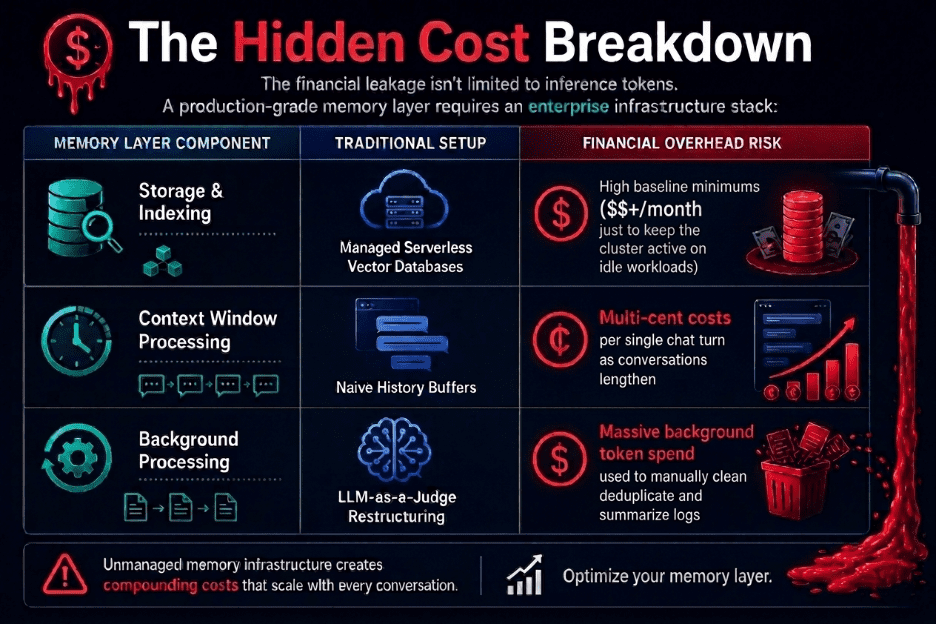
The worst situation can be when the Finance department misses the compounding effect of their avoidable monthly AI expenditure. Memory costs dissolve invisibly into compute charges, masquerading as ordinary usage until someone pulls a detailed breakdown. Centralized memory governance eliminates this redundancy, yet the financial bleed continues until leadership recognizes that duplicate storage and repeated token loading are types of avertable expenses.
The Economics of a Forgetful (or Overly Verbose) Agent
To understand why agent memory is an executive-level budgetary problem, look at the two distinct ways developers traditionally give AI a “past.” Both have severe financial flaws.
- The “Stuff the Context Window” Trap (The Infinite Loop of Costs)
With providers offering context windows up to millions of tokens, the tempting solution is to just append every past chat, preference profile, and enterprise PDF into the active prompt. The issue is with LLM pricing, which scales linearly with prompt length. If a customer has a multi-turn conversation over a month, an agent utilizing raw long-context windows forces the system to process the entire history on every single new message. Turn 1: User Prompt (500 tokens) -> Cost: $0.001
Turn 10: System Prompt + History (25,000 tokens) + User Prompt (500 tokens) -> Cost: $0.051
Turn 50: System Prompt + Exploding History (120,000 tokens) -> Cost: $0.24 per turn At thousands of daily sessions, that innocent chat agent transforms into a financial black hole. Furthermore, data proves that LLMs suffer from “Lost in the Middle” syndrome as context lengths cross 100,000 tokens; the model’s accuracy drops by up to 30% when retrieving details hidden in the middle of the prompt. You are paying premium rates for a slow, lossy brain.
- Flat RAG (The Continuous, Noisy Chunker)
To avoid context stuffing, many turned to classic Retrieval-Augmented Generation (RAG), which converts text into mathematical vectors and searches for a database for relevant snippets. But classic “flat” RAG has no concept of time or evolution. If a user tells an agent, “I moved from Chicago to London,” flat RAG saves both facts. The next time the user asks for a weather update, the vector database blindly fetches both the Chicago and London snippets because they are both semantically relevant. The agent gets confused, processes unnecessary tokens, and forces you to pay for redundant storage and computing.
Three Architectural Corrections That Work
The path from recognition to resolution runs through your architecture, not only configuration. The strategies that consistently deliver finanial returns share one organizing principle: they impose structure at the point of storage, so retrieval can remain fast, lean, and precisely calibrated to each request.
- Strategy 01 — Tiered Memory Architecture
Tiered memory separates what an agent needs immediately from what it might need eventually. Active context resides in fast memory for real-time task execution. Recent interactions move to intermediate storage with automated expiration windows. Extended knowledge consolidates into structured repositories queried selectively — only when specific conditions trigger a genuine retrieval of need. The effect is a memory pipeline that sends only relevant information into each inference call, slashing input token volume while preserving the contextual depth that makes complex agents genuinely valuable. Teams that implement tiered architectures report not just lower bills, but more predictable ones — a distinction that matters considerably when AI costs have been an unpredictable variable in quarterly budget cycles.
- Strategy 02 — Dynamic Trimming & Semantic Compression
Algorithms analyze active conversation threads in real time to identify repetitive statements, stale instructions, and metadata that no longer influence the decision being made. These elements are compressed or discarded before the payload reaches the model, reducing input token volume by as much as sixty percent in high-volume environments while maintaining accuracy and response continuity. Semantic caching extends this discipline further: rather than reprocessing full context payloads for routine queries, agents compare incoming prompts against a library of previously generated responses and surface matching results when confidence thresholds align. The most expensive inference call is the one you never have to make again.
- Strategy 03 — Retrieval-Augmented Context Injection
Modern retrieval systems rank knowledge fragments by semantic similarity, recency, and direct task relevance before injecting selected passages into the context window. Agents receive targeted, current information — not a sprawling archive of everything adjacent to the topic. The result is a leaner pipeline that processes fewer tokens, generates faster responses, and produces outputs better calibrated to the actual question in front of them. This approach replaces the habit of sending everything with the discipline of sending exactly enough — and the financial difference between those two postures, at enterprise scale, is measured in thousands of dollars per month.
The Best AI Business Tools for Memory Optimization
Selecting the right technology stack determines whether memory optimization efforts yield sustainable financial returns. The market has matured significantly over the past two years, with specialized platforms emerging to address enterprise memory challenges. The following tools represent the most effective solutions currently available for businesses seeking to control AI memory expenses while maintaining operational excellence.
- Vector and Graph Databases That Scale Efficiently
Pinecone and Weaviate continue to lead the vector database market with enhanced indexing algorithms that reduce storage overhead and accelerate retrieval times. Both platforms now support hybrid search capabilities that combine semantic matching with keyword filtering to improve precision while minimizing false positive results. Organizations that migrate from basic vector storage to optimized indexing frameworks report significant reductions in memory-associated compute costs. These databases also offer automated compaction features that consolidate duplicate embeddings and remove stale entries without manual intervention. Graph database solutions like Neo4j and Amazon Neptune provide structured relationship mapping that eliminates redundant data storage across agent workflows. Teams can define explicit connections between entities, documents, and decision pathways to ensure that agents retrieve only necessary context during execution. Graph-based memory architectures excel in compliance-heavy industries where audit trails and data lineage directly impact operational costs. Properly configured graph networks reduce traversal complexity and lower the token volume required for accurate agent reasoning.
- Agent Orchestration Platforms With Integrated Cost Controls
LangChain and LlamaIndex have evolved beyond simple prompt chaining into comprehensive orchestration environments that include memory management dashboards and cost tracking integrations. These platforms now feature automated context window monitoring that alerts teams when token consumption exceeds predefined tresholds. Administrators can configure retention policies, compression rules, and routing logic directly within the orchestration layer to prevent memory bloat before it impacts billing cycles. The integrated analytics modules provide granular visibility into which workflows generate the highest memory costs and where optimization efforts will yield the greatest returns. Emerging orchestration frameworks like AutoGen and CrewAI incorporate specialized memory isolation that prevents data interference between dedicated agents. Each agent maintains dedicated context pools that scale independently based on task complexity rather than sharing a single bloated memory space. This architecture reduces redundant token loading while enabling precise cost allocation across departments. Enterprise teams can monitor memory utilization per agent and adjust resource distribution based on actual performance metrics rather than blanket provisioning.
- Memory Management Middleware And Specialized Models
Mem0 and Zep have established themselves as dedicated memory middleware solutions that operate between agents and underlying language models. These platforms automatically summarize conversations, extract key decisions, and store structured knowledge in optimized formats that require minimal context space during retrieval. Teams deploy middleware layers to intercept raw memory streams and transform them into lean, query-ready payloads that agents can process efficiently. The middleware approach eliminates the need for custom memory pipelines while providing enterprise-grade cost controls ready to deploy. Mistral 7B has also emerged as a highly efficient foundation model for memory-intensive enterprise applications. Its optimized architecture delivers exceptional context retention capabilities while operating at a fraction of the computational cost of larger proprietary models.
Redis advanced vector modules and semantic caching plugins continue to serve as a high-performance memory acceleration layer for real-time agent workflows. Organizations integrate Redis to store frequently accessed context fragments and session state data that agents require during active processing. The in-memory architecture delivers sub-millisecond retrieval times while reducing the load on primary language models during peak demand periods. Properly configured Redis instances act as a financial buffer that prevents unnecessary token consumption during high-volume interaction cycles. This combination of middleware intelligence and specialized model deployment creates a robust ecosystem that controls memory expenses without sacrificing analytical depth. Enterprise leaders can scale these tools across departments while maintaining strict oversight of token allocation and retrieval efficiency.
The Memory Dividend: Your Next Competitive Edge
Tech leaders stand at a pivotal point where mastering memory economics today secures sustainable enterprise margins tomorrow. With proven frameworks available, the transition from financial liability to strategic advantage relies entirely on execution.
Strategy for execution optimization requires a disciplined, step-by-step approach across the AI engineering stack:
- Measure Before Modifying: Instrument token-level observability across your agent fleet to identify high-context workflows and quantify the gap between necessary and transmitted data. This baseline serves as your optimization compass.
- Prioritize Architecture Over Acceleration: Resist scaling agent counts before stabilizing governance with planned software architecture connecting your business needs. A single well-governed agent delivers more business value than ten bloated systems consuming redundant tokens through an unmanaged context.
- Embrace Model Specialization: Deploy domain-specific, fine-tuned models for memory-intensive tasks and reserve frameworks of Agentic AI. This hybrid approach maximizes performance per dollar spent.
- Align Cross-Functional Teams: Treat memory and interoperability as core product requirements. Product managers should define context retention policies during development, while finance teams track memory cost breakdowns with necessary maintenance costs.
Enterprise building this discipline constructs the lean cost structure required for sustainable, reasonable scaling. Those ignoring these inefficiencies will continue to pay compounding premiums on every inference call. Memory optimization is no longer optional infrastructure maintenance; it is a critical strategic lever that directly impacts operating margins, user retention, and competitive velocity.