The implementation of artificial intelligence is no longer just an experiment; it has become a staple process for many businesses. Enterprises no longer need to think about how to start using AI technologies; they rather need to know how to manage innovations. There is a variety of AI applications and tools, such as chatbots, coding assistants, analytical tools, and workflow automation systems, that have become integral parts of enterprises.
The introduction of multiple AI solutions has raised concerns about the uncontrolled implementation of AI tools. As an example, marketing has introduced generative AI for content creation, the HR department has implemented AI for recruiting, the finance department has introduced predictive analytics, and developers have started using coding assistants. Failure to control the usage of AI brings issues related to security, inconsistencies in the outputs, lack of compliance, rising costs, etc.
Consequently, there now exists a new business term called “AI Operations”, its acronym being “AI Ops” or “Enterprise AI Operations”. In the same way as the DevOps method transformed the software development processes and SecOps has had a positive effect on cybersecurity, AIOps is considered to be the one capable of ensuring the dependability of AI systems and their compliance both with requirements and with the aims of the organisation.
Those who keep an eye on developments in the industry believe that there will be a time in the near future when every company will have to employ specialists in AI operations whose task will not be only the implementation of AI systems but also their operation.
Understanding AI Operations
AI operations include management, maintenance, supervision, governance and improvement of AI systems within the organisation.
In contrast to data scientists who concentrate on developing AI models and software engineers who implement these models into applications, AI operations personnel are in charge of maintaining the functioning of these systems after they have been launched.
Their job consists predominantly of performing the following tasks:
1. Monitoring the performance of AI systems
2. Managing the cost of AI
3. Ensuring compliance with the regulations
4. Improving the quality of the prompt
5. Reducing hallucination
6. Protecting sensitive business data
7. Measuring ROI of AI systems
8. Implementing AI across departments.
From an IT project to an integral part of the daily operations of any organisation
At the beginning, it was understood that AI technology would belong entirely to the field of IT and would be exclusively under the control of that department.
But now AI is present in almost all business domains:
-
Customer service
-
Marketing
-
Sales
-
Finance
-
HR
-
Manufacturing
-
Legal
-
Product development
Each department uses some provider of AI solutions, models, processes, and automated platforms.
In the absence of governance, the company cannot control the following processes:
-
Which AI solutions are in use by employees
-
How data is circulating in the company
-
Whether the results of this work are accurate
-
What is the price for AI subscriptions
If AI makes decisions in compliance with regulations, that means AI operations are in place.
The swift rise of artificial intelligence has surpassed the control of the regulatory systems.
In hundreds of firms, numerous employees use AI on a daily basis.
However, problems occur:
Shadow AI
Workers begin using publicly available AI processing solutions without getting the management’s permission.
Some examples are:
– Disclosing private information related to the company
– Uploading confidential documents
– Getting access to the customer’s data
– Downloading non-permitted AI applications
– Connecting third-party AI services with the organisation’s data systems
The operations team creates AI space and removes associated risks.
The drift of AI models
In the end, AI models experience a drop in accuracy as a result of changing inputs in the company.
An example of this could be:
A demand forecasting model developed in 2024 will provide incorrect information in 2027, as consumer behaviour has changed during that time. The operations team monitors the performance and retrains it whenever necessary.
Hallucination
Large language models are prone to generating inaccurate information from time to time.
It may lead to serious problems in the following areas:
– Customer experience
– Brand reputation
– Legal matters
Significance of Transparency in Spending on AI
Different companies utilise a range of AI software at the same time.
These programmes consist of ChatGPT, Claude, Gemini, Microsoft Copilot, GitHub Copilot, Midjourney, Runway, Perplexity, coding programmes, and tools for managing the workflow.
Where there is little transparency, there are the following:
-
Duplication of licenses
-
Companies throw away money on unused licenses.
-
Predicting costs related to AI becomes difficult.
-
Indicators of the usage of AI are:
-
Usage amount
-
Spending per person
-
Increase in performance
-
ROI.
The Primary Duties of a Specialist in AI Operations

1. AI Governance
Governance is essential to ensure that AI technologies are applied effectively within the organisation.
Some of the tasks involved are the following:
– Inventing AI strategies
– Approving AI suppliers
– Carrying out risk assessments
– Determining allowed usage
– Overseeing compliance with regulations
More and more corporations are setting up AI governance boards, whose implementation is handled by the AI operations team.
2. Prompt Engineering
Many companies do not realise that prompt engineering is a key aspect to take care of after AI has been implemented.
AI Operations specialists:
– Develop prompt libraries
– Create standards for prompts
– Check the quality of prompts
– Control versioning of prompts
– Work on consistency of AI responses
When it comes to customer service bots, even slight changes to prompts can significantly increase customer satisfaction.
3. AI Surveillance
Surveillance is very important in the case of AI use. This applies because it is necessary for the successful performance of AI.
Here are some of the indicators in monitoring:
Accuracy
Does AI provide correct responses?
Latency
How quickly does AI respond?
Cost
Does AI consume too many tokens?
Reliability
Does AI get stuck when there is a large volume of tasks?
Safety
Does AI give harmful and biased answers?
Dashboards are used for AI monitoring.
4. Security Organisation
Security issues arise because of AI.
Here are some security issues.
Prompt injection attack.
Data leak.
Unauthorised access.
Leakage of private information.
When interacting with the teams related to security, AI work processes attempt to solve the mentioned issues.
5. Compliance
Now, AI regulations worldwide are advancing at a fast pace.
Organisations are to follow the following:
-
Privacy rules
-
Industry regulations
-
AI transparency requirements
-
Data retention policies
AI Operations takes care of documentation, audit logs, and governance records.
6. Vendor management
Most companies cooperate with several AI suppliers at the same time.
AI operations checks:
Performance
Pricing
Security
Reliability
Availability of services
This way, companies can choose the best AI platform for each task.
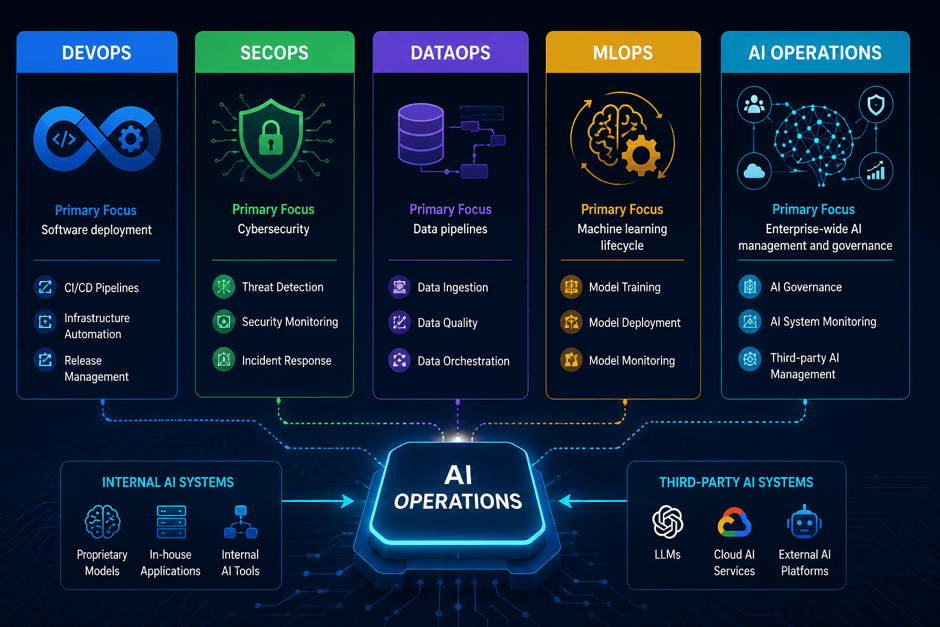
AI Operations vs DevOps vs MLOps
|
Function |
Primary Focus |
|---|---|
|
DevOps |
Software deployment |
|
SecOps |
Cybersecurity |
|
DataOps |
Data pipelines |
|
MLOps |
Machine learning lifecycle |
|
AI Operations |
Enterprise-wide AI management and governance |
While MLOps primarily focuses on machine learning models developed internally, AI Operations oversees both internal and third-party AI systems used across the business.
Real Examples of Why AI Operations Are Important
Example 1: Customer Service
A telecom company implements an AI chatbot that can handle billing issues.
At first, the chatbot does great.
However, six months later:
-
Product changes.
-
Price plans change.
-
Policies change.
If not monitored constantly, the chatbot starts delivering old information.
AI Operations notices the drop in performance metrics, updates the prompts and the knowledge, and brings back the accuracy before the customers start complaining.
Example 2: Healthcare
A hospital uses AI for scheduling appointments, communicating with patients, and documenting health records.
Given that patients’ information is very sensitive, AI operations allow for:
-
Keeping personal information confidential.
-
Controlling access.
-
Recording all AI interactions.
-
Meeting health care standards.
-
Keeping human supervision in case of emergencies.
Otherwise, a single failed AI workflow could lead to huge losses in the hospital.
Example 3: Financial Industry
The reliance on AI technology in the banking industry is growing rapidly due to the following:
1. AI is being utilised to identify fraud.
2. AI is being employed for credit evaluation.
3. AI technology is being used to provide customer service.
4. AI is applied for investment guidance.
The AI Operations division regularly checks whether the existing business models operate fairly, unbiasedly, and correctly while staying transparent for auditors.
Example 4: Industry
A major manufacturer utilises AI to monitor malfunctions of machines and to manage the production process effectively.
Installation of new equipment leads to a lowering of the accuracy of predictions, as the models are based on the old equipment.
The AI Operations division is responsible for making the necessary adjustments to correct the changes in performance.
The Necessary Skills for a Professional in AI Operations
‘AI Operations’ is described as a multi-sector initiative.
Such experts have to have know-how in a variety of fields.
The technical know-how of AI Solutions
Big language models
-
Application programming interface — API
-
Cloud computing
-
Automation processes
-
Data analysis
-
Supervision software
-
AI protection
-
Fundamentals of coding
-
System unification
The business competency
A qualified AI operations worker must know how to jump on:
– Organisational procedures
– Cost saving
– Transformation
– Risk management
– Multidisciplinary teamwork
– Dispute resolution with service providers
Skills of Communication
Because AI is used in numerous departments, professionals in AI operations often work together with the following:
-
The C-Suite
-
Technical Engineers
-
HR personnel
-
Legal Departments
-
Compliance Officers
-
Customer Service Agents
-
Marketing Professionals
Clear communication is as important as technical knowledge.
Expert Perspectives on AI Operations’ Emergence
Andrew Ng: AI Is the Modern-Day Electricity
Andrew Ng, one of the early promoters of artificial intelligence, believes that AI is the new electricity in the business world. His statement shows one vital aspect regarding the fact that once every business process employs AI, companies will require staff who will be responsible for supervising the “electricity”, keeping it efficient and safe. AI Operations takes over the role of ensuring the functionality of AI systems, monitoring them, optimising them, and aligning them with business aims.
Satya Nadella: All Companies Are Becoming AI Companies
The CEO of Microsoft is sure that all companies will become AI companies. As AI technology is increasingly introduced in every business sphere, the challenge today is to achieve operational efficiency rather than to adopt AI.
Jensen Huang: AI Factories Need Operational Efficiency
He frequently refers to contemporary data centres as “AI factories” in that they produce intelligence instead of goods. Just as in the case of traditional factories, monitoring, optimising, maintaining, and controlling the quality of such factories is required. Managers of these digital plants are AI operations professionals.
Ethan Mollick: Human Judgment Is Necessary
Professor Ethan Mollick of Wharton University, who is a key figure in the discussion of AI in the workplace, states that AI can be beneficial only in collaboration with human judgement. His viewpoint strengthens the need for AI operations teams, which take on oversight and validation of results and management of the process in such a way that people still have the right to make decisions, while AI makes the process more efficient and quicker.
The First Industries to Employ Workers in AI Operations
A great number of industries already extensively invest in artificial intelligence management and governance.
Banking industry
Banks have to keep a balance between innovations and rules that have to be strictly followed.
Management of AI operations includes handling systems associated with fraud detection, customer service and examination, risk evaluation, and compliance verification.
Healthcare sector
Hospitals need to utilise artificial intelligence tools that are accurate, secure and respectful of privacy.
The work of AI in this field includes safely dealing with patients’ information while monitoring the work of clinical and administrative procedures using AI.
Retail
The place of work of the retail industry has the use of AI for inventory control, price optimisation, customer recommendations, demand forecasting, and marketing personalisation.
The function of AI operations in this sphere includes running these interconnected systems, as well as measuring their implications for the business.
Manufacturing sector
Using AI enables manufacturers to ensure predictive maintenance, quality control, robotics, and supply chain efficiency.
The process of continuous monitoring secures this technology’s effectiveness because effective equipment is evolving.
Companies in the technology sector
Software companies apply AI in coding, customer support, sales management, cybersecurity, and product development.
Teams working in AI operations play an essential role in standardising tools, optimising expenses, and ensuring efficiency in conditions of fast-changing artificial intelligence management systems. Challenges AI Operations Teams Will Face
Models that evolve rapidly
Foundation models are evolving exceedingly fast.
Companies must always check if new models are more precise, cost-effective, or secure and if they do not disrupt the current workflow.
Striking a Balance Between Innovation and Control
Workers wish to use cutting-edge AI solutions, while management wants compliance and governance.
AI operations must implement a policy focused on responsible experimentation that facilitates innovation.
Evaluating Business Worth
Business executives keep on wondering:
What benefit do we derive from AI?
AI operations specialists should be ready to measure metrics important for the evaluation of the following:
– worker time-saving
– customer satisfaction growth
– revenues affected by AI
– cost savings
– mistakes reduction
– Employee implementation, since these measures are the basis for further investments and policies in the field of AI.
Conclusion
In conclusion, it has been demonstrated that artificial intelligence has taken a step forward in its development. In the past, scientific researchers were only interested in creating models; however, now the situation is altogether different. Today, the main challenge AI is facing is the proper implementation of the found models, which is not an easy task, as the organisation may need to use many different models simultaneously. Moreover, the organisation should keep in mind that it should be governed properly so that the full potential of its artificial intelligence application may be made use of. AI operations is a concept that can help overcome this problem as it provides for the combination of functions related to governance, monitoring, security, compliance, cost management, and continuous optimisation into one unified process.
Thus, just like DevOps became vitally important during the period of development of cloud computing, AI operations may turn out to be equally important in today’s world. Those companies that realise the significance of this concept in time will manage to control both costs and risks when using their AI systems. Those companies that will neglect this issue might experience numerous problems that would reduce the potential of their AI implementations.
Hence, the next competitive advantage will be gained not merely by the use of AI but rather by its proper implementation.