Machines have advanced to understand conversations held inside boardrooms and internal business processes to implement strategies. Delve into business softwares those are mutating AI-powered execution, the realities of autonomous workflows, and must-know insights on autonomous architecture that will yield on AI investment and fortify for a competitive future.
The Development Of Production Plateau
The machines are no longer waiting for the prompt; they are now integrated to work along with you and coordinate at each step to make your work productive and well-organized. Google, Microsoft, IBM, and SAP have spent the last twelve months building AI that gauges your work, instantly provides support, and executes in detail while maintaining decision record trails.
For a while now, Enterprise AI has been pitched to boost productivity by automating tasks, reducing digital gruntwork. Think about it—some bots fill out forms, robotic process automation (RPA) mimics human workflows, redirects consumers to the right information, and machine learning models that help prioritize sales leads. While all of that is useful, industry is at the brink of a new phase of normalizing autonomous execution at the enterprise level, where enabled technology is your co-worker, elevating the way we plan, design, analyze, and manage our workloads autonomously. RPA and workflow tools give companies speed and scale on known processes, but they cannot handle ambiguity, multi-step reasoning, or strategic decisions.
Another transformative use of Agentic AI capabilities is in IT operations with machine learning and workflow automation; the systems can discover, investigate, and resolve issues with minimal or no human intervention.
Today, we stand where enterprises are investing in reliable full-stack AI systems. They are progressively strategizing on which AI model to license, methodologies to leverage their data, regulations, internal governance, budgets, and forecasting their expected ROI. Industry data reflects that enterprises successfully deploying AI are re-strategizing on their business operations and enterprise solutions.
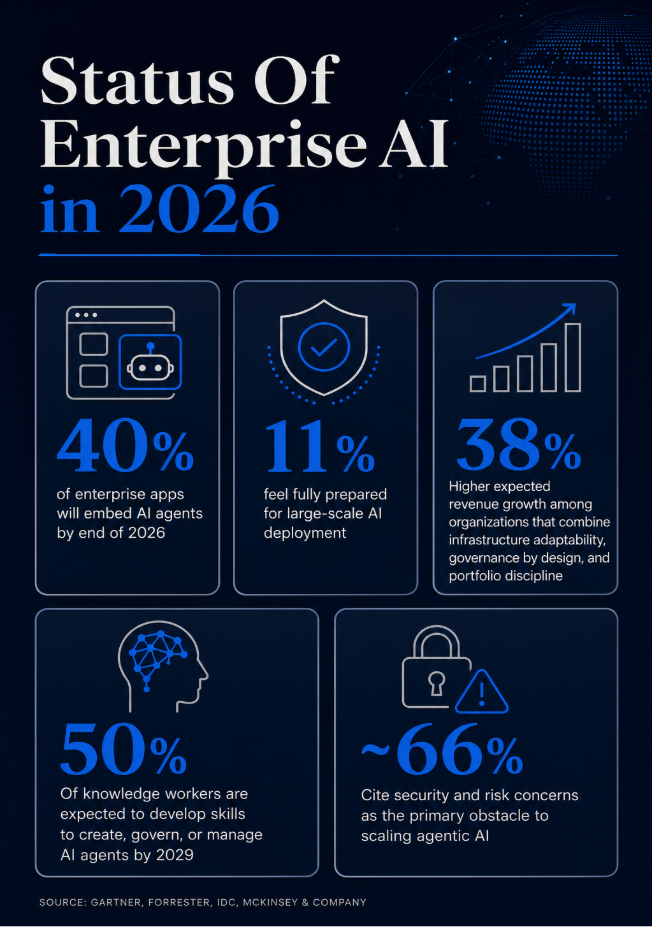
IBM Think 2026 states that issues with AI-ready data, stagnant AI pipelines, and legacy application layers are core reasons for failure of pilot projects to move into operations. One of IBM’s most recent technology collaborations is connecting their AI and automation capabilities with ServiceNow AI Platform to support enterprise clients modernizing the outdated systems and embed AI into corporate workflows.
“We’re building a control plane for AI, so we can identify what’s productive, elevate what’s valuable, and retire what isn’t. Some experimentation waste is unavoidable—but that’s the price of learning fast.”
-
David Treat, CTO at Pearson
Why Autonomous Execution Matters Now
-
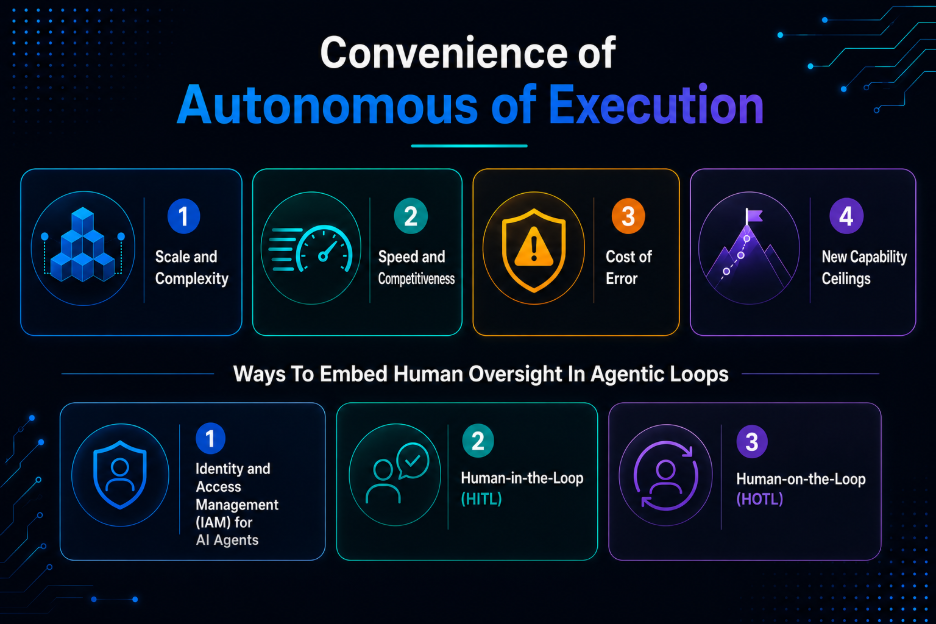
Scale and Complexity: Enterprises operate across fragmented systems with real-time data streams. Static automation breaks when processes deviate and require frequent fixes by humans; autonomy tolerates and adapts to variance. These AI-powered executions provide 24/7, always-on service.
-
Speed and Competitiveness: Markets demand faster decisions on dynamic pricing, inventory rebalancing, incident remediation, and CRM. Automation execution with HITL or HOTL decision gates or regulatory controls will provide productive benefits and make technology a business asset.
-
Cost of Error: In cybersecurity or trading, autonomous agents can keep pace with technology, and their responses can mitigate security threats and liability concerns, and help prevent cascading failures.
-
New Capability Ceilings: Autonomous systems enable higher-level outcomes with traces of records locked in higher-sophisticated systems. The patterns can be observed by AI agents that were missed by humans. The reduction in repetition of manual tasks and excessive trials can ease human fatigue and open new opportunities.
“My role isn’t to generate every transformative idea. It’s to build the foundation that allows smarter people across the organization to bring those ideas to life.”
-
Chad Jones, CIO at Baylor Scott & White Health
Ways To Embed Human Oversight In Agentic Loops
-
Identity and Access Management (IAM) for AI Agents: Every agent must have an auditable identity with defined read/write permissions or additional permissions, subject to the same scrutiny as human employees.
-
Human-in-the-Loop (HITL): In high-stakes tiers, mandatory approval checkpoints for financial disbursements, legal agreements, and sensitive data access injections.
-
Human-on-the-Loop (HOTL): Agent executes autonomously while a human retains real-time visibility and authority to intervene at a given step. This gives the advantage of low latency and fewer disruptive occurrences of human intervention.
Production Risks Involved With Autonomous Execution
Autonomous execution introduces management challenges and legal risks that go beyond traditional technology and automation. Before adopting an AI task force, leaders should carefully assess the technical, operational, legal, and human dimensions of deployment.
-
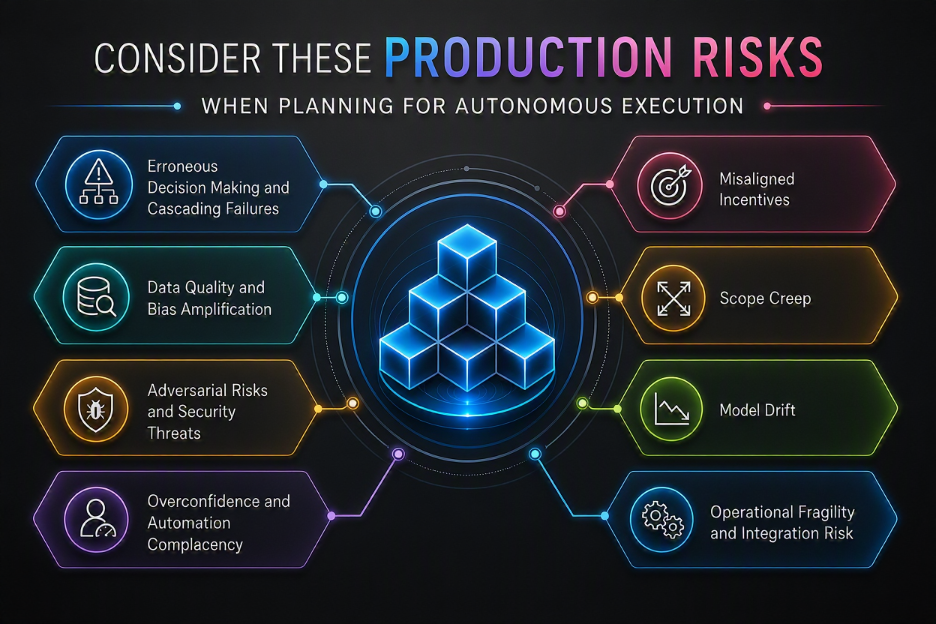
Erroneous Decision Making and Cascading Failures. Autonomous agents can make incorrect or suboptimal choices that spread across connected systems. Because their actions are often multi-step and cross-functional, a single flawed decision can trigger service disruptions, financial losses, or safety incidents. Use staged rollouts, circuit breakers, canary triggers, and automated rollback measures as proactive safeguards.
-
Data Quality and Bias Amplification. Autonomous policies depend on large, often heterogeneous live datasets. Poor data quality, sampling bias, or historical inequities can produce unsafe or biased outcomes that scale quickly. Mitigation controls should include continuous data-quality monitoring, bias audits, synthetic data stress tests, and human review for high-stakes decisions.
-
Adversarial Risks and Security Threats. Adversaries on autonomous systems can manipulate inputs, probe decision boundaries, exploit execution endpoints, and increase the risk of security threats or data breaches. Agents that perform regulated actions, such as provisioning or trading, can magnify the impact of a failure. Hardened model serving, input validation, anomaly detection, red-team exercises, and cryptographic decision records can provide stronger security guardrails.
-
Overconfidence and Automation Complacency. Teams may begin to overtrust autonomous agents once they appear effective – this can weaken vigilance and reduce willingness to intervene. Mitigation measures should preserve human situational awareness, include regular stress tests and escalation drills, and track KPIs while also emphasizing exceptions and edge-case performance.
-
Misaligned Incentives, Scope Creep, and Model Drift. Business units may expand an agent’s accountability beyond tested boundaries in pursuit of ROI, increasing the risk of exposure. Without long-term maintenance checks, disciplined retraining, and drift detection, model performance and safety can decline. Organizations should use controlled model lifecycles with rollback paths, automated drift detection, scheduled retraining, carry out formal change controls by supervision committees, and establish safety metrics for AI agents.
-
Operational Fragility and Integration Risk. Agent sprawl and privilege accumulation can occur when autonomous agents are deployed without centralized governance. Over time, agents may gain excessive permissions, creating security and compliance challenges. Autonomous execution can also increase dependency on external models, APIs, data providers, and vendors. Robust retry patterns, exponential backoff, quality-preservation logic, defined pipelines, and clear guidelines for SLA dependencies are industry-standard measures that can help reduce fragilities.
What Sets Autonomous Execution Apart From Its Predecessors
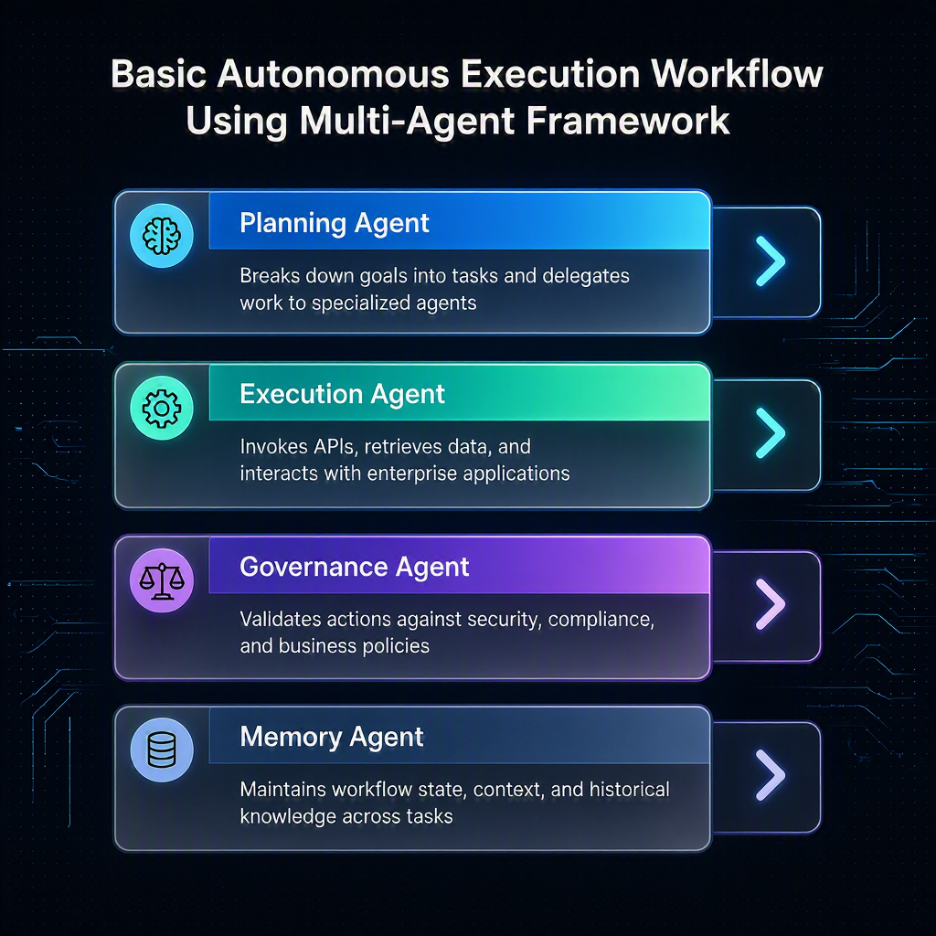
The most capable enterprise deployments of 2026 are not single-model systems with a chatbot interface. They are sophisticated AI-focused architectures with multi-agent frameworks or agentic AI-powered platforms; these architectures are advancing while linking artificial cognition across specialized agents the way software organizes and distributes responsibility across microservices. Each agent handles what it was built to handle.
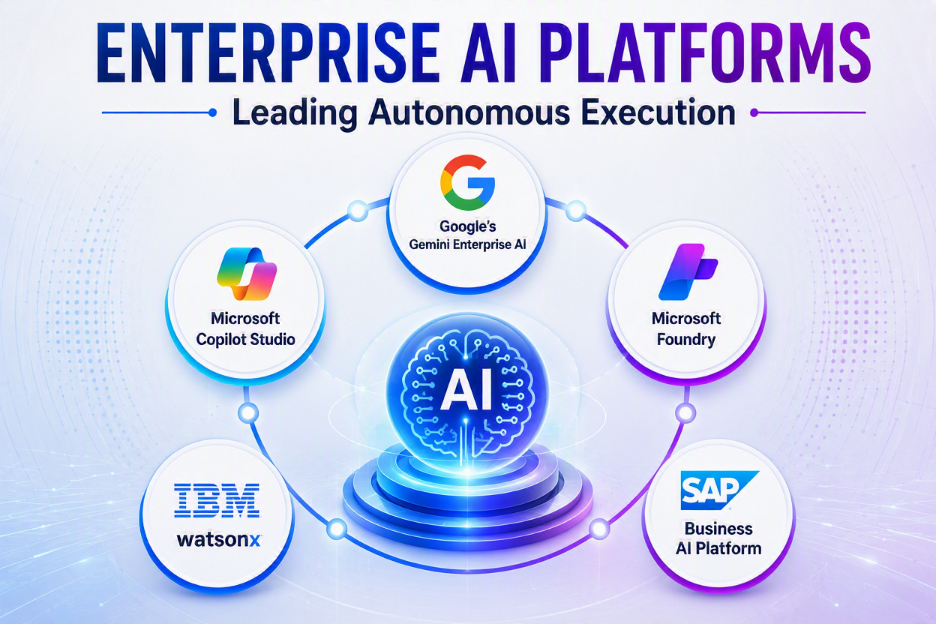
Google, Microsoft, and IBM are creating comprehensive platforms that are changing businesses’ focus from “AI assistants” to autonomous operations. Google’s Gemini Enterprise AI app is designed as an agile strategist that helps users with end-to-end execution of their projects and encourages a shift from reactive work to proactive accomplishment. Microsoft has taken agentic integration further by launching Copilot Studio, enabling easy-to-deploy domain-specific agents within Microsoft 365, and Microsoft Foundry for developers to build single agents, task forces of agents, or even AI apps. The Foundry platform enables businesses to connect to their context, optimize workflows, and integrate more than 1,400 tools with enterprise-grade security; it offers features for modularity, real-time cloud-scale interfaces, and fleet-wide visibility. IBM® watsonx is a strong option for organizations to apply industry-validated concepts such as ReAct, RAG, and IBM’s Orchestrate which is an efficient agentic control panel coordinating among the platform’s agents, tools, workflows, and foundation models. watsonx works live with specialized agents or tools, with the aim of reducing fragmented handoffs and enabling seamless execution across complex processes.
These platforms combine an integrated studio with tools for data governance and management to support trusted automation at scale. Each of these companies places a strong emphasis on data grounding, auditability, security, and robust IT controls.
SAP is a global software company that transformed the way enterprises manage and store data. SAP provides Systems, Applications, and Products in Data Processing for reducing fragmented legacies by automating workflows, real-time synchronization, and data centralization.
At SAP Sapphire 2026, CEO Christian Klein unveiled the SAP Business AI Platform, with Joule Workspace anchoring AI agents under SAP’s own cloud, processes, and compliance frameworks. The platform includes 50 domain-specific Joule assistants and 220+ specialized agents, spanning finance, procurement, HR, supply chain, and customer experience to perform precise tasks or operations. Each Joule Assistant carries defined responsibilities and KPIs and executes through SAP’s single, governed environment. The SAP Knowledge Graph enables AI agents with clients’ organizational network diagrams and sociograms. Early production deployments include automated financial close cycles at multiple global enterprises and autonomous sources at Novartis. SAP thoughtfully brings AI technologies into its enterprise client base with its collaboration with Anthropic, using Claude as its frontier LLM to power SAP’s Joule agent, and harnessing NVIDIA’s OpenShell for runtime, providing secure execution.
Autonomous Execution Demands Trust, Oversight And Discipline
AI Autonomous execution marks a milestone after decades of traditional automation, which follows fixed workflows, rigid rules, or restricted objectives. In perfect ideation, autonomous AI systems can analyze, interpret outcomes, make context-aware decisions, coordinate across applications, and adapt in real time. This capability promises meaningful gains in speed, scale, and efficiency, but it also brings wider responsibility and deeper technical measures when organizations delegate decision-making authority to algorithms.
-
Trusting Algorithms with Decisions
-
Trusting algorithms requires structured, evidence-based, calibrated assimilation and not leap-of-faith adoption. Treat trust as an operational capability you build and measure, not a product implemented with one-time approval. Define clear ownership and accountability, with business owners who sign off on policies, maintain escalation of runbooks, and enforce central legal and operational responsibilities. Remember to reflect boundaries and your business objectives in vendor contracts. Prove reliability through sandbox and digital-twin testing across realistic and edge scenarios, using metrics tied to business outcomes before widening authority given to AI agents.
-
AI Agents as Creative Office Coordinators
A practical way to understand AI agents is to view them as highly capable coordinators, not replacements for human insight. Autonomous agents can orchestrate workflows, resolve routine decisions, aggregate signals, and accelerate cross-team execution. Humans still provide strategic direction, handle nuance and moral judgment, and set priorities. The most productive future will be collaborative: machine-driven execution guided by human expertise.
-
Measure Before Scaling and Implement Secure Rollouts
Organizations should resist the urge to broaden autonomy before systems have proved safe, reliable, and measurable. The better approach is to begin with narrow, well-instrumented pilots, evaluate outcomes rigorously, and expand AI authority with logical stages. Governance controls, HITL thresholds, continuous drift detection, outcome monitoring, and security safeguards should vitalize production rollouts. Success will favor organizations that scale autonomy strategically and as a discipline, not those that automate the fastest. -
The Limits of Autonomous Execution
Autonomous systems can extend enterprise capabilities, but they do not eliminate fundamental constraints or the need for human judgment. Their performance depends on data quality, training scope, and policy boundaries encoded into their design. In unfamiliar contexts, edge cases, ethical dilemmas, and strategic trade-offs, human oversight remains essential. Effective deployments recognize these limits and create clear intervention points for people to monitor, guide, and manage sensitive or ambiguous situations.
Verdict
Autonomous execution can transform enterprise operations by speeding up workflows, reducing friction, and unlocking new opportunities. Realizing that potential requires a careful balance between innovation and governance, autonomy and accountability, and machine action and human oversight. The long-term winners will be organizations that build systems people can trust while maintaining realistic technical control over the decisions those systems make.