
Agentic AI has moved from experiment to enterprise reality in 2026. The workforce is navigating a new phase of disruption where AI doesn’t just assist work, it autonomously performs it.

The year 2026 is the year for enterprises delopying AI technologies to move forward from proof-of-concept to proof-of-value. In many ways across the globe entreprises have achieved to fulfil that was once a dream with high Capex requirements. Artificial intelligence is now embedded in email inboxes, HR platforms, IT infrastructure, customer service queues and financial reporting systems. Half of the U.S. workforce reports using AI tools in their job. Yet a sweeping new survey reveals a stark and widening contradiction as AI adoption is racing ahead while human preparedness lags acutely behind.
In 2026, many U.S employees believe AI usage is pervasive, but only about one in ten employees in AI-adopted organizations strongly agree that the technology has fundamentally transformed how work gets done at an organizational level. The gap between individual task efficiency and firm-wide productivity gain is not just a statistical quirk, the gap is also defining management failure with AI transition into production falling behind the expectations,one core reason being low rates of AI readiness among people.
How AI Is Revolutionizing Daily Office Workflows
AI’s infiltration into offices goes beyond chatbots—it’s redefining core functions. Consider these transformative applications:
- Intelligent Automation: Tools like Microsoft’s Copilot and Google’s Gemini now handle 40% of repetitive tasks, such as data entry and scheduling, freeing humans for strategic work.
- Predictive Analytics: AI platforms forecast project delays or customer needs with 90% accuracy, as seen in Salesforce Einstein’s enterprise deployments.
- Collaborative Agents: Virtual assistants in Slack and Teams join meetings, summarize discussions and even draft briefs, follow-ups, budgets and consolidated presentations.
- Personalized Experiences: AI tailor dashboards and recommendations, boosting employee engagement by analyzing work patterns in real-time.
A McKinsey study predicts AI could automate 45% of office activities by 2030 but adoption hinges on human readiness. Without AI literary companies risk AI overload where tech outpaces talent or higher turnover as talent finds better fit to match with evolving tech.
The Alarming Employee AI Skills Gap in 2026
This AI workplace readiness crisis stems from rapid evolution as open-source AI models have democratized AI, but training programs haven’t kept pace. Remote and hybrid setups exacerbate the issue with 52% of distributed teams reporting inconsistent AI access that has stifled innovation and workers burnout from mismatched tech-human interfaces.
Shadow AI Has Manifested to Now Shadow Operations
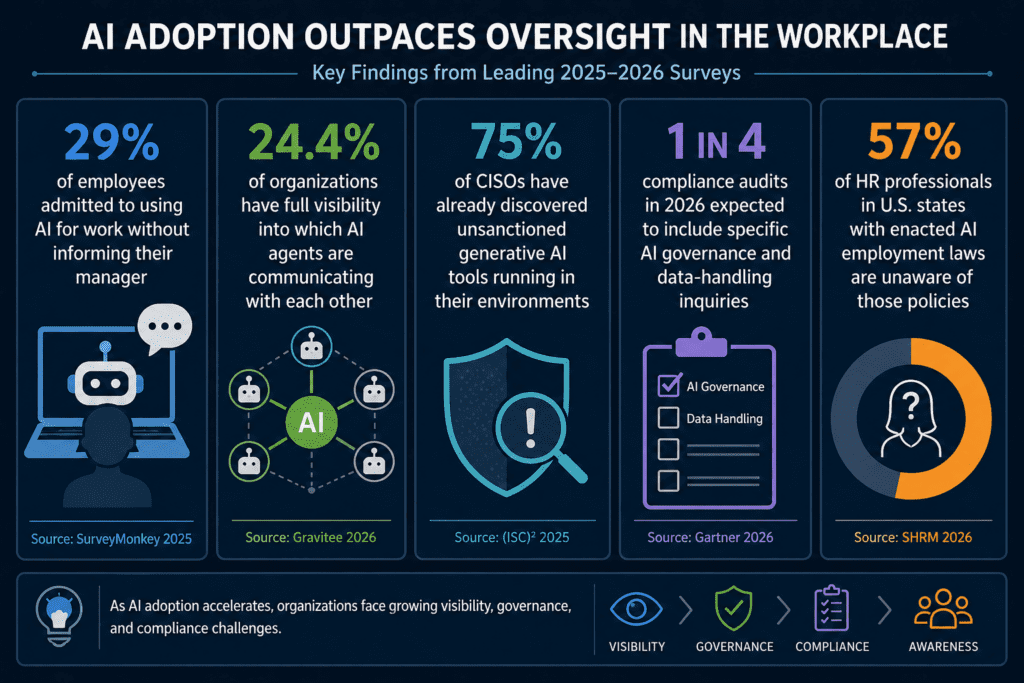
The well-documented problem of shadow AI — employees using unsanctioned tools outside IT oversight — has entered a more dangerous phase. According to research published in early 2026, 68% of employees now use AI tools without IT approval. But the nature of what they’re deploying has changed. Where shadow AI once meant a worker using a consumer chatbot to draft a summary, shadow operations in 2026 means engineers spinning up autonomous agents with administrative-level API access often with no security review, no audit trail and no off switch that anyone can find.
Research from Gravitee found that only 24.4% of organizations have full visibility into which AI agents are communicating with each other within their environments. More than half of all deployed agents operate without any security oversight or logging. The financial consequences are measurable: shadow AI security incidents cost organizations an average of $670,000 more than standard incidents, driven by delayed detection and difficulty mapping the exposure.
The Shadow AI Governance Crisis
Amid the hype, shadow AI that is unsanctioned tools downloaded by employees fuels a shadow AI governance crisis. Gartner estimates 65% of enterprises face it, with rogue ChatGPT or unvetted Copilot clones bypassing IT surveillance.
Key Dangers:
- Data Leaks: 40% of shadow AI incidents expose sensitive info, per IBM’s 2026 report—think customer PII fed to public models.
- Compliance Nightmares: Violations of GDPR/EU AI Act fines average $15M; biased outputs from ungoverned tools amplify discrimination risks.
- Security Vulnerabilities: Malware in pirated AI apps hit 25% of cases (CrowdStrike).
- Productivity Backfire: Inconsistent tools fragment workflows, costing $1.2T globally (Forrester).
Employees grab shadow AI for speed as 92% admit using unapproved apps but lack governance training. The solution enterprises can aim for is centralized hubs like ServiceNow’s AI Marketplace to enforce policies and approved applications while also enabling safe innovation.
The Training Desert
Against this backdrop, the state of employee AI training is alarming. SurveyMonkey’s Q3 2025 AI Sentiment Study found that only 13% of American workers reported that their company offered them any AI training at all. The Bright Horizons Education Index published late 2025 and surveying over 2,000 U.S. workers found that 34% of employees feel unprepared for AI-driven changes while 42% say their employer simply expects them to figure it out on their own.
The contrast with the pace of deployment couldn’t be sharper. SHRM’s 2026 CHRO Priorities report shows 92% of HR chiefs anticipating further AI integration this year, and 87% forecasting greater AI adoption within HR processes. Yet in organizations that have already implemented AI, just 26% of HR professionals use it weekly and 20% daily. Senior leaders adopted AI earlier with 73% of HR directors had adopted AI by 2025 compared to 65% of individual contributors but broader workforce enablement remains an afterthought.
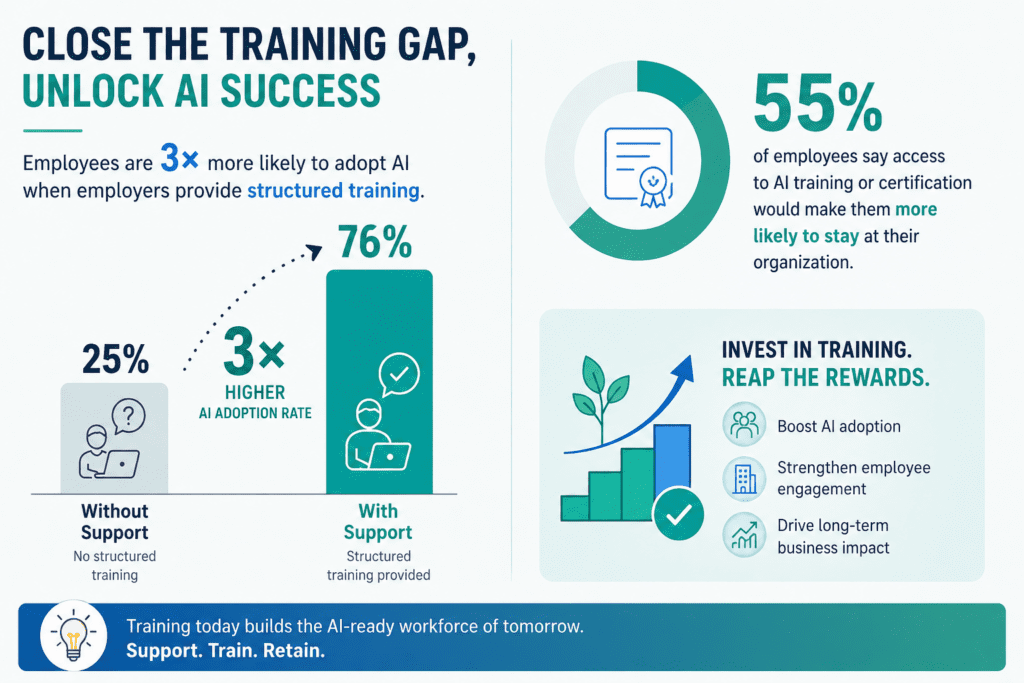
Training gap
3× higher AI adoption rate when employers provide structured training (76% vs 25% without support) — Bright Horizons 2026
Loyalty dividend
55% of employees say access to AI training or certification would make them more likely to stay at their organization
The data shows the scenarios where enterprises are showing negligence and impassivity. When employers invest in AI education, adoption jumps dramatically and with-it measurable productivity gains. The problem is that most organizations are still treating AI literacy as a bonus rather than a baseline. In an environment where the World Economic Forum projects that 39% of workers’ core skills will need to change by 2030 this framing is operationally untenable and weight against employees without established training, recruitment acclimation programs.
Bridging the Gap: 5 Strategies for AI-Ready Workforces
Organizations can’t afford complacency in contrast they should invest in robust frontier frameworks and upskilling employees. Here’s a roadmap to prepare for success with AI models in workplace:
- Assess and Upskill: Conduct AI literacy audits using tools like LinkedIn Learning’s benchmarks, then deploy micro-credentials in prompt engineering and data ethics.
- Foster AI-First Cultures: Integrate uniform AI into daily work rituals. Focus on AI fluency, skills to build, train, deploy and maintain AI models, get AI tools in place with no domain silos and evaluate on new ROIs.
- Invest in Hybrid Training: Blend online platforms (e.g., Udacity’s AI Nanodegrees) with hands-on workshops for 70% retention gains.
- Address Ethical Concerns: Train on bias detection and privacy, using frameworks from the EU AI Act and country’s data protection to build trust.
- Measure ROI: Track metrics like task completion speed and error rates pre- and post-training.
Forward-thinking leaders like Microsoft’s Satya Nadella advocate for human-AI symbiosis where preparation can turn disruption into dominance.
From AI Models to Systems: The New Office Backbone
AI’s office revolution started with isolated AI models like GPT-4 but has exploded into full-fledged AI models to systems orchestration ecosystems that connect data, agents, and humans seamlessly.
- Foundational Shift: Early models handled single tasks; now, systems like Anthropic’s Claude Enterprise and xAI’s Grok Orchestrator chain multiple models for end-to-end workflows, such as auto-generating reports from raw data.
- Agentic AI: Autonomous agents (e.g., OpenAI’s o1-preview extensions) plan, execute, and self-correct, managing complex projects without constant oversight.
- Enterprise Integration: Systems plug into CRMs and ERPs, creating “AI nervous systems” that predict bottlenecks with 95% accuracy.
This progression demands human skills to deploy system orchestration for production and processes, yet 82% of employees still treat AI as a “chat tool,” per IDC research.
Latest Tools Leading the Charge: Microsoft Copilot and Beyond
2026’s standout Microsoft Copilot office tools exemplify AI’s frontline impact. Evolved into Microsoft 365 Copilot with Co-Worker Agents, it now simulates team collaboration.
- Copilot Studio: Acts as invisible hand in live meeting sessions by transcribing, managing action-item, meeting recaps, sending emails through one platform and even simulate “ghost colleagues” for brainstorming with cutting decision times by 35%. Copilot answers, provides logical reasoning of employee work and manages AI agents in action.
- Co-Worker Agents: Custom AI personas (e.g., “Marketing Guru”) join Teams calls, pulling live data from SharePoint for instant insights.
- Competitors Heating Up: Google’s Workspace Duet AI offers similar “AI sidekicks,” while Adobe Sensei automates creative workflows in Acrobat and Photoshop.
Other trailblazers include Notion AI 2.0 for dynamic databases and Slack’s Workflow Builder with embedded Grok agents. These tools automate 50% of knowledge work, but misuse from untrained users’ spikes errors by 28% warns Forrester.
What Organizations Getting It Right Are Actually Doing
The clearest signal from 2026’s research is that success with AI is less about the tools chosen than the change management surrounding them. Organizations building genuine AI readiness share a set of practices that go well beyond license procurement and headline announcements. They are treating AI literacy as a continuous organizational capability embedded in onboarding, career pathing, management evaluation and avoiding AI training becoming a one-time module. Enterprise forming cross-functional AI governance councils to bring together HR, legal, IT, ethics, and operations stakeholders to manage risk collectively rather than in silos. The understanding of deploying disruptive technology that is evolving the way we work, collaborate and envision future is not just measuring AI success as new tool adoption rates, but by independent workflow redesign scrutiny and outcome quality.
The World Economic Forum is clear on what will ultimately determine whether AI’s workplace transformation is broadly beneficial or narrowly captured: “The future of jobs will be shaped less by technology than by leadership choices particularly around inclusive reskilling, responsible AI, and the ability to anticipate signals from technology, policy, and labour markets.” The technology has arrived. The leadership choices are still being made.
Critically, the highest-performing organizations are building AI calibration into their cultures for organizational ability to know if AI is reliable and where it confidently fails and structure human oversight surrounding AI workflows. The resolution lies in building operational architecture with AI where employees not only check AI outputs but progress workings with huma review checkpoints into workflows, assigning human accountability to AI-assisted decisions and creating feedback mechanisms that surface errors before they compound.
The Bright Horizons data offers a practical proof point: when employers provide structured AI training, adoption rates jump from 25% to 76%. Employee retention improves with 55% of employees agreeing access to AI training would increase their likelihood of staying in their current job. The ROI on readiness investment is not theoretical anymore, but AI yield is measurable and organizations still treating AI training as optional are leaving both productivity and talent on the table. By 2027, firms with robust upskilling could see 2.5x productivity boosts, per Forrester. The message is clear for businesses to invest in people now or watch competitors surge ahead.