The article discusses the emergence of Agentic AI as a transformative step beyond Generative AI, highlighting its ability to operate autonomously in various business processes. It explores how companies can leverage Agentic AI to improve efficiency, particularly in customer service, software development, finance, and more while addressing potential challenges.
- Agentic AI can plan, make decisions, and execute tasks independently, improving productivity beyond Generative AI's capabilities.
- Businesses should focus on integrating Agentic AI into existing processes to enhance operations and reduce costs.
- Critical areas for Agentic AI implementation include customer service, software development, finance, and health sectors.
- Companies must address governance, security, reliability, and employee adoption challenges when implementing Agentic AI.
Generative AI is changing how companies create content, write code, work with data, and increase productivity. Technologies (like ChatGPT, Microsoft Copilot, and Google Gemini) help businesses to function efficiently and make their employees do better and more quickly. However, another type of AI is on the verge of emerging, and it will provide the ability for productivity optimisation beyond text and image production.
The newly created AI is called Agentic AI, and it is capable of planning, making decisions, and executing several operations to achieve certain goals independently. Unlike generative AI, which could just respond to questions, this one will address the whole working process more productively and can be an effective solution for many companies.
Agentic AI is expected to become the next technological breakthrough that will influence a lot of industries, including customer service, software development, finance, medicine, etc. Besides, the current aim of many companies is to introduce AI systems and develop AI-based technologies that are capable of making a profit.
What Is Agentic AI?
‘Agentic AI’ denotes AI systems with the capacity to strategise, reason, and carry out tasks autonomously to accomplish a particular objective. Unlike regular generative AI, which works only based on commands given, Agentic AI is capable of identifying what to do based on the current situation and taking necessary actions such as using external software applications, issuing commands, etc.
For instance, if a company needs to enhance customer satisfaction, the artificial intelligence agent can identify the common pain points appearing in customer support enquiries, enhance the information repository available for service agents, write responses, and submit reports on its own.
To put it simply, generative AI functions as an assistant, whereas Agentic AI works like a digital employee capable of handling an entire workflow.
How Agentic AI Is Different From Generative AI
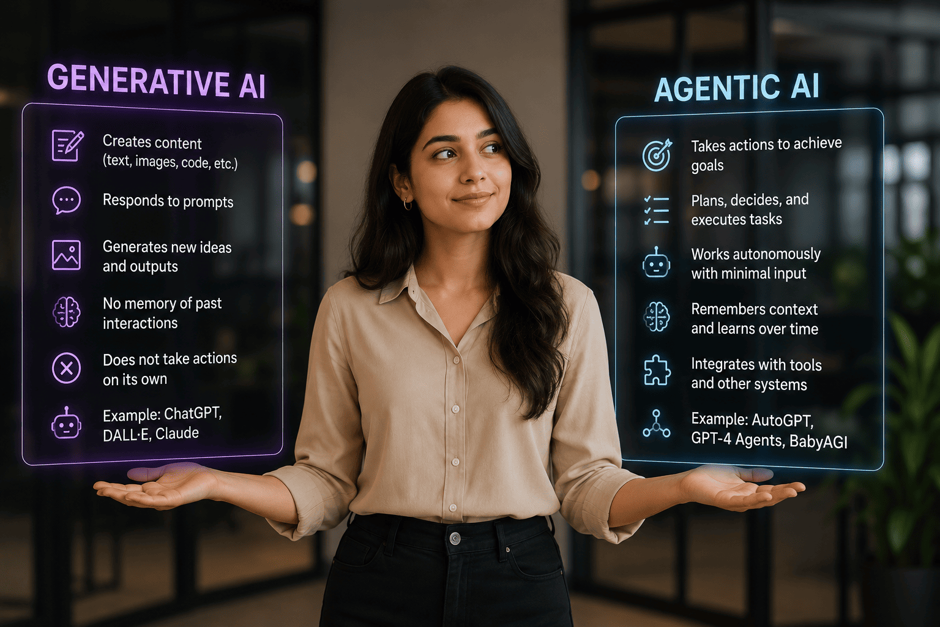
Though both technologies utilise cutting-edge language models, their functionalities are quite dissimilar.
|
Generative AI |
Agentic AI |
|---|---|
|
Responds to input |
Seeks objectives independently |
|
Generates text, code, or graphics |
Implements multi-step processes |
|
Demands consistent interaction from user |
Makes decisions according to limitations |
|
Operates on a single task at one time |
Supervises a range of related tasks |
An example of the difference between generative AI and agentic AI is that the former may craft a marketing email, while the latter can produce the email, initiate a campaign, track results, improve messages over time, and evaluate the overall effectiveness of the action.
Why Are Companies Putting Money into Enterprise AI?
Several causes contribute to enterprises’ urge towards Agentic AI.
Increased Efficiency
Companies operate under enormous pressure to bring expenses down and at the same time achieve greater efficiency. AI agents help to overcome routine tasks, making it possible for human employees to work on strategic and creative issues.
More Capable AI Systems
Recent advances in terms of reasoning and memory, together with tool-feature integration, allow AI systems to do things that earlier AI generations couldn’t do.
Integration of AI in Business
Now AI platforms can connect to CRM software, ERP systems, databases, email, and other service platforms. Therefore, AI agents can operate within established business processes rather than working separately from them.
Using Agentic AI in Practice
Serving Customers
AI technology is revolutionising customer service processes, as it can handle all service requests without human intervention. AI agents can process refunds, authenticate customer information, run CRM systems, and inform customers about their cases.
For instance, Salesforce has developed a platform for artificial intelligence that automates many processes; however, people still have an option to intervene in case of any complicated or confidential situations.
Software Creation
Many development teams are utilising AI agents to help them with coding and programming work.
These agents can:
-
Read project requirements
-
Create codes
-
Conduct automated testing
-
Identify errors
-
Provide solutions
-
Write documentation
This allows programmers to spend more time on analysing and improving software instead of performing boring and repetitive tasks.
Expert Opinion
According to Sam Altman, CEO of OpenAI, artificial intelligence technology is headed toward the development of independent AI systems. In Altman’s opinion, as time goes on, AI will not simply be viewed as a chatbot but rather a full-fledged collaborator capable of performing necessary jobs in the fields.
Sales and Marketing
AI assistants can be utilised by sales teams to carry out research for potential prospects, customise emails, update CRM systems, schedule meetings, and create reports. Marketing teams can also utilise AI assistants for the process of optimising campaigns or examining customer behaviour immediately.
This would result in employees being able to spend more time building good relationships with customers instead of being busy with administrative work.
Sectors That Stand to Gain the Most

Finance
Financial organisations may employ artificial intelligence agents to mitigate fraud, monitor compliance, onboard customers, and process loans. Human intervention is crucial in making risky decisions. Nonetheless, AI technology can help minimise workloads.
Health Sector
Healthcare service providers may introduce automation in respect of scheduling appointments, filing claims, documenting clinical processes, and following up with patients. Thus, medical staff are liberated from administrative functions.
Industry
Industries can adopt AI agents for monitoring machinery, estimating maintenance, and creating production schedules.
Business Ideas To Pursue Today
Currently, fully automated processes are not necessary for business gains from Agentic AI technology. Businesses should rather look at the applications that have proven to show results.
Knowledge Agents
A lot of time is wasted by people searching for different policies, documentation, and information related to business. With the help of AI technology, the necessary information can be retrieved in no time, plus summarising and presenting answers to questions will make operations faster.
Support Agents
The majority of requests made by customers can be automated. For instance, problems like password resets, appointment scheduling, or refund processing can be dealt with using AI solutions, while difficult issues can be solved using human agent experience.
Sales Agents
Thanks to AI technologies, sales agents can better manage leads, research customers, make proposals, and update CRM.
Finance Automation
With the finance processes becoming automated, the finance division can stop being occupied with invoice processing, expense authorisations, and financial report making. Challenges Businesses Must Address
While Agentic AI offers enormous potential, businesses must also address important risks.
Governance
Companies must ensure that they have a well-defined set of rules concerning the actions of AI agents, including those situations in which approval from human beings is necessary, as well as the documenting of the processes for compliance.
Security
Since AI agents are able to access various enterprise systems, a solid identity management system, access controls, and continuous monitoring are critical to safeguarding sensitive information.
Reliability
AI systems can create errors or produce wrong information. Businesses need to make sure that validation systems are in place and that human input is obtained for important business processes.
Employee Adoption
The implementation of AI technology must be accompanied by the full trust of the employees involved. It is essential to introduce AI in the role of increasing productivity rather than replacing humans and provide proper training, if necessary.
Experts’ Views
According to NVIDIA’s CEO Jensen Huang, artificial intelligence is transforming into a new kind of workforce in which digital employees will be able to carry out significant business tasks along with humans. Huang believes that in the near future, AI agents will play a vital role in business operations.
AI educationalist and deep learning AI founder Andrew Ng agrees with Huang on the need to use agent-based workflows, which involve reasoning, planning, and execution, to achieve better results in businesses compared to the use of AI for single queries.
The opinions of both experts indicate that the trend in future AI is towards the use of goal-oriented autonomous systems rather than merely using chatbots.
Final Thoughts
Generative AI has shown companies how to utilise intelligent assistants, but agentic AI is the next step in the journey of business transformation. AI agents combine reasoning, planning, rule-based decision-making, and workflow automation processes, making it possible for them to execute complicated business processes in almost no time.
What companies can do is identify repetitive and valuable workflows where AI brings quick productivity improvements while ensuring a high level of security, governance, and human oversight.
Frequently asked questions
What is Agentic AI and how is it different from Generative AI?
Agentic AI refers to AI systems capable of strategizing and executing tasks autonomously, unlike Generative AI, which responds to commands. Agentic AI can implement multi-step processes and handle entire workflows, whereas Generative AI typically focuses on single tasks.
How can businesses utilize Agentic AI?
Businesses can employ Agentic AI for various applications such as automating customer service requests, improving software development processes, and enhancing financial operations, leading to increased efficiency and better resource allocation.
What are some key sectors that can benefit from Agentic AI?
Key sectors poised to benefit from Agentic AI include finance, where it can help reduce fraud; healthcare, where it can automate administrative tasks; and industries needing automation in production and maintenance processes.
What challenges do companies face when implementing Agentic AI?
Companies must address challenges such as governance to ensure responsible AI use, security to protect sensitive data, reliability to prevent errors, and the adoption of AI systems by employees to boost productivity.
What future trends are experts predicting for Agentic AI?
Experts predict that Agentic AI will evolve into a key workforce component capable of executing significant business tasks alongside humans, with a focus on reasoning, planning, and autonomous decision-making for enhanced business outcomes.